

Monero (XMR) has lost around 5.6 percent over the past 24 hours and trades at about $568 on Tuesday morning, according to CoinGecko, roughly €506. There is no single confirmed trigger for the decline. Meanwhile the most important news around the coin is technical: the decentralised exchange THORChain has finished the development work for Monero but has not yet switched on XMR trading. Before real swaps are possible, node operators first have to generate a new key.
For investors in Germany this is more than a footnote. Since large regulated exchanges dropped Monero from their offering, there has been no convenient way to buy it. A THORChain integration would open an additional route to swap Monero for bitcoin or ether without a centralised exchange. This article sets out what is confirmed, what is still pending and which questions about buying, custody, tax and leverage follow from it.
Monero price at $568: the numbers from Tuesday morning
CoinGecko data paint a clear picture of the day. The 24-hour high was just under $604, the low just under $564. The price is therefore trading near the bottom of that range. Over seven days the coin is down a little more than 6 percent, while over 30 days it is up around 8.6 percent. Year on year, Monero is about 35 percent higher.
Market capitalisation stands at around $10.7 billion, enough for 13th place among all cryptocurrencies. Some $141 million worth of XMR changed hands in 24 hours. The all-time high of $797.73, reached on January 14, 2026, is almost 29 percent away.
The wider market barely moves
What stands out is the gap to the rest of the market. Over the same period bitcoin slipped only around 0.7 percent, according to CoinGecko, to about $74,400, and ether lost a little over 1.5 percent. So Monero's decline is not simply a case of following the market leader. Anyone looking for an explanation will find no concrete trigger in recent days' news, such as a delisting, a security flaw or a regulatory action, that demonstrably moved the price.
Zcash and Monero in the red: privacy coins weaker than the market
Monero is not falling alone. Zcash (ZEC), the second major privacy coin, shed around 6.9 percent in 24 hours, according to CoinGecko, and costs about $1,149. A privacy coin is a cryptocurrency that hides the sender, recipient or amount of a transaction, either by default or as an option. Monero conceals all three in every transfer, while Zcash offers shielded transactions as an option.
Both coins had clearly outperformed the wider market in the preceding weeks. Monero is still up over 30 days, while bitcoin lost ground over the same period. Whether the joint decline is a pullback after that strength cannot be established from the available data. All that is confirmed is that both fell much more sharply than bitcoin on the same day.
Zcash at least has project news of its own: its developers are discussing NU7.1, a proposal for shorter block times, which cryptoticker.io reported on November 9. Monero has no comparable trigger in the past 24 hours.
 Before Monero swaps can start, THORChain's nodes have to rotate and generate a new key.
THORChain v3.21.1: the Monero integration is coded
THORChain is a network for cross-chain swaps. Users exchange native coins, meaning real bitcoin rather than a wrapped token, directly against each other. The counterparty is a set of liquidity pools funded by investors. No account with identity verification is required.
According to a TokenPost report of November 8, THORChain completed the development work for Monero with version v3.21.1. The release, however, explicitly does not enable XMR swaps. The release notes in THORChain's source code repository show the path there: v3.21.0, released on October 19, hardened key generation and signing for XMR after an audit by the security firm Least Authority. Since then, operators who activate Monero must explicitly select the Monero mainnet, otherwise the software refuses to start. Version v3.21.1 followed on November 3 as a maintenance update, and v3.21.2 on November 7.
Technically, THORChain uses a threshold signature scheme called FROST for Monero. No single node holds the full key to the shared funds. Only when enough nodes take part is a valid signature produced. It is exactly this key that still has to be generated for Monero.
THORChain node churn: why XMR swaps are still on hold
On THORChain, a churn is the regular rotation of active nodes. Some operators leave, new ones join, and the jointly managed keys are regenerated. Only during such a rotation can a key for Monero be created. According to TokenPost, the start of mainnet testing depends on exactly that.
THORChain developer Chad Barraford estimated on Thursday, November 5, that it could take at least a week, and possibly two, before the rotation resumes. It is being held up by issues related to Solana and Base. After the churn, a small mainnet pool holding a few hundred dollars is due to open first for test trades. According to the report, Barraford argued for waiting with larger liquidity while the Binance theft dominates the headlines. The final decision on liquidity rests with the node operators.
The link to the Binance theft
The reference to Binance has a background. In early November THORChain temporarily halted swaps for bitcoin and ether to slow the laundering of stolen funds; cryptoticker.io covered this in detail on November 2. A protocol already under scrutiny, and a coin that hides transactions completely: that combination explains why the team prefers to start small with Monero.
In practical terms for investors, anyone who wants to swap Monero via THORChain today cannot do so. A test pool will open after the churn at the earliest, and at a few hundred dollars it is too small for serious amounts. There is no timetable for full trading.
Buying Monero in Germany: the exchange route stays narrow
Owning Monero is legal in Germany. Buying it is the hard part. On October 5, 2026, cryptoticker.io counted the trading lists of eight exchanges: Bitpanda, Bitvavo, Coinbase, Bitstamp, Gate.io and OKX listed not a single XMR pair. Kraken does offer XMR markets, but has blocked them for customers in the European Economic Area since October 31, 2024. The details are in our October 5 article on buying Monero in Germany.
Behind the withdrawal is the EU's Markets in Crypto-Assets Regulation, MiCA for short. Article 76(3) requires licensed trading platforms, as a rule, not to admit crypto-assets with a built-in anonymisation function to trading, unless their holders and transaction history can be identified. Regulated providers in the EU therefore stay away from Monero.
Those who still want in often take a detour: first buy bitcoin or ether on a licensed platform, then swap via a swap service or a decentralised exchange. For the first step it is worth looking at crypto exchanges with a MiCA licence, because fees and withdrawal rules there determine the cost of the whole route. A THORChain integration would add a decentralised option to the second step, but it does not replace the first.
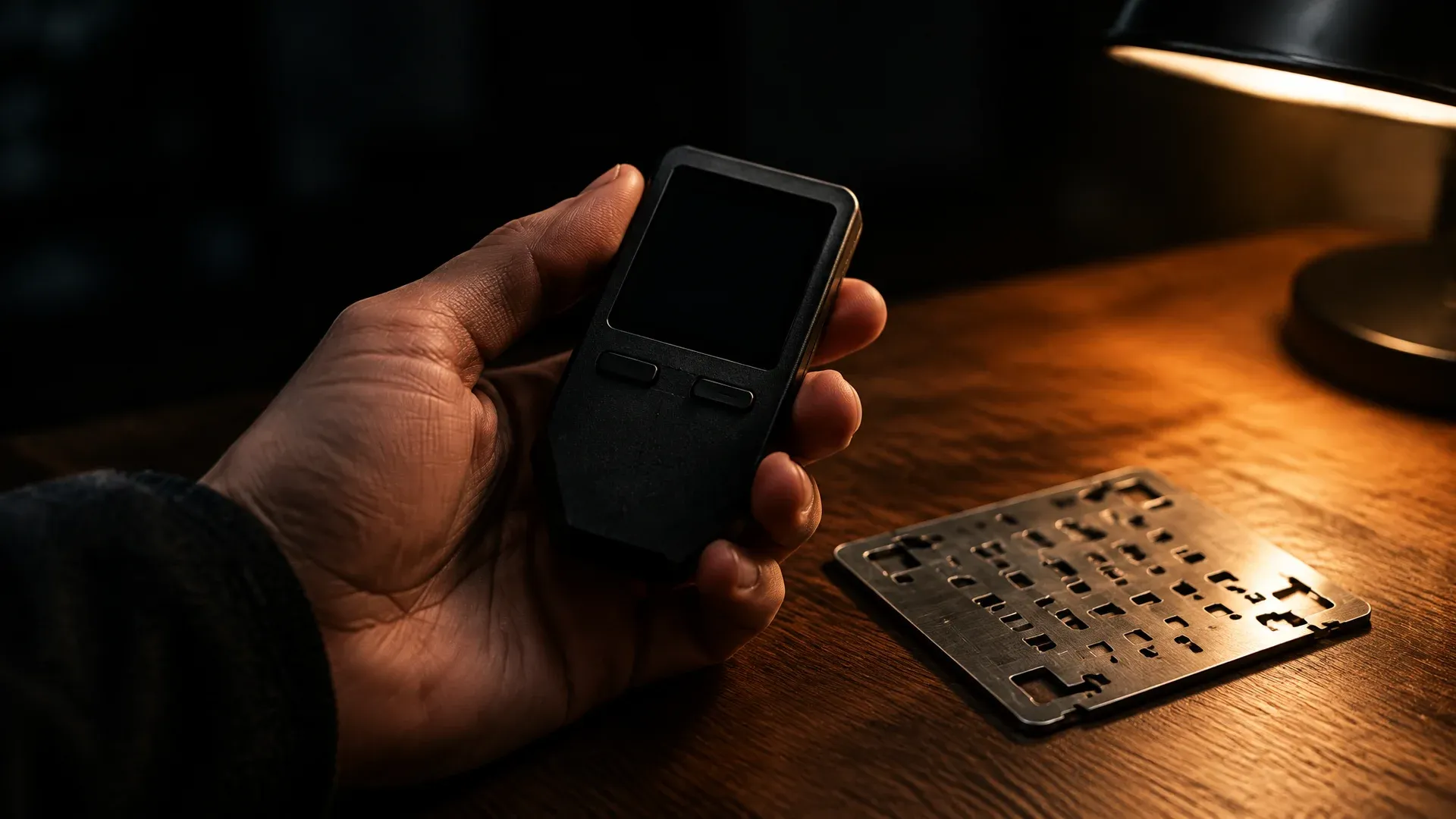 Monero holders usually store their coins themselves, because regulated exchanges do not list the coin.
Monero custody: wallets, seed phrases and data leaks at swap services
Because Monero is missing from regulated exchanges, most holders keep their coins in a wallet of their own. The seed phrase is the sequence of words from which all of a wallet's keys can be restored. Lose it and you lose access; reveal it and you lose the coins. Many holders therefore use a hardware wallet, which keeps the keys offline. How the devices differ and what they cost is shown in our hardware wallet comparison. Check with the manufacturer before buying whether a device supports Monero.
A second risk concerns the swap services themselves. In early November it emerged that order data had leaked from the swap service Wagyu.xyz; according to an analysis by the security firm Hudson Rock, the deposit, receiving address and IP address appear together for 4,580 completed Monero orders. The Monero blockchain itself is not affected, as the data come from the service's order management. cryptoticker.io reported on this on November 2. A decentralised route such as THORChain stores no customer accounts, but the transactions on the bitcoin or Ethereum side remain publicly visible.
Crypto tax on Monero swaps: holding period and exchanges
For tax purposes, the German tax office treats Monero like any other cryptocurrency. Under current law, gains from a sale are tax-free if more than one year passes between purchase and sale. Within this holding period there is an exemption limit of €1,000 in total gains per year; if it is exceeded, the entire gain is taxable.
This matters for the detour via bitcoin or ether: in the view of the tax authorities, swapping one cryptocurrency for another also counts as a disposal. Anyone who buys bitcoin and swaps it into Monero three months later therefore realises a taxable gain or loss on the bitcoin. The swap starts a new holding period for the XMR received. With several intermediate steps, record-keeping quickly becomes confusing, especially because Monero transactions cannot be traced on the blockchain. Keeping your own log with the date, amount and euro value of every swap is therefore essential.
Staking and mining with Monero
Monero has no staking. The coin uses the proof-of-work consensus mechanism, and new blocks are created by mining with ordinary processors. Holding XMR therefore earns no ongoing income from the network itself. Offers that promise fixed interest on Monero lend the coins on to third parties and carry the provider's default risk.
Monero futures and leverage: liquidations on a 5 percent daily move
Part of Monero trading runs through derivatives. With a perpetual future, a futures contract with no expiry date, the trader posts only a fraction of the position's value as collateral. Liquidation is the forced closure of such a position once the collateral no longer suffices. A daily move like the current one shows the effect: at ten times leverage, a 5.6 percent price drop equals a loss of 56 percent of the collateral posted, and at 20 times leverage the position is mathematically wiped out before the move reaches that size.
Monero has a further peculiarity. Because the coin is absent from regulated European platforms, XMR derivatives trade mostly with providers that lack EU authorisation. For German customers this means less protection in disputes and in the event of insolvency. Low leverage, or avoiding derivatives altogether, limits the risk of a sell-off whose cause is not even known.
Monero levels: $564, $600 and $798 in focus
On the downside, the daily low of just under $564 marks the first line. If the price falls below it, the day's decline is no longer just a swing within the existing range. On the upside, the round $600 mark lies close to the daily high of just under $604. Monero needs to win back this zone to make up for the decline.
A little higher is the price from October 22, when cryptoticker.io reported a rise to $644. The all-time high of $797.73 from January remains the big target for optimists, almost 29 percent away. A start of swaps on THORChain could be a catalyst, but no such effect is proven. The integration has been known for months, and earlier timetables have already slipped.
How analysts see the outlook, and which scenarios exist for the coming months, is collected in our Monero price prediction, linked in the first paragraph above.
Monero and THORChain: first the test pool, then real liquidity
All told, the price drop has no confirmed trigger, while the THORChain integration is technically finished but not yet usable in practice. Three steps help put the situation in context:
Choose your buying route: Monero is not available on regulated exchanges in the EU. If you take the detour via bitcoin or ether, pick a licensed platform with low withdrawal fees, for example from our crypto exchange comparison. Secure your custody: Monero usually sits in a wallet of your own. A hardware wallet from our comparison keeps the keys offline, and the seed phrase belongs in a safe place without a network connection. Document every swap: each swap of bitcoin or ether into Monero is a taxable event. Crypto tax software records the date, amount and euro value so that the holding period for every position remains provable.When THORChain opens the Monero test pool depends on the next churn. Until then, the news remains an announcement.
(As of November 10, 2026. This article is not investment advice. Prices and fee structures change; check the terms with the provider before you buy.)




 Bengali (Bangladesh) ·
 English (United States) ·