
 11 hours ago
2

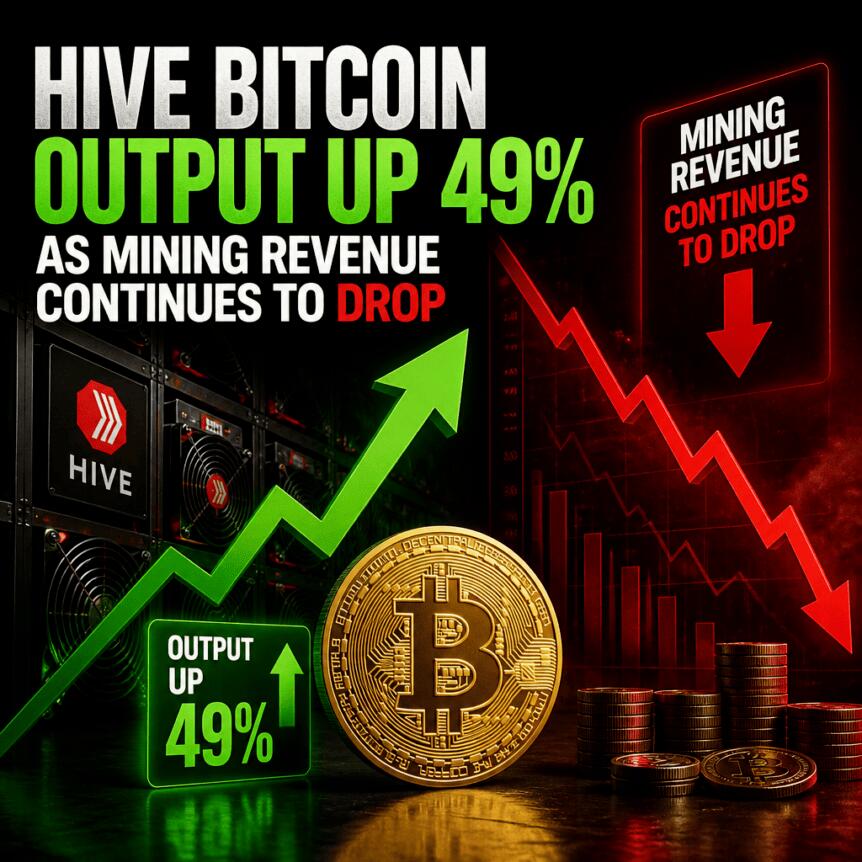
Bitcoin mining has delivered more output for HIVE Digital Technologies, but its latest quarterly filing shows how quickly revenue can fall when Bitcoin prices weaken. In the three months ended Sept. 30, 2026, the miner produced 1,070 Bitcoin—up from 718 in the prior-year quarter—yet mining revenue declined 7.4% to $76 million as the average price of Bitcoin fell to $71,003 from $114,382 a year earlier.
The quarter also highlighted intensifying cost pressures. HIVE’s electricity expense rose to $45.6 million from $37.9 million, reflecting expansion of its global mining capacity. The company further recorded a $31.2 million noncash write-down on mining equipment, attributing it to “depressed mining economics,” according to its latest regulatory filing.
Key takeaways
HIVE produced 1,070 Bitcoin in Q3 2026 (ended Sept. 30), a major year-over-year increase from 718 Bitcoin. Mining revenue still fell 7.4% to $76 million because the average Bitcoin price dropped sharply versus the prior year. Electricity costs climbed to $45.6 million, rising alongside HIVE’s mining capacity buildout. HIVE posted a $31.2 million noncash write-down on mining equipment, citing depressed mining economics. HPC hosting revenue rose 71% to $8.8 million, while HIVE continues spending heavily on AI infrastructure.More Bitcoin, weaker revenue
HIVE’s production growth indicates the company has continued to scale operations into 2026. In the September quarter, it produced 1,070 Bitcoin, compared with 718 a year earlier, as noted in its filing with the U.S. Securities and Exchange Commission (Form 10-Q). However, revenue moved in the opposite direction.
Mining revenue decreased 7.4% to $76 million. The key driver was pricing: HIVE reported that the average price of Bitcoin in the quarter was $71,003, versus $114,382 in the year-ago period. In effect, higher output was not enough to offset a substantially lower realized market value per coin.
This dynamic matters for investors because it underscores a recurring theme for miners: operational gains can be overwhelmed by commodity-style exposure to Bitcoin’s price. Even when production rises, mining profitability can compress quickly as costs lag behind revenue sensitivity—or accelerate if power and operating expenses increase at the same time.
Costs rise and equipment is written down
Alongside the revenue decline, HIVE’s cost base moved upward. Electricity costs rose to $45.6 million from $37.9 million, tied to the company expanding its mining capacity worldwide.
HIVE also recorded a $31.2 million noncash write-down on mining equipment. In its filing, the company linked the adjustment to “depressed mining economics.” Noncash charges like this are often used by firms to reflect reduced expected value of assets when near-term profitability and forecast cash flows look less attractive—particularly in periods where Bitcoin price weakness meets higher operational expenses.
Put together, the quarter provides another data point in the broader debate over whether the industry’s cost structure is strong enough to withstand lower Bitcoin prices. It also helps explain why miners are increasingly diversifying—either into higher-margin compute services or into entirely different business models.
Pressure across the mining sector—and HIVE’s pivot toward HPC
HIVE’s results align with other recent reporting on mining pressure. Earlier coverage from Cointelegraph noted that American Bitcoin reported a large treasury-driven quarterly profit while its mining margins remained weaker. Cointelegraph also reported that Core Scientific plans to leave bitcoin mining entirely by year-end as its AI-focused business grows.
HIVE, by contrast, appears to be pursuing a dual-track strategy: continue investing in bitcoin production while expanding high-performance computing (HPC) services. In the latest quarter, the company’s HPC hosting revenue climbed 71% to $8.8 million, representing 10.4% of total quarterly revenue.
While HPC revenue was smaller than mining revenue, its growth rate suggests HIVE sees meaningful operating leverage in compute hosting as AI-related demand expands. For readers, the important question is whether these HPC services can become a stabilizing offset when Bitcoin prices soften—or whether they remain too modest relative to mining to materially change the risk profile of the business.
Spending plans: GPUs, data center buildout, and continued mining expansion
HIVE also provided details on future expansion. The company said it anticipates spending up to $493 million over 36 months to expand its HPC operations. According to the filing, that includes acquiring land, building data center infrastructure, and purchasing GPUs. HIVE reported spending $145.3 million toward that expansion as of the time of the filing.
The company also plans roughly $35 million to convert its Toronto facility into a Tier-III data center. Alongside HPC, HIVE is continuing to invest in mining infrastructure, including targeting a 100-megawatt substation expansion at its Yguazú site in Paraguay during 2026.
For investors, these capital plans are a key moving piece. Higher spending can support growth, but it also raises the stakes if Bitcoin prices remain depressed or if electricity and operational costs continue trending upward. The quarter’s write-down suggests management is at least acknowledging that parts of the mining value chain may be under strain.
Meanwhile, HIVE’s shares reacted negatively after the earnings release. After-hours trading showed the Nasdaq-listed stock down 1.7% to $1.78 following the release, according to Google Finance, despite the regular session closing up 1.7% at $1.81.
HIVE reported fiscal second-quarter revenue of $84.9 million, down 2.7% from a year earlier but above a consensus estimate of $79.4 million listed by MarketBeat. MarketBeat reported an adjusted loss of 15 cents per share, improving versus expectations for a 16-cent loss. HIVE’s GAAP net loss was $78.7 million, or 29 cents per share.
What to watch next
HIVE’s filing frames a clear tension for miners: even with rising production, revenue can weaken quickly when Bitcoin prices drop and power costs rise. With HPC hosting growing fast but still a fraction of total revenue, the next quarterly results will show whether HIVE’s AI-driven expansion can meaningfully cushion mining volatility—or whether mining economics continue to deteriorate.
This article was originally published as HIVE Bitcoin Output Up 49% as Mining Revenue Continues to Drop on Crypto Breaking News – your trusted source for crypto news, Bitcoin news, and blockchain updates.




 Bengali (Bangladesh) ·
 English (United States) ·