

A fleet of telescopes around the world just captured the first shocking moments of a supernova explosion in the most detailed-ever observations of their kind.
The explosive event was first spotted by China's Einstein Probe space telescope as a flash of X-rays in March. Ground-based telescopes jumped in within the hour and quickly identified the flash as a supernova, a powerful explosion of a massive dying star. Before long, a big team of observatories was on the job, including the wide-field Vera C. Rubin Observatory, which began its ambitious 10-year survey of the sky in late June.
With this fleet of telescopes, astronomers charted how the light of the supernova, located 500 million light-years away, changed over time. They reported their results in two papers published July 14 in The Astrophysical Journal Letters.
Each science team verified the "shock breakout" — the point when a supernova emits its first light from the explosion as a huge shock wave. The recently detected supernova is only the second stellar explosion in the past 20 years in which a shock wave was observed, because these events tend to be short — only seconds to hours, the researchers noted.
They classified the stellar explosion as a Type Ic broad-lined (Ic-BL) supernova, meaning that the blast included jets with material moving close to light speed. This type of supernova is often associated with gamma-ray bursts, which are extremely powerful flashes of high-energy radiation from space. However, the recently detected supernova presented some surprises: Its shock breakout was the faintest seen in an Ic-BL supernova, and no gamma-ray bursts were observed.
"Follow-up observations using the most sensitive facilities found no evidence" of the gamma-ray bursts, Brendan O'Connor, an astrophysicist at Carnegie Mellon University and co-author on one of the studies, said in a statement. "One possibility is that the jet was 'choked,' either by the surface of the star or by circumstellar material surrounding the star."
Telescopes of the world unite
The Vera C. Rubin Observatory happened to be monitoring the area (left) when the supernova erupted. Rubin and Dark Energy Camera images of the blast are shown in boxes to the right. (Image credit: NSF–DOE Vera C. Rubin Observatory/NOIRLab/SLAC/AURA)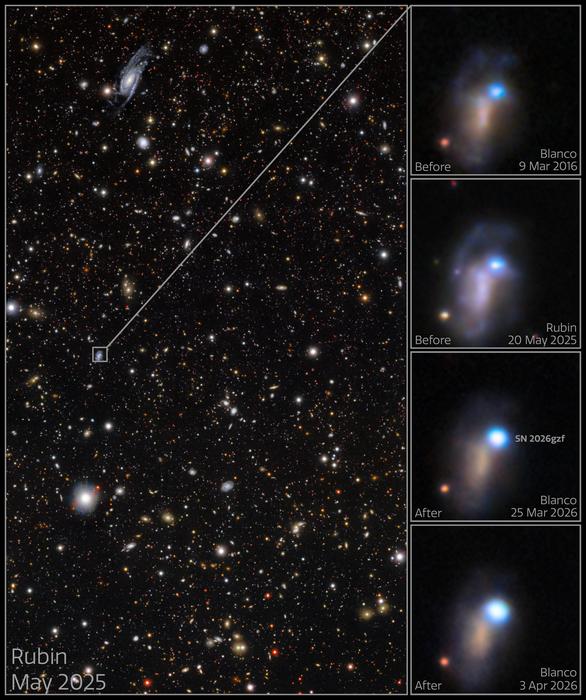
The Rubin telescope, located in Chile, happened to spot the explosion because it was viewing that particular patch of the sky at the time, known as the COSMOS Deep Drilling Field.
"Thanks to Rubin's rapid cadence and unprecedented sensitivity, continued observations are expected to provide detailed, long-term records of the supernova as it evolves for years to come," the science teams said in the statement. The Rubin Observatory will spend the next decade mapping the entire southern sky many times over, creating a time-lapse movie of the cosmos expected to reveal millions of supernovas, asteroids, comets, and other transient events.
As Rubin spots events in the sky, the Dark Energy Spectroscopic Instrument on the National Science Foundation's Nicholas U. Mayall 4-meter Telescope at Kitt Peak National Observatory in Arizona is tasked with springing into action for follow-up observations. The instrument confirmed the recently detected explosion as an Ic-BL supernova.
When the scientists dove into 10 years of data from the 570-megapixel Department of Energy Dark Energy Camera on the National Science Foundation's Víctor M. Blanco 4-meter Telescope in Chile, they found a "blue source" just where the supernova later occurred, revealing clues about what the star system and its environment looked like before it exploded.
Meanwhile, a team led by Jillian Rastinejad, an astronomer at the University of Maryland, College Park and co-author of the second study, used the Gemini Multi-Object Spectrographs on two telescopes — Gemini North in Hawaii and Gemini South in Chile — to investigate the explosion, among other observatories. Those telescopes also confirmed the explosion as an Ic-BL supernova, without the jets, and the astronomers obtained archival details on the star's structure and environment before their demise.
"Our observations allowed us to study the physics of three pieces of this explosion: the X-ray shock breakout, the accompanying supernova, and the interaction of the supernova with material previously cast out by the dying star," Rastinejad explained in the statement. "With this information we were able to map out the structure of the material surrounding the star and understand the star's violent lifestyle before it collapsed."
The star was about 20 times the mass of the sun and was classified as a Wolf-Rayet — a star that used up most of its hydrogen early in its life. Just before the star exploded, it periodically ejected massive chunks of hydrogen and helium, leaving behind only carbon and oxygen. These chunks of material generated shells that were visible in telescopes as individual events, including the first X-ray shock.
"This is the first time we've mapped out the pre-explosion environment of a star that has been stripped of hydrogen and helium," said Gokul Srinivasaragavan, an astronomer on Rastinejad's team who was a doctoral student at the University of Maryland at the time of the study. "Going forward, I'm excited to observe more shock breakout events in similar detail to test if all stripped stars have a similar ‘lifestyle' prior to collapse and what, if any, differences we see."


 Bengali (Bangladesh) ·
  English (United States) ·