

Lab mice who spend time in space seem to bear offspring with reduced reproductive capacity, a new study suggests. But what that might mean for human astronauts and their families is still unclear.
The research, published June 30 in the journal PNAS, looked at female mice that had spent extended periods on the International Space Station (ISS). These mice had similar levels of fertility as Earth-bound mice. However, their children and grandchildren produced smaller-than-average litters, had fewer litters overall and had lower levels of key reproductive hormones, among other measurable differences.
"The offspring of those that came back from space were altered in their behavior, their muscle, their ability to reproduce further," study co-author Lane Christenson, a professor of cell biology and physiology at the University of Kansas Medical Center, told Live Science. And "just about every marker we looked at had some differences."
As the study was conducted in mice, it’s difficult to determine whether the effects might carry over to human astronauts. However, mice are good biological models for understanding the health impacts of space travel, given that they are mammals with a similar reproductive system to humans, experts told Live Science.
As scientists explore the feasibility of long-term space travel, this study highlights the need for further research on the impact of long-term spaceflight on the reproductive system, the study authors argue.
A "void" in research
Past research, such as the NASA Twins Study, has suggested that short-term spaceflight has modest effects on human health. That study compared astronaut Scott Kelly, who completed a year-long mission on the ISS, to his identical twin brother, Mark Kelly, who remained on Earth.
However, few studies have explored the long-term health impacts of spaceflight, including those that might affect reproduction.
A 2019 study looked at male mice that spent time aboard the ISS and found they could father healthy offspring. The new study, by contrast, was conducted to "fill a void" in research investigating how space travel might impact the female reproductive system, Christenson said.
Such investigations are especially important because hormones like estrogen affect more than just reproduction; they "influence almost all organ systems in the female body," he added. For example, estrogen supports processes like bone maintenance, too.
For the new study, 20 female mice lived on the ISS for 42 days. The female mouse reproductive cycle is very short, only about four to five days long, while the human menstrual cycle is 28 days on average, Christenson noted. "But a lot of the molecular background is very similar" in terms of how hormones fluctuate each cycle, he explained.
Upon their return to Earth, the mice could still get pregnant and give birth to live offspring. Their litters were slightly smaller than those of comparison groups of mice that did not spend time in space. But that difference was not statistically significant, meaning it could be coincidence.
The current study focused on lab mice, so it remains to be seen how the effects might translate to people. (Image credit: dra_schwartz via Getty Images)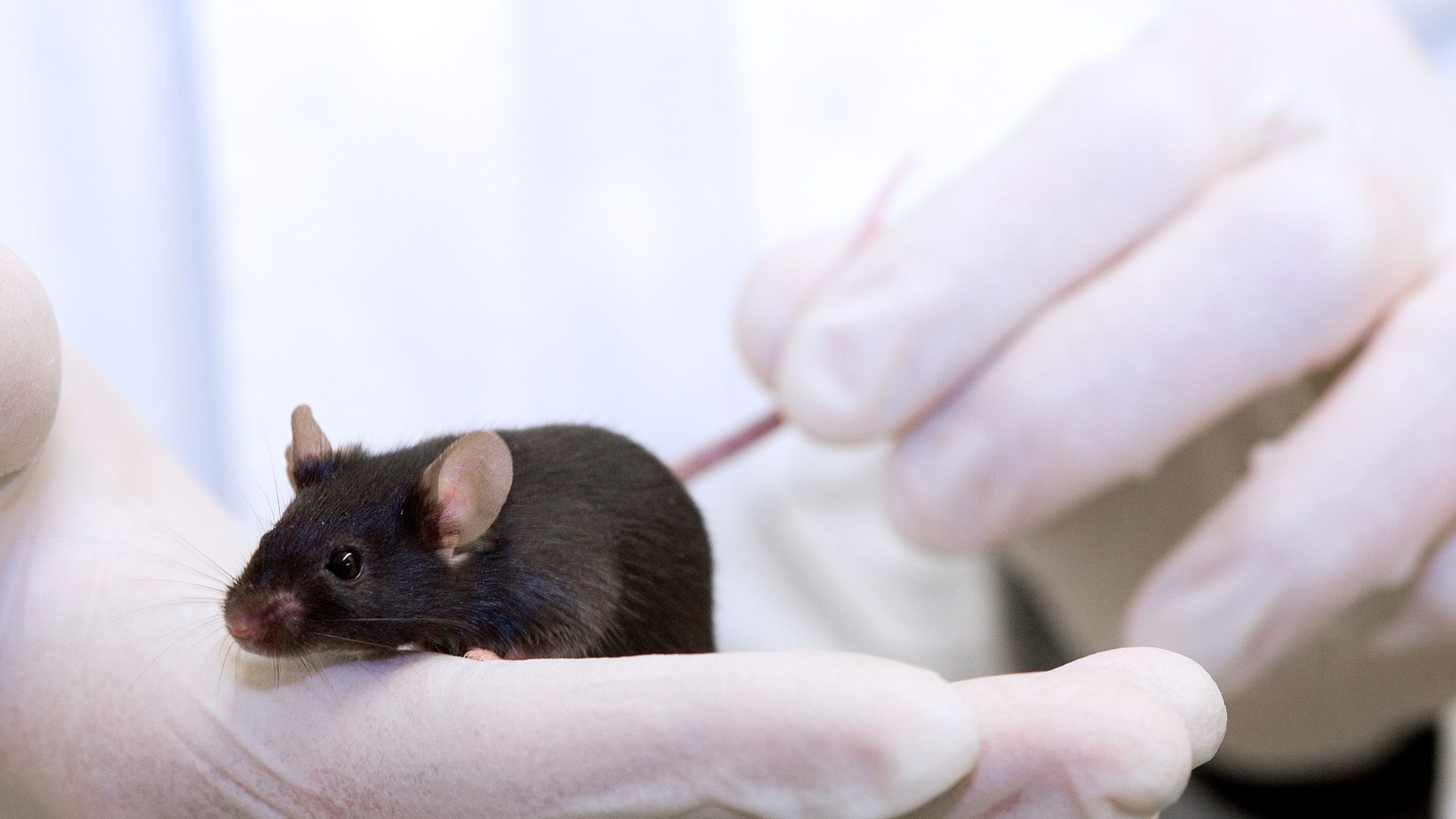
Researchers saw clearer differences in the next generation of mice. The offspring of the spacefaring mice had about 15% less muscle strength than the control groups' offspring. Additionally, the female mice in that second generation were more prone to stress than the female offspring in the control groups, based on a behavioral experiment.
"We were pretty surprised that a relatively short period of time, 42 days, was able to induce these striking changes," Christenson said.
The second generation of mice could also get pregnant, but these mice had fewer litters and much smaller litters than the control mice did. Further testing also showed that the offspring of spacefaring mouse mothers had lower levels of anti-müllerian hormone (AMH), a hormone whose levels correlate to overall egg count. Higher AMH means higher egg reserves and vice versa. The subsequent third generation also had lower levels of AMH compared with mice in the control groups.
Christenson theorizes that this pattern may be the result of an "acceleration of aging" caused by the mice's predecessors being exposed to microgravity. Previous mouse and human-tissue studies have suggested that a lack of gravitational force may leave cells more vulnerable to stress. This has been tied to dysfunction in mitochondria, the powerhouses of cells that contain special DNA that's exclusively passed from mother to child.
This theoretical mechanism and its relationship to mice's reproductive capacity still needs to be confirmed, though.
For now, "this study adds to the growing body of literature on the effects of space travel in general on the reproductive system," said Dr. Ulrike Luderer, director of the Center for Occupational and Environmental Health at the University of California, Irvine, who was not involved in the research.
Luderer noted that, given that the research was conducted on the ISS, which has less exposure to cosmic radiation than deeper regions of space do, the impacts of traveling in deep space — say, on a journey to Mars — may be even more consequential. Earlier this year, Luderer published research that found that exposing mice to radiation levels similar to the ones an astronaut might experience on a trip to Mars lead to a "very significant decrease in the number of eggs and follicles in the ovaries."
She hopes that further research can focus on additional reproductive markers, such as hormonal levels, to pinpoint the long-term consequences of deep-space travel. Those will be especially relevant if "humans spend long periods of time in [space] or colonize some other planet."
This article is for informational purposes only and is not meant to offer medical advice.
How much do you know about the process of pregnancy? Find out with our pregnancy quiz!




 Bengali (Bangladesh) ·
  English (United States) ·