

York County Library (South Carolina) has just banned books about gender identity from areas in the library meant for children and teenagers. In addition, the board–which has a history of attempting to push anti-LGBTQ+ policy–identified use of the far-right, partisan book ratings site Rated Books, as one of the tools library workers should consult in making collection decisions.
In 2024, South Carolina’s budget included a provision that required public libraries restrict access to so-called “prurient” books for those under 18. This proviso, rightly identified as vague and overreaching, was passed at the same time that the state ramped up its efforts to put the power of book bans at public schools across the state into the hands of the State Board of Education. As of writing, South Carolina leads the country in state-sanctioned book bans.
That budget proviso applicable to public libraries has led to a movement in some of the state public libraries toward partisan politics dictating the collections made available to the whole of taxpaying communities. We saw Greenville implement a blanket ban on “trans” books in the teen areas of their library last year, following its ban on such books for children. This led to a lawsuit filed by patrons of the library, with support from South Carolina’s chapter of the ACLU.
York County borrowed their updated collection policies on those from Greenville when they were proposed earlier this year. Those policies came in response to the board announcing in late 2024 that they would simply stop purchasing any materials for the library’s teen and children’s collections in light of the proviso. Library and literary advocates in York County pushed back against York’s attempt to simply rebrand Greenville’s policies as their own. In response, the board tweaked the proposed policy, which passed on Thursday, December 11. It still strips the rights taxpayers and their families in the community have to unhindered access to a wide array of materials and imbues the board with the power of what material is or is not appropriate.
You can read the full policy here.
Among the highlights–or, rather, lowlights–of the policy are that any and all books addressing “gender identity” will be removed from all children’s and teen sections of York County libraries. This is how the board defines books appealing to “prurient interests” and books that lead to “lewd and lascivious desires and thoughts.”
Librarians in the system who make collection decisions are provided tools within the policy as well. These include:
The rulings of the South Carolina Department of Education, guidance from the South Carolina State Library, and reviews by ratedbooks.org will also be considered. In terms of sexual content, the library will additionally follow all applicable laws for minors and such State of South Carolina legislative Provisos, as may be applicable.
The York County Board has not only elevated a review site by a partisan “parental rights” group as one worthy of use to determine material appropriateness, the board has intentionally undermined the role the public library plays in a community. It is not subject to the same rules or policies as public school libraries–and yet, the rulings of the South Carolina Department of Education are placed there to warn library workers that books banned in public schools statewide should be given stronger consideration in the public library system. Put a pin in this particular piece of information for a moment; we’re going to come back to it.
While books on “gender identity” are not going to be outright banned in the libraries, several things will happen. First: they’ll be relocated to adult areas of the library if deemed worthy of remaining on shelves. This action of relocation is still book censorship. Moreover, because York County Library does’t restrict library card access by age, any young person who has a library card will still be able to borrow any book on “gender identity.” They just now have additional hurdles to jump through in order to look for or find books that are written for their age group because those books have been put elsewhere.
Second, “gender identity” is defined in the policy as loosely and uselessly as possible for the purposes of how the library is to determine whether or not materials need to be relocated. It’s defined as “an individual’s self-declared identity that may not align with biological sex.” Where and how are library workers to determine every single book that fits this definition and where and how will it be misapplied to books where the main character isn’t human? We’ve seen books like Katherine Applegate’s Wishtree banned in several places for having a tree that doesn’t fit some arbitrary definition of “gender,” and we’ve seen the same happen several times with Shannon Hale and LeUyen Pham’s picture book series Itty Bitty Kitty-Corn because it features a cat who dreams of being a unicorn. Do charges of youth literature being “about gender identity” then determine whether or not they are?
We know the answer, as much as we know that a policy like this creates a chilling effect. It will lead, intentionally or not, to widespread quiet/silent/self censorship of any books written for young readers that even touches on something remotely tied to “gender identity.”
Only one member of the York County Library board vetoed this policy, Terry Plumb. Plumb pointed out that the policy puts undue burden on young people who are looking for these types of books, to which supporters of the policy is the entire purpose.
Plumb posted a lengthy public explanation of how the vote for the policy happened, including his comments on why its passage was unnecessary. Among the points he made, available to read in full here, are the following:
1. If it ain’t broke, don’t fix it. During the nearly two years, the Board of Trustees has wrestled with this controversial issue, no proof has been provided to show that the current policy (before 12/11/25) caused harm or inconvenience to patrons.
2. Let the professionals do their job without undue interference from the Board. The Collection Policy adopted by majority vote on Thursday is a clear example of why this rule should never be violated. In specifying that acquisition of materials be subjected to “reviews by ratebooks.org,” the new Collections Policy not only omits any number of nationally respected book-review sources, but it also requires use of a website that is both rife with political bias and virtually useless for choosing titles to purchase. Ratebooks.org does not recommend books based on their value (literary merit, significance, community interest, etc.) but only whether they pass a smut test as determined by random, unidentified individuals, who are not required to demonstrate any professional qualification.
3. The Collection Policy as adopted 12/11/25 is rife with contradictions. Some examples.:
Under General Selection Criteria, the following standards are to be considered: “informational, educational or recreational needs of county residents”; “interest of the community,” “contemporary significance.” By simultaneously stipulating that “Books addressing topics on gender identity or other mature themes may be excluded from the Juvenile Collection and placed in another collection,” the new policy, in effect, bans books from the juvenile collection that some patrons may want to read.
The Appendix in our Collection Policy includes the following seemingly contradictory statements:
• “Libraries should provide materials and information presenting all points of views on current and historical issues. Materials should not be proscribed or removed because of partisan or doctrinal approval or disapproval and remain neutral in controversial issues.”
• “A person’s right to use a library should not be denied or abridged because of origin, background, or views.”
• “Librarians shall not determine the acceptability of a book based on their personal history, political affiliation, or ideology.” The latter statement moved me to ask whether the same standard should also apply to Trustees.
4. Many of the critics of the Collection Policy in place before 12/11/25 have been outspoken about the rights of parents to determine what materials are acceptable for their children to read. Why do their “parental rights” trump the rights of parents who want their children to be able to read books that may contain topics such as gender identity or “other mature themes”?
5. I find it ironic that we spend so much time and energy debating how to deny r children access to certain books while ignoring the much greater threat to their wellbeing, which is that children increasingly are NOT READING books. Instead of trying to erect barriers to children, including LGBQT children, we should be focusing on how best to make our libraries welcoming places where all children can explore their creative interests.
Let’s circle back to the part of the policy where recommendations from the South Carolina Department of Education comes in. York County’s Board had ten members in 2023; thanks to county leadership, though, it was reduced to seven thereafter.
“In 2023, the York County Council began appointing partisan library board members after the existing board members refused to remove or relocate challenged LGBTQIA+ materials,” explains Tenley Middleton, President of the South Carolina Association of School Librarians and plaintiff in a lawsuit filed over the state’s removal of books from public school libraries. “The passage of the library’s new collection development policy shows the influence and control the County Council was able to impose on the library board.”
This reduction, as we have seen happen in other boards and in the Supreme Court, too, allows for a far easier simply majority vote. And in the case of York County, at least one member of the current board has direct ties to the South Carolina Department of Education and its head, Ellen Weaver–who used taxpayer money to hire a lawyer to lobby in support of the state’s school book banning bill.
Carol Herring is the York County Library Board Secretary. Her husband, Mark Herring, is an Education Associate for the South Carolina Department of Education, hired by Ellen Weaver for the role, which includes writing K-12 policy statewide. He is an outspoken republican in the state, with his history including writing about the pandemic in racist terminology and, more relevant here, a screed about how libraries have taken a turn to the left and that conservatives can “hasten the demise of ALA’s stranglehold on libraries.”
It would make sense the right-wing tool being elevated to the level of approved use by library workers in York, as well as make sense that the State Board of Education has prominence in the policy, too.
Passage of this policy was not without tremendous pushback on the ground. York County Library, as well as both public and public school libraries statewide, have significant advocacy behind them from parents, professionals, and citizens who believe the purpose of these institutions of democracy is just that: they are there as spaces of free inquiry and unencumbered access to information.
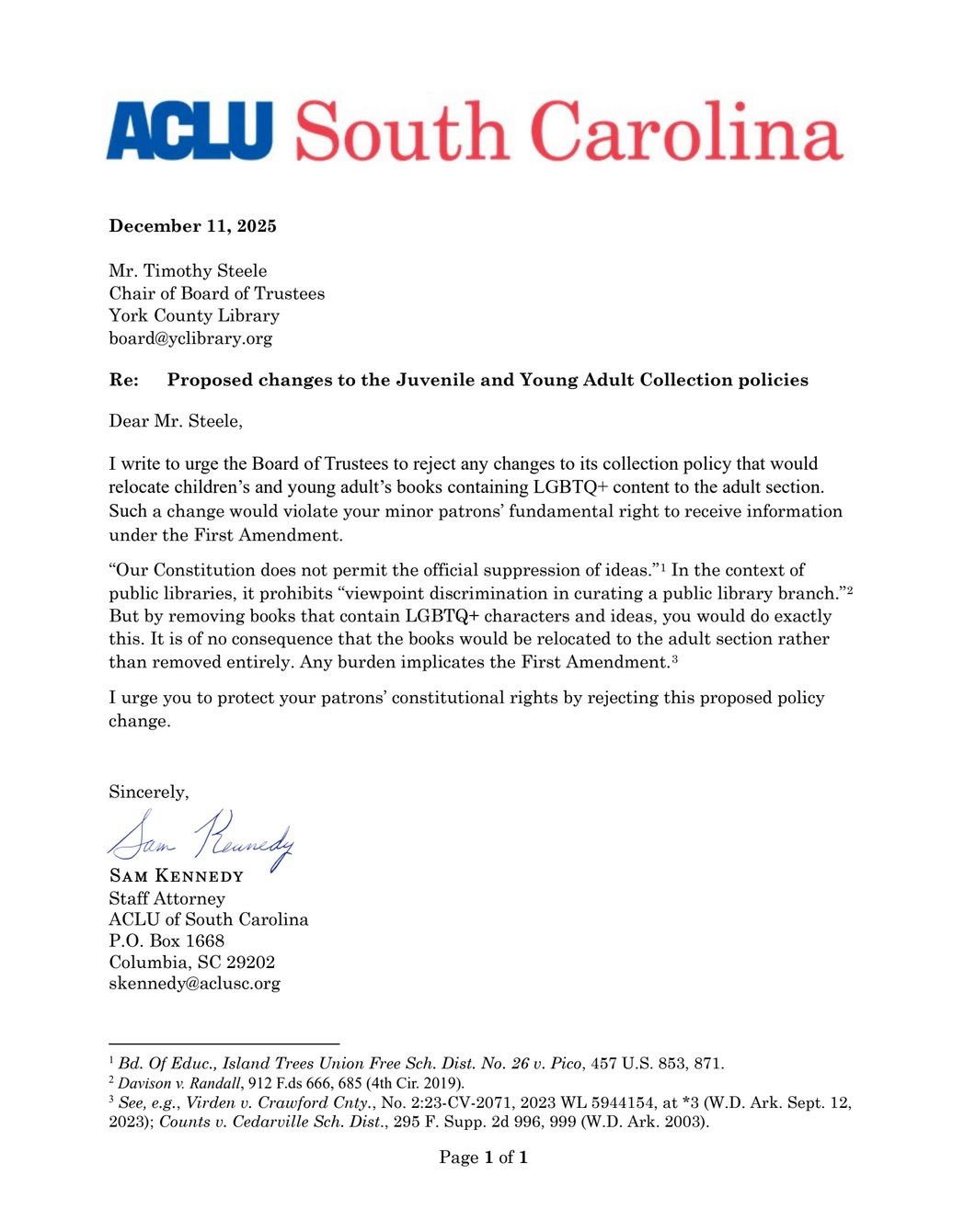
Prior to the meeting where the policy passed, the ACLU of South Carolina also sent the board a letter, urging them not to move forward.
 |
It’s unclear what will happen next in York County Library. The Board has set themselves up for a potential lawsuit, much as Greenville did. The lack of guidance provided to the library’s employees ensures that there will be a lengthy period of confusion and uncertainty about where and how they can do the jobs they’re experts in–that, of course, being part of the point.
What is clear is that this is another harmful policy that impacts not only the vulnerable LGBTQ+ populations in York County and South Carolina more broadly. It is tremendously harmful to all young people in the county and state, who continue to be used as pawns in a cruel political game while retaining no autonomy or rights to learn, grow, and become who they’re meant to be.






 Bengali (Bangladesh) ·
  English (United States) ·