
 25 minutes ago
1


XRP Ledger’s proposed lending system is gaining validator support, but the gap between a promising upgrade and a usable credit market remains significant. The lending amendment has 22 supporting votes against a current requirement of 29, while the vault technology it needs has 23.
The November 12 governance snapshot puts the project closer to approval than in mid-October. It also establishes an important limit on the excitement: lending has not activated, and its two-week approval countdown has not started.
XRP Ledger lending votes climb, but approval is pending
The independent XRPL Dashboard snapshot records 22 of 35 trusted validators supporting LendingProtocol and LendingProtocolV1_1, with 23 supporting SingleAssetVault. CoinDesk’s November 12 report put the earlier October 19 counts at 19 for lending and 21 for vaults.
That is progress, rather than a launch date. The lending proposals still need seven additional supporting votes on that validator set, and the vault amendment needs six. Counts can move in either direction before activation.
The network’s amendment documentation says: “Amendments must maintain two weeks of support from more than 80% of trusted validators to be enabled.” With 35 counted validators, strictly more than 80% means 29 votes. Reaching 28 would leave the proposals short.
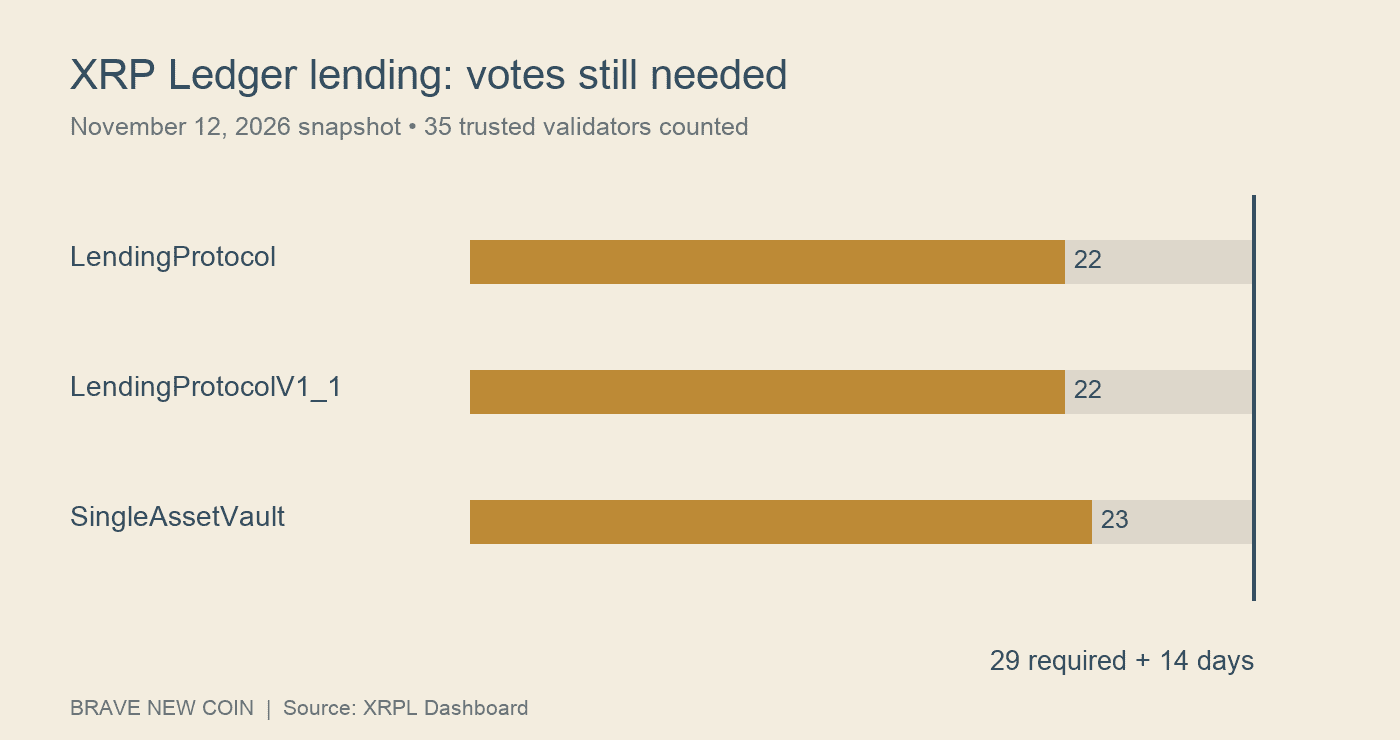 Validator support in the November 12 snapshot; 29 votes must be maintained for 14 days. Chart: BNC. Source: XRPL Dashboard.
The two-week rule prevents a brief burst of support from instantly changing the ledger. It also means that a forecast launch date cannot simply be calculated from today’s vote count. The required majority must first form and then persist.
What the lending system would actually do
The XLS-66 lending specification describes fixed-term loans funded through pooled assets. A broker would arrange credit for borrowers, with the ledger recording the loan and its payments. Borrowers would not need to post the on-chain collateral familiar from many existing crypto lending markets.
That changes where lenders must look for protection. The specification says the design “relies on off-chain underwriting and risk management.” Assessing a borrower’s ability to repay therefore remains a human and institutional task even when the agreement is recorded on a blockchain.
First-loss capital can absorb part of a default loss where provided, but it does not eliminate credit risk. A lender still needs to understand the broker, borrower selection, terms and available loss protection. A transparent record of a loan is valuable; it is not proof that the loan will be repaid.
For institutions, the attraction is the possibility of combining conventional credit assessment with ledger-based origination and servicing. That could reduce some coordination work without turning every borrower into an overcollateralised crypto trader. Whether it produces a commercially useful market will depend on the participants and the terms they offer.
Why the vault amendment matters
The separate single-asset vault specification sets out how depositors can pool one asset and receive shares representing their interest. Lending uses that pool as its source of funds, so approving the loan mechanism without the necessary vault infrastructure would not complete the system.
The vault concept separates the money pool from individual loans. That makes the relationship between deposits, outstanding credit and withdrawals important. Investors should examine how a particular product handles funds committed to loans rather than assuming a vault share is equivalent to immediately available cash.
These are product-design questions, not merely software questions. A ledger can enforce accounting rules while the underlying credit remains illiquid or subject to default. Higher promised returns would need to be assessed against those risks rather than treated as an automatic benefit of moving finance on-chain.
Developers are still refining the design
Work continues alongside the governance process. A public development proposal proposes another lending amendment, LendingProtocolV1_2, addressing transaction sequencing when a loan is opened. It remained an open development proposal when checked for this report, rather than an activated network feature.
That distinction matters because software proposals, released code and enabled amendments represent different stages. A feature can exist in public development without being available for live borrowing. Conversely, a patch to supporting code does not by itself authorise the full lending market to begin operating.
For readers following XRP as an investment, governance progress is a concrete development to monitor. It is more informative than a broad claim that institutional adoption is inevitable. It also supplies no reliable formula for translating a validator vote into a token-price target.
BNC’s coverage of David Schwartz’s personal XRP holdings concerns a separate question about an individual’s portfolio. Protocol adoption should be assessed through implementation and usage evidence rather than inferred from one holder’s buying or selling.
What would turn this into a stronger XRP catalyst?
The next meaningful milestones are a sustained validator majority, activation of the required amendments and actual lending activity. After launch, the quality of borrowers, performance of loans and treatment of defaults would offer a better test of the system than a headline deposit total alone.
The relationship to XRP demand will also need evidence. A credit platform can support ledger activity without every loan necessarily requiring a speculative purchase of XRP. Investors should distinguish network utility, the asset used in a particular vault and the economic benefit that eventually reaches token holders.
For now, the upgrade is an advancing proposal with visible numbers to track. Its strongest promise is a new credit mechanism. Its biggest unanswered question is whether participants can manage ordinary lending risk as carefully as developers manage the ledger rules.





 Bengali (Bangladesh) ·
 English (United States) ·