
 2 hours ago
13
2 hours ago
13 
TLDR
European stocks rose on Friday after falling to three-month lows the day before. The STOXX 600 gained ground but is still set for its worst week since April. France’s 10-year bond yield hit its highest level since 2002 amid fiscal concerns. The euro fell to its lowest level against the dollar since 2025. IG Group shares dropped sharply while JD Wetherspoon shares jumped on earnings news.European stock markets rose on Friday. This came one day after major indexes fell to their lowest levels in three months.
The pan-European STOXX 600 index rose 0.9%. The STOXX 50 gained 1.1%, helped by falling oil prices and lower government bond yields.
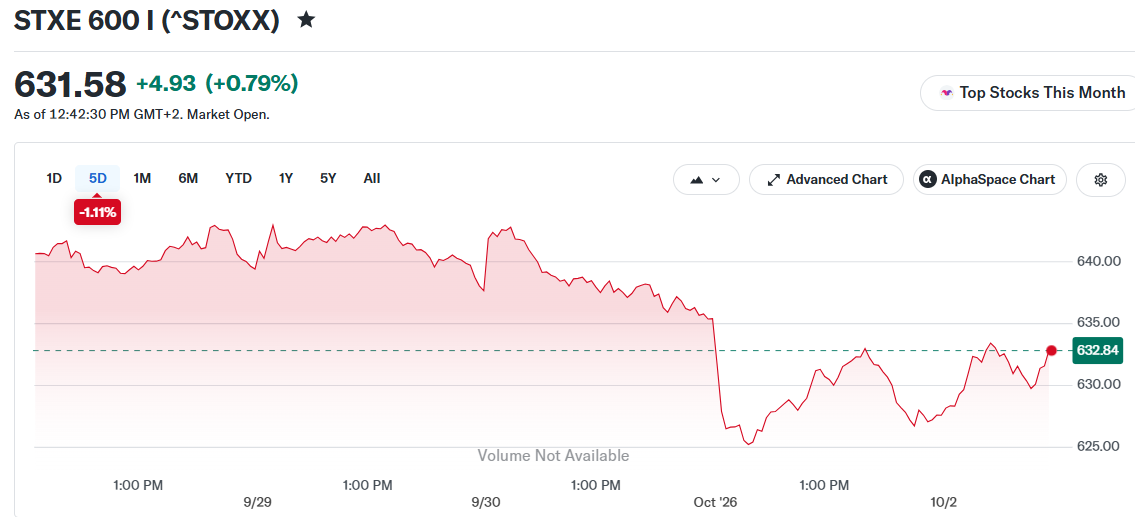 STXE 600 I (^STOXX)
Even with Friday’s gains, the week has been rough for European markets. The STOXX 50 is down 2% for the week. The STOXX 600 has fallen 1.9%. Both are on pace for their worst weekly performance since April.
Germany’s DAX rose 0.9% on Friday. France’s CAC 40 climbed 0.6%. London’s FTSE 100 showed little change.
French Bond Yields Hit Multi-Decade High
The selloff earlier in the week was tied to a sharp drop in European government bonds. This followed growing concern about France’s finances after the government released its 2027 draft budget.
France’s 10-year bond yield rose to its highest level since 2002. Investors are asking for more return to hold French debt because of worries about the country’s spending plans.
The gap between French and German 10-year bond yields widened past 140 basis points. That is the widest gap since the European debt crisis in 2012.
This fiscal strain pushed the euro down. The currency fell to its lowest level against the U.S. dollar since 2025.
On Friday, Reuters reported that European Union countries discussed a French plan to release diesel fuel stocks. Brent crude oil fell toward $99 a barrel following the news. Lower oil prices helped ease worries about inflation and pulled government bond yields down, including in France.
Inflation Data and Jobs Report Ahead
Investors are watching for the preliminary September inflation reading for the Eurozone. Economists expect the number to rise to 3.6% from 3.2% in August. Higher energy costs linked to the war in the Middle East are seen as the main driver.
Attention is also turning to the United States. The September jobs report is due soon. A strong labor market reading could support the Federal Reserve’s stance of keeping interest rates higher for longer. That could push global bond yields even higher.
Individual stocks moved sharply this week. Trading platform IG Group fell as much as 27% at one point, reaching its lowest level since April 2025. The company said it expects third quarter revenue of about £240 million. That would be a 14% drop from last year.
JD Wetherspoon moved the other way. Shares jumped more than 8% after the pub chain reported stronger recent sales. The company said full year profit should meet market forecasts, even after a 28% drop in annual profit due to higher costs.
Tech and industrial stocks led Friday’s gains. ASML Holding rose 2.4%. Siemens added 1.1%. Inditex gained 2.2%.
Infineon rose 5.9%. Thyssenkrupp climbed 4.5%. Stellantis added 4.1%. These were among the top performers on the STOXX 600.
Sanofi was the biggest loser on the index, falling 3.2%.
Markets will now watch the inflation and jobs data for direction heading into next week.
The post Why European Stocks Are Bouncing Back From a Brutal Week appeared first on CoinCentral.





 Bengali (Bangladesh) ·
  English (United States) ·