

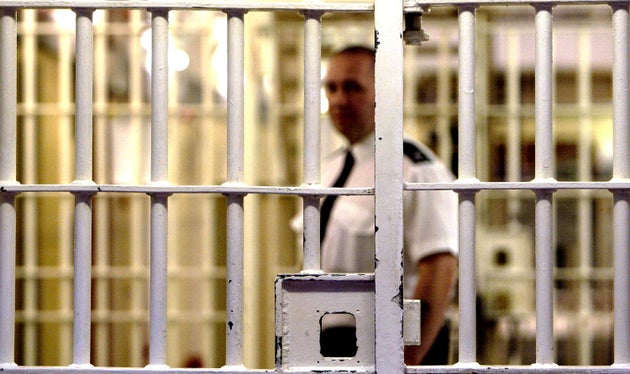
 A prison guard at HMP (Her Majesty's Prison) Pentonville stands behind a locked gate May 19, 2003 in London.
 Around 700 inmates are being released early from their prison sentences today.
It’s part of the government’s controversial plan to free up spaces in Britain’s overcrowded prisons.
Male prisons in England and Wales are currently operating at nearly 99% capacity, limiting the justice system’s ability to punish future offenders.
As of September 1, there were only 1,500 free spaces available out of nearly 89,000, as the crisis worsened.
Without government intervention, current sentencing rates mean there would have been no spare cells by Christmas.
Here’s what you need to know.
How The Scheme Works
Approximately 700 prisoners who are serving sentences of under 19 months are being freed just a third of the way into their expected time behind bars, working out to around six people per prison.
Despite pushback from some campaigners, that does include domestic abusers, stalkers and coercive-control offenders.
The scheme will only apply to those expected to serve half their term in jail and half in the community on a licence – around 70,000 offenders in total.
Leaving on licence means an inmate could still be recalled if they break their conditions. They can be returned to jail immediately.
It will also work in tranches. Another 650 – who are serving longer sentences – are expected to be released on October 13.
The scheme will extend to offenders serving up to three years and two months from November.
By next June, serious offenders on fixed terms of more than 12 years will become eligible. They will have been expecting to serve two-thirds of their sentence, but given a community licence after just half.
The government is expected to have released around 4,500 people in total by next summer.
Around 18,000 inmates are not ever going to be part of the scheme, including anyone convicted of murder, manslaughter, a sexual or grooming-related offence or a driving offence that led to a death.
Ministers also insist the released prisoners will not be able to return to normality, as they will be under the “toughest restrictions ever”.
Hgh-risk offenders will be restricted to a few square miles, banned from pubs and football grounds.
There will also be a significant expansion of electronic tagging and victims will have a say over the license conditions of their perpetrators.
How Has The Scheme Changed?
Keir Starmer first revealed the extent of the crisis in July 2024, when he first came to power.
He ran an emergency scheme where some offenders would be released after serving 40% of their sentence.
It sparked immediate backlash, especially when freed prisoners went viral on social media for thanking Starmer and celebrating outside.
Most fixed-term prisoners at that point were only eligible for release after serving more than half of their sentence.
His long-term programme would have allowed 500 more offenders to be released.
But his replacement, prime minister Andy Burnham,delayed the scheme by a month following concerns over the impact on victims and called for a review.
In particular, a huge row erupted after it emerged that two of the killers of PC Andrew Harper would be released early.
Burnham then announced that anyone convicted of manslaughter – such as PC Harper’s killers – would not be eligible for inclusion in the scheme.
Why Is This Happening?
The Conservatives have been blamed by the Labour government for ignoring the problem during their 14 years in power.
They only added 500 new prison spaces despite promising to build 20,000.
Courts have also been jailing more criminals than the number being released for more than 30 years.
Justice secretary Alex Norris said last month that Labour was forced to take “tough decisions” because it inherited a justice system “on the brink of failure”.
Is The System Set Up For So Many Freed Prisoners?
HM Chief Inspector of Probation Martin Jones said the system was too reliant on electronic tagging, which he claimed a “false sense of security”.
He also said probation services are not properly resourced, with not enough equipment or personnel to watch over the newly released prisoners.
Those with electronic tags are not always prevented from breaching the terms of their release and license conditions are not always enforced either.
The probation inspectorate said just 55% of tags are fitted properly.
Meanwhile, victims’ commissioner Claire Waxman said the confidence is “not yet matched by the reality on the ground”.
Chairman of the Prison Officers’ Association, Mark Fairhurst, pointed to the staff shortage, saying: “You can create as much additional space as you like, and build as many new prisons as you like, but where are the staff coming from to supervise people? Nobody wants to be a prison officer anymore.”
The Conservatives’ shadow justice secretary Nick Timothy said the early release programme was an “insult to victims”.
Reform UK’s Sarah Pochin wrote in The Telegraph that victims will be “quite literally fearing for their lives”.
The Lib Dems’ Jess Brown-Fuller blamed the Tories for the issue but called on Labour to “correct the mistakes”.
Former safeguarding minister Jess Phillips also said she would be lying if she said she was “completely confident” that everything is ready for the early prisoner release programme.
Former safeguarding minister Jess Phillips says she’d be lying if she said she was “completely confident” that everything that “should be in place” is ready for the early prisoner release starting today.
“I expect there will be huge recalls to prison of domestic abusers.”… pic.twitter.com/cyPNLjsIex
What Else Is The Government Doing?
The government projects the prison population will still climb to approximately 100,000 by the end of the decade, so it has a series of other measures to help ease the overcrowding crisis.
Extra prison spaces will also be created by deporting more foreign prisoners and releasing some inmates serving indefinite sentences.
Some 18-year-olds will be held in young offenders’ institutions for longer, to avoid transferring them to adult facilities in an effort to help overcrowding.
The government has also promised to create more cells in existing prisons with an investment of £110 million to convert unused office space, laundry rooms and storage.Norris also told MPs this year that the government plans to “bring forward legislation” to end Imprison for Public Protection sentences, where the inmates are considered at serious risk of causing harm to the public.
They could only be released if the Parole Board was satisfied they were no longer a threat to the public, after serving a minimum term.
The government is effectively scrapping one-year jail terms, too.
Are There Any Alternatives?
The think tank the Prosperity Institute has suggested the government should spend £15 billion on building prisons to resolve this long-standing problem.
That would create 20,000 extra spaces across at least six new prisons.
It also suggested using former university campuses or conference centres for lower-security prisons.
HuffPost UK reported this week that much of the public would rather send alcohol and drug addicts to rehabilition centres rather than prison if they commit crimes.
Listen to Commons People, the podcast that makes politics easy. Every week, Kevin Schofield and Kate Nicholson unpack the week’s biggest stories to keep you informed. Join us for straightforward analysis of what’s going on at Westminster.




 Bengali (Bangladesh) ·
  English (United States) ·