
 2 hours ago
10
2 hours ago
10 

Those who aspire to change America’s criminal justice system are split into two camps, which can be shorthanded as activists and “factivists.” Activists believe they know what needs to be done to policing, courts, corrections, and society as a whole, whether it’s abolishing prisons and defunding police (on the far political left) or purging allegedly “woke” prosecutors and handing down many more multi-decade prison sentences (on the far political right). Activists, even those in academia, usually see research mainly as an opportunity to prove what they are already sure of themselves. Factivists share activists’ desire to improve the system but differ from them in seeing rigorous research as a precondition for determining what is true, and only then do they feel comfortable translating those findings to policymakers and the public. Jennifer Doleac’s new book, The Science of Second Chances, is squarely and self-consciously within this tradition.
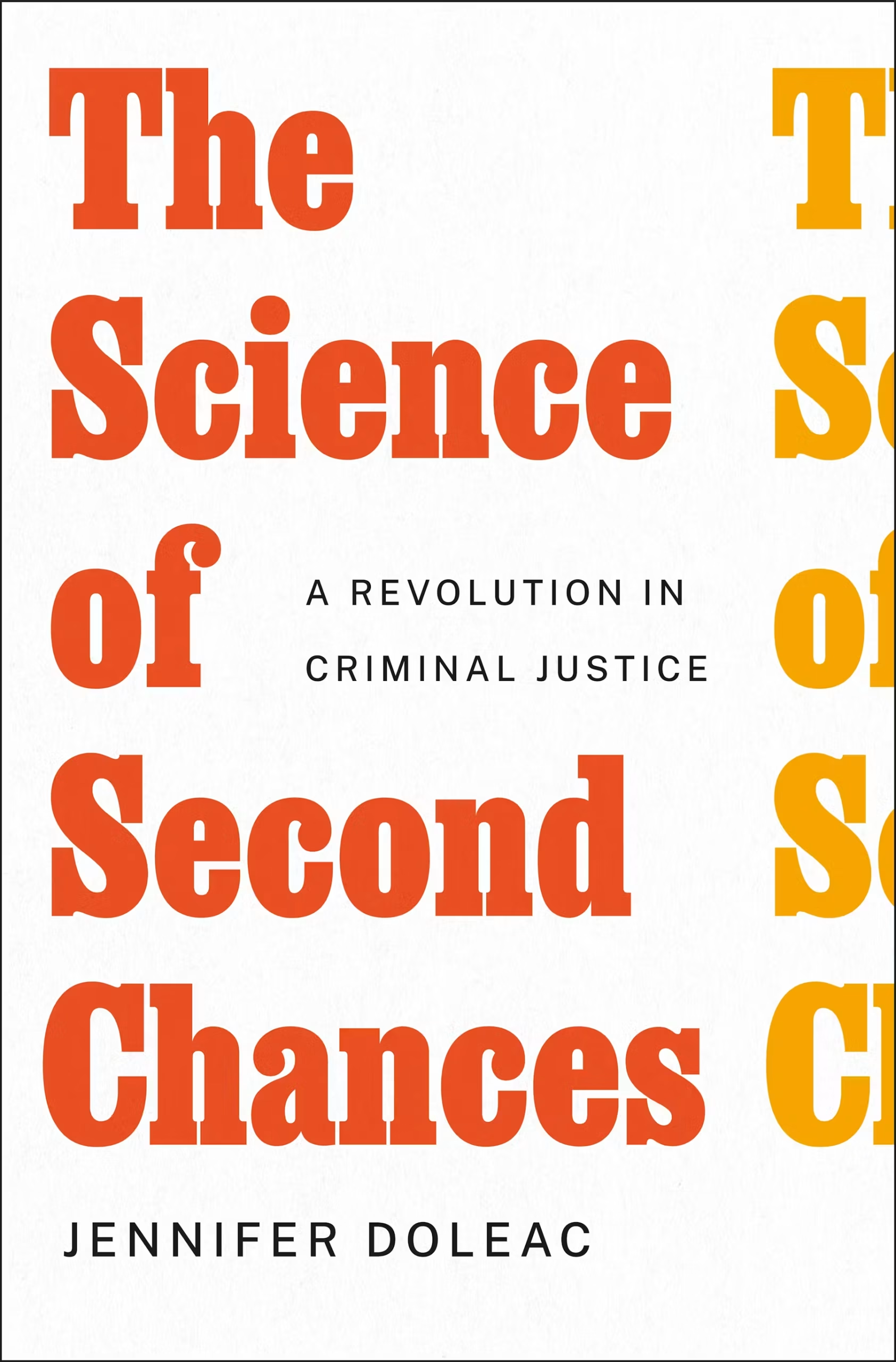 The Science of Second Chances:
A Revolution in Criminal Justice
by Jennifer Doleac, 304 pp.
The factivist criminologist that Washington Monthly readers are most likely to have heard of is Professor Mark Kleiman, a long-time contributor to this magazine who passed away in 2019. Kleiman brought a taste for evidence to a range of topics, including marijuana legalization and regulation, community supervision of people with drug problems, re-entry programs, and crime deterrence. Doleac warmly remembers his brilliance and impishness, and he would surely have appreciated many of the volume’s empirically grounded conclusions, not least those likely to discomfit ideologically driven activists on the left and right.
Although the book devotes some attention to the primary prevention of crime (e.g., studies showing that better nutrition, air quality, and education reduce young people’s likelihood of initiating a criminal career), as the title suggests, its focus is on how to prevent the “next bad thing” from happening regarding someone involved in the criminal justice system. For one person, the next bad thing might be returning to prison; for another, committing a new crime; and for still another, failing to comply with probation or parole conditions. Concretely, that means examining evidence on the effects of different approaches to deterring and punishing crime, getting people to participate constructively in the criminal justice system (e.g., show up at their hearing so that no bench warrant is issued for their arrest), conducting community supervision (e.g., probation and parole), and managing jails and prisons.
This is a large range of material to cover. Still, by organizing each topic in the chronological order in which people encounter the criminal justice system, from arrest, trial, conviction, and incarceration to release, Doleac shepherds the reader along. The writing is mercifully light on jargon, and the tone is conversational, with personal anecdotes interspersed. These range from Doleac describing her fear as a young academic at the University of Virginia when a female student was kidnapped and murdered, to relaying her shock and pain when her character and motives were questioned at a Congressional hearing. She reveals that when she left academia in 2023 to work at the Arnold Ventures philanthropy—arguably the most influential funder of criminal justice innovations and research—a detractor wrote to her new employers, “claiming I have no ‘ethical core’ because of my preference for using strong research methods rather than accepting his preferred policy prescriptions.” Some readers may find this too personal in a book that reviews sophisticated research on a serious topic, but I suspect many will find her writing more accessible than “science journal speak.” Also, Doleac’s candid description of run-ins with activists indirectly illuminates the differences between factivists and activists and why they often look askance at each other.
The studies reviewed generate admiration for Doleac, an economist by training, and other featured scholars who creatively draw causal conclusions in the messy, complex, and uncontrollable world of the criminal justice system. When people choose the intervention they receive, determining whether the intervention works is challenging because the characteristics of the person and intervention are hard to distinguish (e.g., people who complete a demanding program may have been more motivated to change in the first place than were those who dropped out). Researchers often address this inferential problem by randomly assigning people to programs or treatments. Within the medical system, researchers can randomly assign people to conditions (e.g., receiving a medication or a placebo), making it easier to determine whether a treatment really works. Such opportunities are rarer in criminology for practical and ethical reasons. For example, it would violate civil rights to punish people convicted of the same crime at random. Further, the operators of the criminal justice system have less awareness and regard for the value of randomized trials than do the operators of the health care system, who are trained to see clinical experimentation in near-Biblical terms. Criminal justice program evaluators thus usually have to improvise by opportunistically exploiting natural experiments.
For example, Doleac details how she used the fact that DNA testing of people arrested for particular crimes has been expanded in some locales, such as Denmark and some states in the U.S. This means that if two people committed the newly covered crimes, say, a week before and a week after the policy change, with one person’s DNA recorded and the other’s not, there is an imperfect but plausible way to estimate the effect of the new policy.
In the case of DNA collection research, evidence gathered by Doleac and other scholars shows that the deterrent effect on future offending is extremely large. In Denmark, for example, collecting the DNA of people charged with felonies reduced their future rate of criminal conviction by 42 percent. This is one of many studies that allows Doleac to underscore a critical point: The most powerful deterrent is not the severity of the punishment but the certainty of being punished. Once criminals know that it will be hard to get away with crimes because their DNA is on file, many desist. And importantly, as Doleac notes, crime deterrence isn’t just good for future victims; it also increases the likelihood that the one-time criminal will do more productive things, such as obtaining a job or receiving an education.
Other inventive work takes advantage of the fact that after a first arrest for a felony or misdemeanor, some people receive unusually lenient treatment due to chance factors (e.g., an overburdened junior prosecutor drops the case, a witness fails to appear at the hearing, the assigned judge is a soft touch). Tough-on-crime advocates may be surprised that studies consistently find that those who luck into lenient treatment after a first offense are 60 percent less likely to re-offend than those who are punished more severely. However, anti-policing advocates will have their own conniptions as Doleac explains that these studies do not mean that announcing that first felonies will no longer be punished would reduce crime. She notes that even first-time offenders who luck into leniency still face consequences, including arrest and adversarial questioning by police, and don’t know in advance that they will get a break in the end. If everyone knew in advance that there would be no punishment for crimes, those crimes would become more common.
The data Doleac reviews on post-incarceration monitoring also serve up some sacred cowburger to the right and the left. Intensively monitoring people after release generates slightly more crime, arrest, and re-incarceration (e.g., for ticky tack violations) than less intensive monitoring, a repudiation of the punitive mindset with which some people approach ex-prisoners. However, provision of mentoring, employment services, and case management for people leaving correctional facilities doesn’t seem to help, according to a trial of over 4,500 participants that Doleac discusses. Indeed, as hard as this is to swallow for rehabilitation-minded people (like me), the study found that those who were randomized to have access to these services had a 21 percent greater chance of being convicted of a new crime in the three years after release. Despite the study’s focus on employment, those receiving services were, if anything, less likely to land and keep a job. The provision of rehabilitation services may even increase the likelihood that released individuals commit more crimes for unclear reasons. Doleac notes that this study was not a fluke: Another large evaluation generated similar findings with a different package of services. She offers several post-hoc explanations for these results, but with humility, as the precise mechanisms at play are unknown.
The one exception to the negative verdict on community supervision concerns regularly testing for alcohol and other drug use and responding to it with swift, certain, and fair consequences. The majority of people under criminal justice supervision have an alcohol or other drug use disorder, and such problems increase criminal offending. Most notably, about one-third of property and violent crimes are committed by people who are currently under the influence of one or more substances. Perhaps because it is so prevalent in criminal justice population, such a frequent a driver of offending, and so reliably detectable (unlike say, parole conditions such as not associating with criminals or having a gun in the home), fair monitoring of substance use generates large returns to both public safety and the well-being of offenders (As Mark Kleiman wrote about in this magazine). The research presented in the book made me wonder if perhaps the best approach to probation and parole conditions is to have substance use monitoring be universal and require little or nothing else.
The book also presents evidence supporting some rational optimism that the U.S. could continue its recent progress in reducing the size of the prison population, which has declined by about 350,000 people since its peak in the late aughts. Medicaid as a whole is slated for massive cuts starting later this year, but Medicaid services for people leaving incarceration seem to have avoided the budgetary axe. This matters because multiple studies Doleac reviews suggest that being on Medicaid reduces crime and incarceration by 20-30 percent, particularly for people with psychiatric disorders. This is an intriguing, as yet unexplained contrast to the dispiriting findings mentioned earlier on the effect of wrap-around services on people leaving incarceration. Perhaps Medicaid gives access to a broader range of services that might affect future offending than does the typical menu offered by wraparound service providers.
Relatedly, with the explosion of technology that allows remote monitoring of people’s location as well as an increasing number of other behaviors (e.g., alcohol use, social isolation, physical activity, depression), some incarceration sentences can be partially or entirely replaced with electronic monitoring devices. The studies Doleac reviews show that non-violent criminals in such arrangements have 10-20 percent lower rates of re-offending, perhaps because they can keep working in legal jobs. In contrast, incarcerated people typically lose their jobs and come out better primed to generate income through the illegal rather than legal economy, in which few employers want to give them a chance.
Activists tend to feel confident that their policies will generate only good results; this book is a factivist’s pointed reminder that no one is above the law of unintended consequences. When tough-minded voters and policymakers restrict opportunities for parole and early release, prisoners lose an incentive for good behavior, making correctional facilities more disorderly, violent, and criminogenic. Further, once judges realize that full sentences must be served, they sometimes reduce the sentences they hand down. Doleac notes another vivid example: Well-meaning opposition to drug testing as part of employment interviews is intended to make it easier for groups stereotyped as being drug users (e.g., young black males) to find jobs, but banning drug testing makes them less likely to be hired because it is the negative drug test that often overcomes the employer’s unfair presuppositions. (Obviously, an even better solution would be for employers not to make racist assumptions in the first place, but if you can crack that nut, you will be getting a medal in Stockholm soon.)
More generally, Doleac exhibits the intellectual humility that factivists rightly celebrate. She is candid that no study, not even vaunted randomized clinical trials, provides all the answers. Further, because the criminal justice system and the society around it are always changing, what worked in the past may not work today, and vice versa. And she is commendably straightforward about the reality that even programs she highlights as generally working, for example, 24/7 sobriety for alcohol-involved offenders, just about never work for every single person.
 Jennifer Doleac’s new book, The Science of Second Chances, shows that no criminal justice policy is above the law of unintended consequences. Credit: Wikimedia Commons
Another strength of the book is its clarity about the democratic choices that must be made about criminal justice, which cannot be made scientifically. This point is almost lost in academic criminology because the field includes almost no political or cultural conservatives, making leftist subjective values so omnipresent that they are often mistaken for facts rather than policy preferences (e.g., the opinion that punishment should be limited wherever possible). I credit Doleac for acknowledging the reality that some voters and policymakers see retribution for crime as a suitable goal of criminal justice, even though I am not sure there is a single academic criminologist who agrees. Those who do not cope with this fact—for example, by vetting their policy ideas only among colleagues before venturing into the public policy arena—are preparing for a heavyweight bout by sparring with featherweights.
The book’s conclusion chapter is both surprisingly short and underdeveloped relative to what preceded it. But that flat ending does not diminish the fact that this is a well-organized, well-reasoned, thought-provoking volume that merits close attention from researchers, practitioners, and policymakers in the criminal justice field. It embraces the best features of the factivist tradition, namely rigorous methods, humility about what is known, and disregard for ideological comfort food. There are more than enough good ideas here to significantly improve the lives of those who come into contact with the criminal justice system, as well as the broader public that wants to be safe.
The post Where Left and Right Both Go Wrong on Crime appeared first on Washington Monthly.





 Bengali (Bangladesh) ·
  English (United States) ·