
 10 hours ago
4
10 hours ago
4 
Look to your left. Now look to your right. I’m 100 percent confident that any one of those people in your eyeline—regardless of their reading taste—would love a book by Rachel Khong if you put it in their hands. Like many readers, I fell in love with Khong’s writing through her debut novel, Goodbye, Vitamin. I recently finished listening to her latest novel, the New York Times best-selling Real Americans, on audiobook and found myself taking the long way just to keep listening a few minutes more. My Dear You, her new short story collection, completes the trinity—the literary treasure trove that is Khong’s body of work.
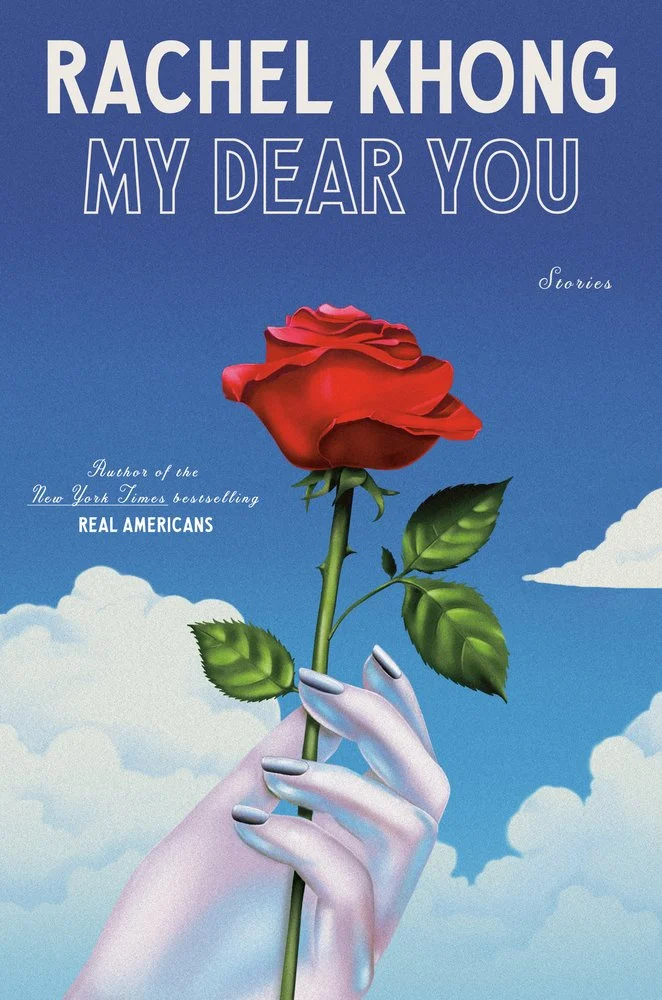
In My Dear You, Khong turns her attention to a wide-ranging cast of characters navigating scenarios that are at once surreal and deeply familiar: a government program that alters how people perceive race and gender, a cat that conjures the ghosts of past relationships, a vision of heaven where memory itself begins to slip. Oscillating between the absurd and the intimate, these stories explore identity, love, relationships, friendship, and the quiet, often overlooked ways we misunderstand one another. The result is a collection that is as funny as it is unsettling—one that asks what it means to love, to belong, and to be a person in a world that rarely makes as much sense as we’d like it to.
I sat down with Khong to talk about absurdity as a lens, identity and belonging, and the complicated, often contradictory ways we connect with one another.
Greg Mania: One thing I love about My Dear You is how the stories take these absurd or speculative situations and use them to look closely at very ordinary human feelings. What draws you to that space where the strange and the everyday collide?
Rachel Khong: I guess I don’t think of the strange and the everyday as separate things. To me, the everyday is strange, and vice versa. So many things that are happening now are so strange and unbelievable—whether it’s the Epstein files or anything that comes out of Trump’s mouth. At the same time, our internal lives are such rich territory. Obviously we’re still writing and painting and making music about human emotion. Even though we’ve been doing it for hundreds—thousands—of years, there is so much more to write and sing about and explore: The complexity of human emotion is endlessly deep and interesting and just weird. I feel that it’s my job to make art that comes from my particular experience, living through this very strange moment in time, metabolizing the events I’m living through on a national and global level, but also on a really private and personal level. I’m not sure why the stories get so weird, but if I were to articulate it—though articulating feels really antithetical to the way I work, which is more intuitive—I think it’s a reaction to our circumstances: When the powers that be want sameness, conformity, and fascism, I want to exist in the world of my own imagination.
GM: Why do you think the absurd can sometimes reveal truths about the real world more clearly than realism can?
I don’t think of the strange and the everyday as separate things.
RK: Absurdity is a way of exposing the faulty logic of systems we’ve grown used to. Realism reproduces the world as we recognize it, but I’m more interested in making the structure beneath our world visible. When something becomes ridiculous (like what happens in “The Freshening,” for example), we are more likely to question if our rules make sense to begin with. I recently read the stories of Leonora Carrington; her stories are so strange and absurd—our world isn’t always recognizable in them. But what she and other surrealists did was to suggest that the systems we take for granted as rational and logical really aren’t so—they’re actually terrible and inhumane. What’s absurd isn’t talking hyenas, it’s inequality and the fact of billionaires; it’s losing track of every person’s humanity. Absurdity can be such a powerful lens for looking at racism, misogyny, capitalism—it reveals the illogic embedded within systems that present themselves as rational.
GM: This is your first short story collection. What did writing short stories allow you to explore that felt different from writing a novel?
RK: Stories were how I found my way into writing fiction in the first place. I have been writing stories far longer than I’ve been writing novels. Often, I use stories as a way of exploring topics—writing my way into what I’m interested in. Goodbye, Vitamin grew from a short story about a character named Ruth. That novel expanded my interest in memory, and how we can love each other with our faulty memories. And though they are so tonally different, writing [the story] “My Dear You” led me to writing Real Americans, because it introduced me to my interest in choices: What do we choose for us, and what’s already chosen? How do we become who we become? Stories are a way to experiment, too: I’m much more wacky and playful in my stories because I think wackiness is much more manageable and palatable in small doses—it would get annoying (for both the reader and the writer) in a novel. And I love precision and brevity in writing; I love that stories can be distilled and potent.
GM: A lot of the stories seem interested in how we see one another—or fail to. I’m thinking in particular of the story where the government injects everyone with a drug that makes them see others as their own race and gender. What interested you about exploring identity and perception that way?
RK: I’ve been really interested in projection for a while now—what we think and assume about other people. I think it’s gotten even worse with social media and the internet. These tools that were supposed to help us have a more democratic society are instead fostering and fomenting a more fascistic one. We assume so much about other people that really isn’t true; we forget the richness of every individual person, forget that everyone else’s lives are as complex as our own. What we assume about other people can be fatal, especially when it comes to Black men and boys dying at the hands of police. How did things get so inverted that the people who are supposed to be protecting us instead cause harm to an entire community? With “The Freshening” in particular, I wanted to try to answer that question: How could we stop this violence? How could we stop making these fatal, racist assumptions? Obviously the answer isn’t so straightforward.
GM: There’s also this recurring question across the collection about what it means to be an Asian woman in America. When you were writing these stories, what kind of questions about identity and belonging kept surfacing for you?
These tools that were supposed to help us have a more democratic society are instead fostering and fomenting a more fascistic one.
RK: The main question was probably, “This again?” We’ve talked a lot about absurdity, and I do find racism more than a little absurd. I was interested in writing racism in the way that I experience it most often, which is in a quieter way, almost as an afterthought. It happens when doctors don’t take my complaints seriously, because I’m “probably” healthy. It happens when people confuse me for another Asian author, which happens more often than you’d think. The fact that my books get the most attention when it’s AANHPI month in May. A lot of literature covers racism that’s more overt, that’s really loud, but I was interested—especially in these stories—in presenting it in the more mundane way that I often experience it.
GM: The dating stories in the collection are often very funny but also a little painful in a recognizable way—awkwardness, misread signals, lingering ghosts from past relationships! What about love and intimacy at this stage of life felt especially rich or compelling for you to explore?
RK: It’s been a while since I went on a date, and I never experienced online dating, but I can recall the weirdness of dating so vividly—and can imagine the weirdness of it, especially now with apps and, like I said, so much projection about other people—that I wanted to write about it. I wanted to write about desiring and being desired, about expectations and falling short, about how the way we love other people might not be exactly the way that they’d prefer to be loved. We bring a lot of assumptions into relationships—about the other person, about what relationships should even be—and at the same time, relationships can be so life-changing and essential and deeply loving. I’m sorry the fetishizing guy is named Greg, by the way. I promise he’s not named after you!
GM: I appreciate the clarification—I was getting a little nervous there! But I’m curious about what you said about people wanting to be loved in particular ways—why do you think that mismatch happens so often in relationships?
I’m not entirely sure our lives are so ordinary; I’m not entirely sure things are exactly as they seem.
RK: Well, every person’s perspective is so different—shaped by an entire life. I think the mismatch happens with books, too; I could give a book I love to a friend, but my friend might hate it. Who or what you connect with can be so subjective, which is why it feels kind of miraculous when you do meet someone or something you deeply connect with. With both books and relationships, I think it’s important to be humble and open. The assumptions we bring to relationships probably aren’t correct. Can we be open to how interesting the person or book might be, rather than jump to conclusions based on who or what we’d like them to be?
GM: Several of the stories brush up against the supernatural. There are ghosts, heaven, even the end of humanity! What do those possibilities open up for you when you think about what might exist beyond the boundaries of ordinary life?
Piecing Together a Novel
Rachel Khong describes how reading Joan Didion, Renata Adler, and other women showed her that a novel could be like a puzzle

RK: I’m not entirely sure our lives are so ordinary; I’m not entirely sure things are exactly as they seem. Our lives are both ordinary and not—that’s always on my mind as I write fiction. It’s pretty magical that the world we live in exists at all, and that we’re here for it. It’s magical that a tree grows from a seed, or that a baby forms in a womb. That our hearts just beat, until they don’t. We’re walking contradictions, in that we are all ordinary and mortal and limited, but we also have these amazing minds and imaginations that can take us practically anywhere. I write, in part, to remind myself of this contradiction: My life can feel so ordinary on a day-to-day basis, yet the fact that I’m here at all is pretty miraculous and odds-defying, and one day I’m going to die. What am I doing with that? Am I spending time with my closest friends, am I doing the most human things possible, am I caring as deeply as I can for the people I’m in relationships with, am I making things—am I creating—what I feel called to? Writing is how I remember what’s most important to me.
GM: What did writing this collection teach you about yourself?
RK: Honestly, putting all these stories together made me a little sick of myself. But as I grow as a writer, I’m learning to have compassion for myself, too. I did learn a lot from this collection, but it’s hard to separate growing older from the writing itself. For me, they’re intertwined and inextricable. I’m grateful to have writing, not to make sense of life—because a lot of it doesn’t make sense—but to accompany me in life.
The post Using Absurdity to Expose the Faulty, Inhumane Logic of Our World appeared first on Electric Literature.




 Bengali (Bangladesh) ·
  English (United States) ·