


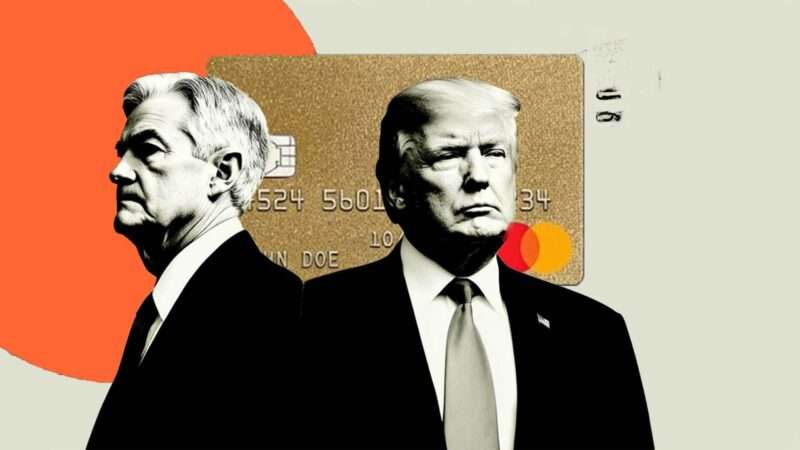
With a pair of moves over the weekend, President Donald Trump signaled his intention to bully various institutions into providing lower interest rates for American consumers and the federal government.
First, Trump called for capping credit card interest rates at 10 percent in a Truth Social post on Friday. That was swiftly followed by news that the Justice Department was investigating Federal Reserve Chair Jerome Powell for misleading Congress about the cost of a renovation project—a move that seems like the most blatant yet by the administration to compel Powell to lower interest rates in accordance with Trump's wishes or resign his post.
You might think of this as Trump's war on high interest rates. Like other, less metaphorical conflicts that the president has started in recent weeks, this one has been launched with little regard for its legality or the possible consequences. What Trump perceives as a pincer movement of populist policies seems likely to backfire in ways that could make credit more difficult to obtain and otherwise destabilize the economy.
On the question of credit card interest rates, Trump seems to be on shaky ground both legally and economically. The president does not have the authority to tell credit card companies—or any other financial service—how much interest to charge. Trump said Sunday that companies would be "in violation of the law" if they don't lower their interest rates. That is simply untrue, because federal banking policy is not set by a social media post.
Even so, this is in some ways an understandable impulse. No one likes paying high interest rates (or late fees, which former President Joe Biden unsuccessfully tried to cap during his term), and with credit card debt at a record high, there may be some political points to be scored by beating up on companies perceived to be, as Trump put it, "ripping off" Americans.
Capping interest rates, however, would not be without trade-offs.
"One of those unintended consequences is that banks will reduce or eliminate credit offerings to borrowers who are too risky to justify a 10 percent annual interest rate," wrote Ryan Young, a senior economist at the Competitive Enterprise Institute. "Wealthy people will do just fine, as will people with an established credit history. Poorer people and younger people will, in many cases, suddenly be unable to get credit from banks."
Implementing "a 10% interest rate cap would reduce credit availability and be devastating for millions of American families and small business owners who rely on and value their credit cards, the very consumers this proposal intends to help," said a joint statement from several banking industry groups.
The administration's move against Powell—which is properly understood as an attack on the political independence of the Federal Reserve—is a similar attempt to bully an institution into adopting Trump's preferred policy. It would likely bring with it a similar set of unintended, negative consequences.
In this case, Trump's motivations are some combination of political and fiscal. If the Federal Reserve lowers interest rates, that would be good for economic growth in the short term (as it would make everything from car loans to mortgages more affordable). It would also help the federal government's bottom line, since interest payments on the national debt are now one of the largest segments of the budget—and cost nearly $1 trillion last year.
The trade-offs, however, could be nasty. The Federal Reserve hiked interest rates to combat higher inflation earlier this decade, and inflation has yet to return to the 2 percent annualized rate that the central bank views as its goal. Many economists believe that lowering interest rates would unleash higher inflation once again—an outcome that might be marginally better for the federal budget, but quite frustrating for consumers and businesses.
The history of political interventions in the Federal Reserve is not good for Trump. Most famously, President Richard Nixon pressured Federal Reserve Chairman Arthur Burns to loosen monetary policy before the 1972 election. The result was a weakening of the dollar and a period of "stagflation" that lingered through the rest of the decade.
One hallmark of populist economic policies is that they tend to backfire on the very same population intended to benefit. Trump's tariffs were supposed to resurrect manufacturing and boost American farmers, but they have raised input costs and slowed job growth across a range of blue-collar industries (and triggered another taxpayer-funded bailout for farmers).
The president now risks repeating a version of those same mistakes by inserting more misguided populism into how Americans do their banking.
The post Trump's War on Interest Rates appeared first on Reason.com.










 Bengali (Bangladesh) ·
  English (United States) ·