
 1 hour ago
4
1 hour ago
4 
TLDR
Trump called the Iran ceasefire “on life support” after rejecting Tehran’s latest peace offer as “totally unacceptable” Brent crude climbed to around $105 a barrel, with West Texas Intermediate near $99 Iran demanded the US lift its naval blockade, provide sanctions relief, and keep partial control over the Strait of Hormuz Saudi Aramco’s CEO warned global markets are losing 100 million barrels of supply every week the strait stays shut Traders are watching US inflation data and Trump’s upcoming meeting with China’s Xi Jinping for clues on what comes nextTrump rejected Iran’s latest peace offer on Monday, calling it “totally unacceptable” and a “piece of garbage.” He told reporters the ceasefire was on “massive life support,” raising fears the 10-week war could escalate again.
"I have just read the response from Iran’s so-called 'Representatives.' I don’t like it — TOTALLY UNACCEPTABLE! Thank you for your attention to this matter." -President DONALD J. TRUMP pic.twitter.com/MIQDS9Ujjy
— The White House (@WhiteHouse) May 10, 2026
Brent crude rose to around $105 a barrel on Tuesday, building on a nearly 3% gain from the session before. West Texas Intermediate climbed to about $99 a barrel.
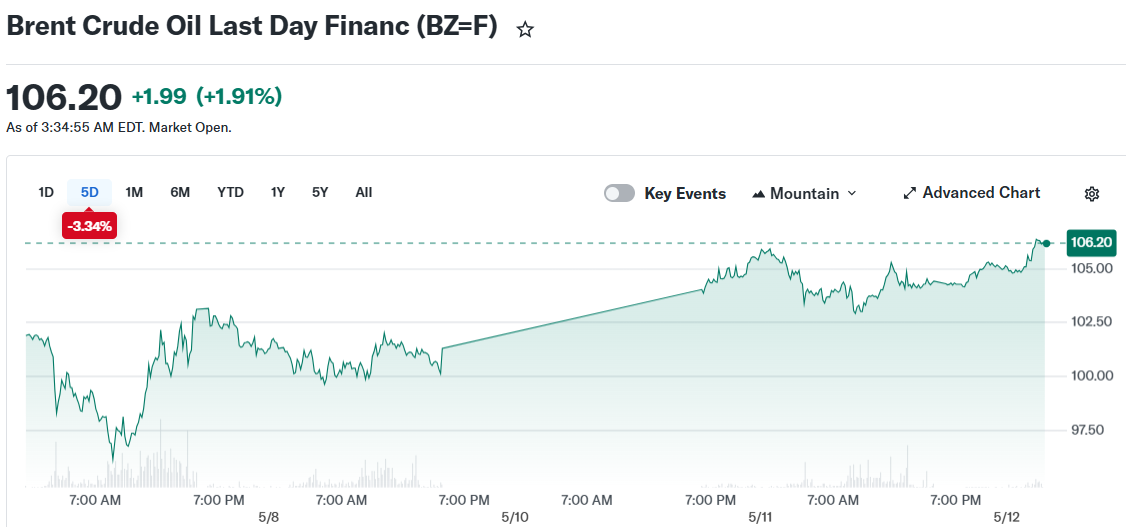 Brent Crude Oil Last Day Financ (BZ=F)
The fighting began roughly ten weeks ago and a fragile ceasefire has been in place since early April. But recent attacks on ships in the region have kept tensions high.
Iran responded to the US peace proposal with a list of demands. These included lifting the US naval blockade, providing sanctions relief, restoring Iranian oil exports, paying war damage compensation, and retaining partial control over traffic through the Strait of Hormuz.
The Strait of Hormuz is one of the world’s most important oil shipping routes. Around one-fifth of global oil and fuel passes through it.
What the Strait Closure Means for Oil Supply
Saudi Aramco’s chief executive, Amin Nasser, said the world is losing 100 million barrels of oil supply for every week the strait stays closed. Aramco has rerouted some exports through its western port, but prices remain elevated and buyers, including China, are taking fewer volumes.
Gasoline prices in the US have jumped, putting political heat on Trump and Republicans ahead of November’s midterm elections. The US has released emergency oil reserves in an attempt to cool prices.
Bloomberg Economics analysts wrote that a full peace deal looks unlikely. They said fighting could resume but would likely settle into lower-level exchanges, which they described as “the new normal.”
Axios reported that Trump is meeting his national security team to discuss the possible resumption of military action. Trump told Fox News he is also looking at reviving a plan to escort ships through the strait.
What Traders Are Watching Next
Markets are keeping a close eye on US Consumer Price Index data released Tuesday. Economists expected the headline inflation rate to rise to 3.7% from 3.3% year-on-year, partly due to higher energy costs from the conflict.
Producer price figures due Wednesday are also expected to show rising pipeline pressures from higher gasoline and transport costs.
Higher inflation could complicate the Federal Reserve’s next steps and keep interest rates elevated for longer.
Traders are also watching Trump’s planned meeting with Chinese President Xi Jinping in Beijing. The two leaders are expected to discuss Iran, trade, and energy security. China is Iran’s largest oil buyer and has diplomatic influence over Tehran.
The US Treasury sanctioned more entities on Monday for helping sell Iranian oil to China. Analysts said the outcome of the Trump-Xi talks could play a key role in shaping the direction of the conflict.
Market strength indicators have softened in recent sessions as some refiners have pulled back on buying.
The post Trump Rejects Iran Peace Offer — What It Means for Oil Prices and the Strait of Hormuz appeared first on CoinCentral.




 Bengali (Bangladesh) ·
  English (United States) ·