

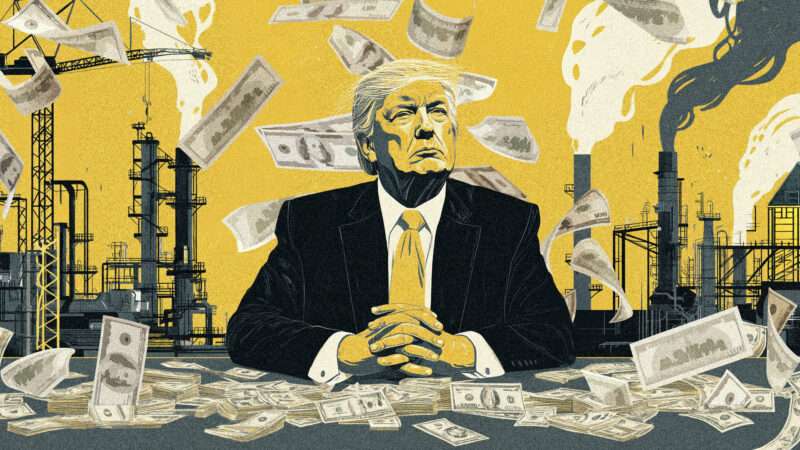
Since reentering office, President Donald Trump has taken equity shares in multiple private companies on behalf of the U.S. government. For example, after then-President Joe Biden awarded an $8.5 billion grant to Intel, Trump demanded a 10 percent stake in the company—all this, even though such an act has no basis in law.
A new GOP bill would not only codify the practice but expand it.
Rep. Warren Davidson (R–Ohio) has introduced the DPA Modernization Act of 2026, which would reauthorize the Defense Production Act (DPA).
Passed in 1950 at the outset of the Korean War, the DPA gives the president considerable power over the economy. While some provisions have expired over the years, the law still allows the president to compel private companies to prioritize the manufacture of certain goods if it is determined to be key to national security priorities.
The Defense Production Act Committee—made up of the heads of federal agencies—coordinates DPA actions with money from the Defense Production Act Fund. Davidson's bill would raise the DPA Fund's maximum budget from $750 million to $2 billion, and it would allow any member of the DPA Committee to make equity investments in private companies with it, so long as the secretary of the treasury—acting as the "Fund manager"—says the company "is unable to obtain additional equity investment from private sources on commercially reasonable terms."
The bill caps total government ownership of any company at 15 percent and requires the committee to "sell and liquidate any equity support for an entity provided under this section as soon as commercially feasible…taking into consideration the national security interests of the United States."
None of these are meaningful limitations: With only Treasury Secretary Scott Bessent's permission, the government can use taxpayer funds to purchase equity in companies. While it's likely intended as a restraint, 15 percent of a multi-billion-dollar company is still a sizable piece—when Trump demanded a 10 percent stake of Intel, it would've made the U.S. government its largest shareholder. A 15 percent shareholder can wield significant power over a company's decision making, even when they don't also control the world's largest army.
And although the bill would require the DPA Committee to "liquidate" its holdings, the added provision to do so only after "taking into consideration…national security interests" means it can hold the shares indefinitely. As Tufts University professor Daniel W. Drezner wrote in 2024 at Foreign Policy, eventually, "everything became national security and national security became everything," and the same officials who would be subject to the law are also the ones who can decide what does and does not constitute "national security."
Currently, there exists no clear legal basis for what Trump is doing, past his own ability to bully companies into cooperating. Davidson's bill would not only codify Trump's actions into law, but it would also set up a framework for both this administration and any in the future to do it too.
Some in the administration defend the proposal by saying that as long as taxpayers are making investments into private companies, we should reap the rewards. "Hey, we want equity for the money. If we're going to give you the money, we want a piece of the action," Commerce Secretary Howard Lutnick told CNBC in August, characterizing Trump's rationale for demanding a 10 percent stake in Intel.
But there are several problems with that way of thinking. First of all, it assumes the government has a role in funding private companies, which undermines the free market principles that have turned the U.S. economy into the envy of the world (and for that matter doesn't appear to work).
If the goal is to let American taxpayers reap the benefits of an equity stake, that can only happen if the investment pays off. But ahead of the Intel announcement, the company had struggled for years, registering as the worst-performing tech stock in 2024. Turning a grant into an equity stake ties the taxpayer to the company's financial future, raising the possibility of a need for future investment.
"You don't want the executive branch treating government programs as if they're running a mutual fund," Cato Institute policy analyst Tad DeHaven tells Reason. "The private sector is more than capable of making such investments. That's not the role of the state."
The post Trump Keeps Taking Equity Shares of Private Companies. A New GOP Bill Would Codify the Practice. appeared first on Reason.com.




 Bengali (Bangladesh) ·
  English (United States) ·