

Space rovers are often big machines. The Perseverance and Curiosity rovers driving around Mars are the size of small cars. VIPER, a rover NASA will send to the moon next year, is the size of a golf cart. But a toy-sized Japanese vehicle now shows that mini robots may have a big role to play in the future of space exploration.
The new lunar rover is called SORA-Q. It takes its name from the Japanese words for “space” and “sphere.” About the starting size and shape of a baseball, it weighs as much as a cup of water. But once on the lunar surface, it morphed into a robot that steered itself around, gathering data.
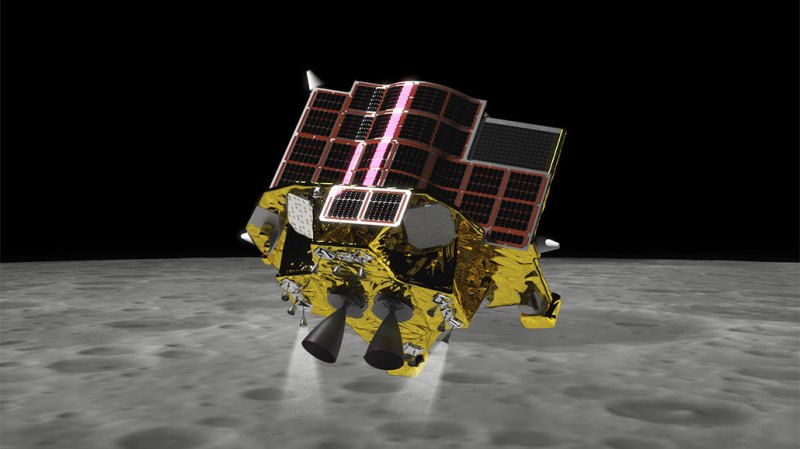 Here’s an artist’s representation of the SLIM lander (spacecraft) approaching the lunar surface. It carried the SORA-Q rover into space.©Japan Aerospace Exploration Agency
The tiny transformer rode to the moon aboard a space probe named SLIM (for Smart Lander for Investigating Moon) in 2024. The goal of the SLIM mission was to test new tech for precise, soft moon landings. SORA-Q’s job: Capture pics of how and where SLIM landed. That way, researchers could see how their new tech performed.
After touchdown, SORA-Q crawled around the landing site for more than 90 minutes, taking pics. Its results show that small, independent rovers can enhance missions, say SORA-Q’s creators. They described what the tiny rover achieved in the June 10 Science Robotics.
Do you have a science question? We can help!
Submit your question here, and we might answer it an upcoming issue of Science News Explores
A toy-like design
The moon and rocky planets have cratered, uneven surfaces. A thick layer of regolith — weathered rock particles and dust — covers the ground. Large rovers with big wheels can carry more gear and cover this terrain more easily than small rovers.
But big rovers are expensive to develop and launch into space, notes engineer Daichi Hirano. He works for JAXA, the Japan Aerospace Exploration Agency, in Sagamihara.
Small rovers cost less to build and are easier to launch. They might also be able to reach cramped spaces where big rovers can’t fit, such as caves and narrow craters. That makes them good options for “higher-risk and more challenging exploration,” says Hirano, who helped design SORA-Q.
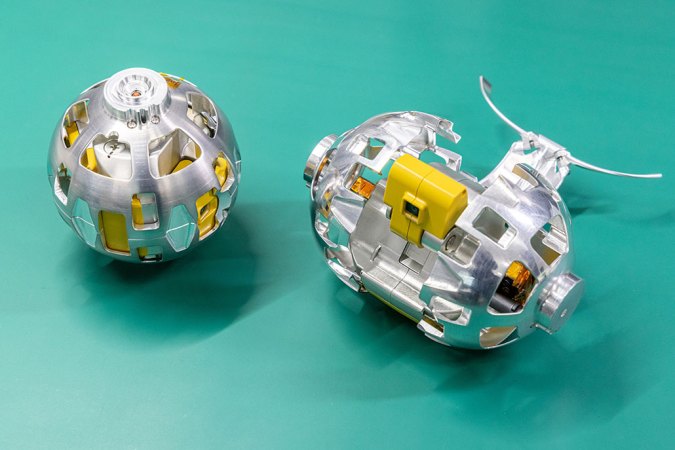 In its compact form, SORA-Q has the basic shape of a baseball or maybe a Christmas ornament (left). But once it opens up (right), its two cameras — at center, in yellow — pop up and are ready to take pictures. One camera faces forward; the other faces backward.©JAXA/TOMY/Sony Group Corporation/Doshisha University
In its ball form, SORA-Q could fit in your palm. To transform, a rod inside the sphere rotates. When “keys” inside line up with special cutouts, the rover unlocks and begins to morph. Each half of the ball’s outer shell becomes a wheel. Then, a flat head pops out with a camera on both sides. It also shoots out a tail for stability.
If SORA-Q sounds like a toy, that’s because it was inspired by them.
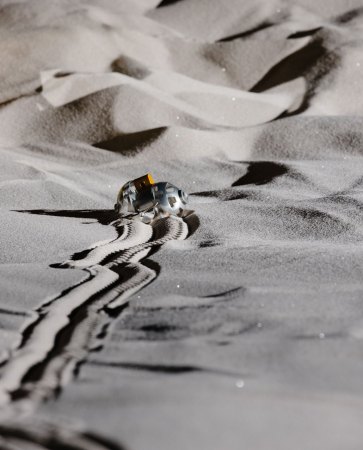 SORA-Q travels by sort of swimming through regolith. ©JAXA/TOMY/Sony Group Corporation/Doshisha University
Transformers are popular figures that can turn from cars and trucks into robots. They need to be tough and reliable for kids, so toy engineers use as few moving parts as possible. Space rovers have similar needs, Hirano says. So his team worked with toy engineers at the company that owns the Transformers franchise in Japan: TOMY Company, Ltd.
One big challenge for small rovers is mobility, Hirano says. Smaller wheels get stuck more easily in powdery regolith. To gain traction, his team offset the rotation of the robot’s wheels. That way, they sweep up and down in circles as they spin. If one wheel sweeps up while the other moves down, SORA-Q crawls. If both wheels sweep up and down in sync, the rover moves like a swimmer doing the butterfly stroke.
“Many people say that it looks more like a small animal exploring the lunar surface than a machine,” Hirano says. But this helps it hurdle obstacles.
Another challenge was programming the robot to act on its own. SORA-Q had to see where it was, decide what to do next, get to where it wanted and then take and process images by itself. Making all of this happen — with the tiny amount of computing power the rover could carry — took some trial and error. But since the rover was small and cheap, the team could easily test and revise the robot’s internal software.
After landing, SORA-Q unlocks itself. Its wheels open up and a head and tail pop out (as illustrated in this movie). The wheels rotate off axis to better traverse the lunar surface. In one mode, the rover moves kind of like a swimmer using a butterfly stroke. In another mode, the rover seems to crawl.D. HiranoNavigating the moon
JAXA’s SLIM probe reached the moon on January 19, 2024. Seconds before the probe touched down, it dropped SORA-Q.
The rover had been locked in a ball shape for the trip. But upon landing, it cracked open and began to transform. Pieces whirred, spun and sprang to life.
First, the rover had to get its bearings. To do this, SORA-Q snapped a photo of its surroundings. Using real-time image processing, it found SLIM. Informed by the probe’s size and position in the image, the rover moved to where it could see the spacecraft better. Then, it took another photo. SORA-Q repeated these steps until it was about 5 meters (16 feet) from the probe. Then it moved around SLIM, taking more pics.
Along the way, SORA-Q sent its best photos to another lunar rover. That rover relayed them to Earth. “Receiving the first image from the moon was one of the most memorable moments of my career,” Hirano says. “A rover does not have to be large or complex to provide valuable mission capabilities.”
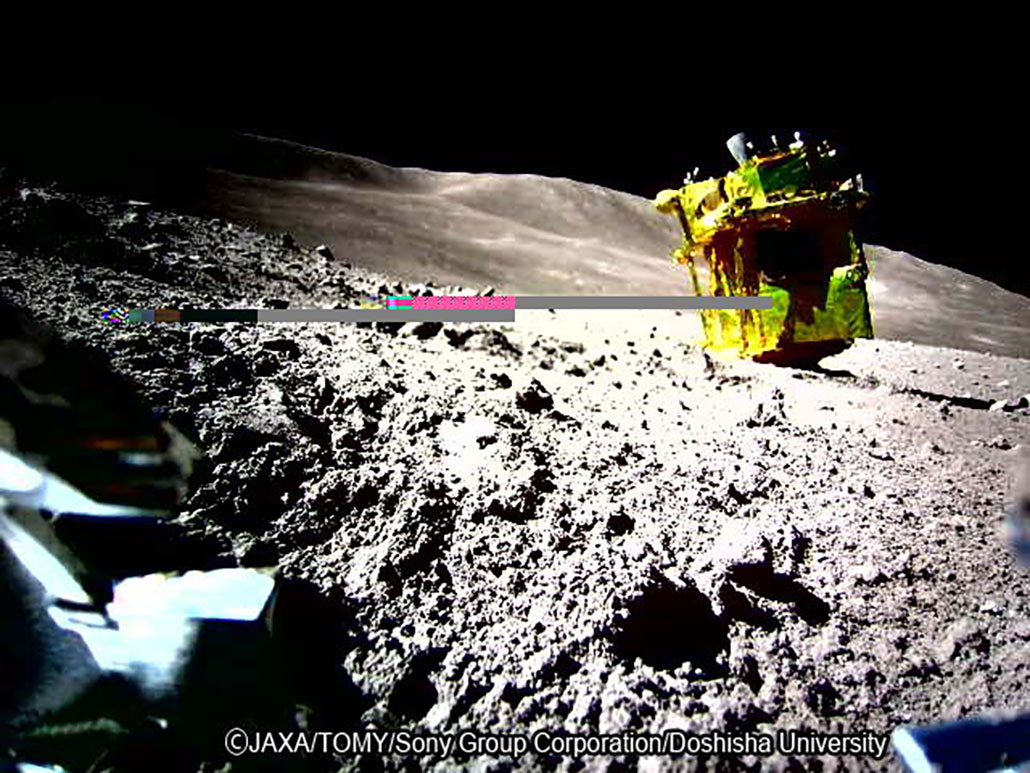 An image of the SLIM lander on the lunar surface. SORA-Q, which took this photo, then relayed it back to Earth. The colored and gray bars indicate where data were lost during that transmission.©JAXA/TOMY/Sony Group Corporation/Doshisha University
SORA-Q shows that putting a lot of effort into designing robotic systems can pay off, says Keenan Albee. He’s a roboticist at the University of Southern California in Los Angeles. He didn’t work on this rover. But he does help design robots for extreme places, such as the moon.
“The most impressive part to me was the packaging,” Albee says. “They only had a little bit of space to work with, a little bit of weight allowance and only a select few sensors.” Packaging everything into a ball, he says, made the most of what they had.
Only a few missions have ever been to the moon or Mars. But there are many more coming, Albee points out. “Any data we get from those robotic explorers is very precious and helps us build better systems in the future.”




 Bengali (Bangladesh) ·
 English (United States) ·