
 6 hours ago
4
6 hours ago
4 
Women’s basketball is on fire, but the real test is whether that heat can travel beyond familiar borders. With the WNBA’s biggest stars now stepping onto the FIBA World Cup stage, Berlin offers a chance to turn growing attention into a truly global basketball business, but the real question is how?
For the record, the event dates back to 1953, when the first edition was held in Chile. In its 20th edition, games are taking place at the 14,000-seat Berlin Arena and the 9,000-capacity Max-Schmeling-Halle. The tournament has expanded to 16 teams after the success of the 2022 edition and the growing popularity of women’s basketball. But the WNBA star power is what is generating more buzz.
Caitlin Clark and Paige Bueckers are named to the 12-player roster for the FIBA Women’s Basketball World Cup 2026. The buzz around Clark and Bueckers was not limited to the court. FIBA called them two of the biggest stars in the world, and together they had 7 million Instagram followers. Belgium’s Emma Meesseman, the 2025 Continental MVP lead the list of A-listers, with Japan’s Kokora Tanaka and France’s Dominique Malonga being the rising talents to watch.That combination could help FIBA cast a wider net and attract people who may not usually follow international women’s basketball. But the million-dollar question: will those fans follow them from the WNBA to international basketball? The initial numbers show promising signs.
The dazzling numbers & loud fans: FIBA is booming
The Germany-Spain matchup was sold out, with 12,550 fans in attendance. What’s interesting is that Germany lost 84-53, but even after that, fans showed up when Germany faced Japan.
Even at the smaller Max-Schmeling-Halle, 8,367 fans filled the venue. Then Germany also drew a big crowd in the quarterfinals, with 10,537 fans watching the hosts beat Belgium 93-74 at Berlin Arena. All because of the star power of Leonie Fiebich, Nyara Sabally, and Frieda Buhner and others.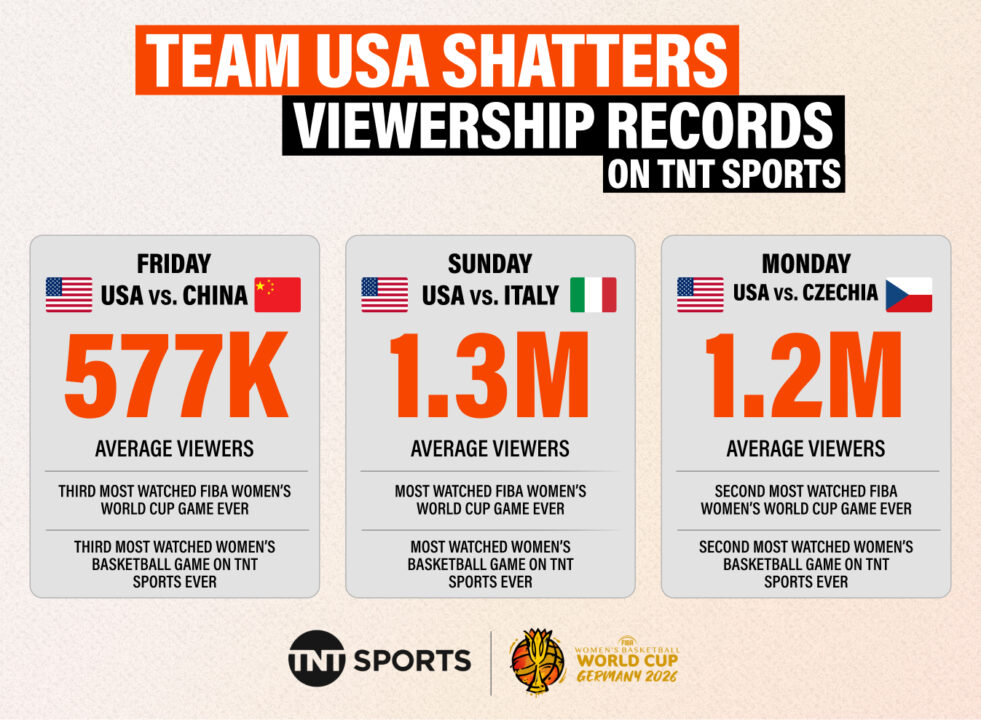
Riding on the same confidence, FIBA is expecting more than 200,000 fans to attend the 2026 Women’s Basketball World Cup Final at Berlin Arena. FIBA now has to see whether all the attention around the Women’s World Cup can turn into long-term business value.
The 2022 World Cup set a benchmark
The 2022 FIBA Women’s Basketball World Cup in Sydney was a huge success in terms of grabbing fans’ attention and numbers.
The official website attracted 1.5 million visitors. Social media generated 1.1 billion impressions and 14 million engagements. Highlight reels also garnered 500 million views.The numbers kept piling up on the broadcast side:
U.S. viewership tripled, while China recorded more than 750 million viewers across CCTV and Tencent. The China-USA final alone attracted more than 18 million viewers on CCTV-5, along with another 23 million video views on Tencent. 145,000 spectators attended the tournament, making it the most-attended Women’s World Cup at that time.That puts Berlin 2026 in a tough spot because Sydney has set the bar high. But FIBA has more arsenal with it this time.
Star power is the key
FIBA’s website traffic shows which players are getting the most attention from fans during the 2026 Women’s Basketball World Cup. Here are the top 10 most-visited player pages:
| 1 | Zhang Ziyu | China |
| 2 | Han Xu | China |
| 3 | Caitlin Clark | USA |
| 4 | Paige Bueckers | USA |
| 5 | Angel Reese | USA |
| 6 | Breanna Stewart | USA |
| 7 | Cecilia Zandalasini | Italy |
| 8 | Emma Meesseeman | Belgium |
| 9 | Sonia Citron | USA |
| 10 | Sika Kone | Mali |
Clark’s presence gives the tournament a new kind of commercial pull. She has already built a huge audience through college basketball and the WNBA, and now she is bringing the same for Team USA on the international stage. Her records prove it.
In 2024, the Indiana Fever drew a franchise-record 340,715 home fans during her rookie season. The same year, 19 of the 22 WNBA games featuring Clark reached at least 1 million viewers.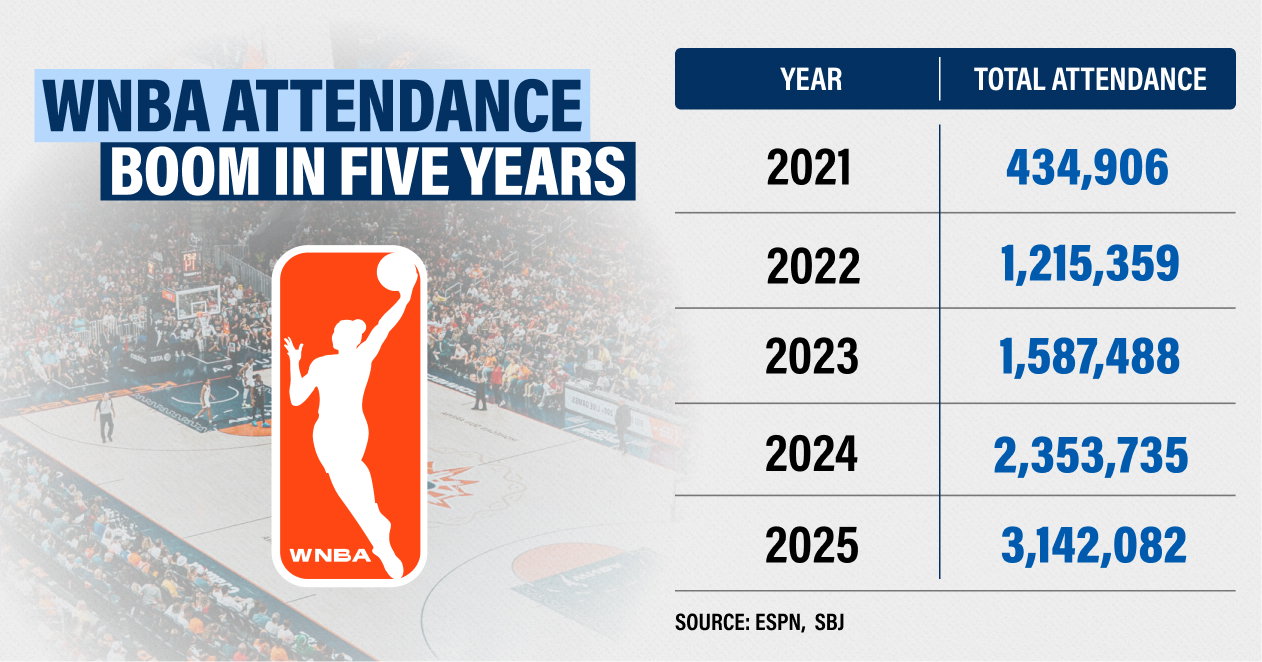
Then there’s Zhang Ziyu, who caught eyes during the World Cup. In China’s opening game against the U.S., she scored 13 points, made 9 of 10 free throws, and blocked two shots. That performance, which came with a huge height difference between her and the American players, became a viral talking point on social media, and it’s part of a bigger story as well.
According to Nielsen, women’s sports generated 28.6 billion minutes of viewing in the first half of 2026, up 18% from the same period in 2025. And the WNBA is a big part of that growth, with 3.8 billion minutes viewed through the 2026 All-Star break. That momentum can be easily carried over to the international stage through Courtside 1891, FIBA’s own streaming service, where fans can watch FIBA basketball.Its move to DAZN gives FIBA a chance to gain new long-term fans. Someone may watch the tournament because of Caitlin Clark or another star, but FIBA’s bigger goal is to keep that person interested in more FIBA games after the World Cup, such as World Cup qualifiers, Continental Cups, or other national-team events.
Then, when the Olympics arrive, the same fan already knows and follows those players. Later, they may watch those players in their domestic leagues or the WNBA. The idea is to keep the fan moving from one competition to the next instead of losing them after the World Cup.
Along with this, other things also help them generate revenue. Fans buy tickets, watch games, subscribe to streams, buy merchandise, follow players online, and attract sponsors and advertisers. So, it will be interesting to see how well FIBA continues to do it.
The post The FIBA World Cup Is Becoming Women’s Basketball’s Global Growth Test appeared first on EssentiallySports.





 Bengali (Bangladesh) ·
  English (United States) ·