

Happy Tuesday, and welcome to another edition of Rent Free. This week's newsletter includes stories on:
The Montana Supreme Court's decision to reject a challenge to a slew of pro-growth state zoning reforms. A new lawsuit arguing that state laws requiring landlords to accept federal housing vouchers violate the Fourth Amendment. A broadly disappointing growth plan for D.C.But first! A few reflections on the failure of the Washington, D.C., streetcar, which will cease operations by the end of the month.
The D.C. Streetcar's Other Failures
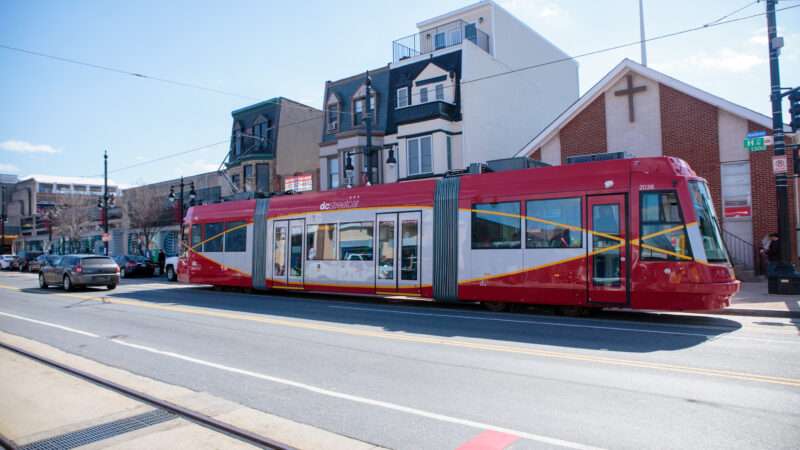
The D.C. Streetcar is set to shutter operations later this month after an ignominious decade of crawling up and down the city's H Street Corridor.
Few are shedding any tears for its end.
As the obituaries note, the streetcar effectively offered the same service as the bus lines that already covered H Street, save for the fact that it was slower, didn't directly connect to any Metro stations, and would occasionally get stuck behind cars parked partially in the right-of-way.
As someone whose decade of living in D.C. has run concurrently with the streetcar's life, I can say that I can only remember riding it one time. The last time I considered using it to travel from one end of H Street to the other—the only trip the streetcar can perform—it was faster to just walk.
Given that even the most rosy-eyed transit enthusiasts have become D.C. Streetcar critics, bemoaning its failures as a mode of transportation feels a bit like beating a dead horse, with the only real difference being that the dead horse will probably get you to your destination faster.
That's in no small part because the streetcar was not built to be a good piece of transportation infrastructure. Instead, its funding from the Obama administration as part of its post-recession "streetcar revival" was predicated on its utility as a driver of local economic development and domestic manufacturing. Moving people from A to B was a secondary goal at best.
As it happens, the D.C. Streetcar failed at those wider goals as well.
The Portland, Oregon, factory that built streetcars for D.C., Tucson, and Portland, and which was supposed to be the linchpin of the streetcar revival, closed over a decade ago. Meanwhile, H Street today is in economic decline. Local business owners blame higher crime and, ironically, the damage streetcar construction did to small businesses.
As it closes for good, however, the D.C. Streetcar does have one final lesson to teach.
Increasingly, urban politics is turning away from reflexive NIMBYism. More and more, politicians are winning elections with promises to get cities building again.
That's a welcome attitude generally. But there are risks embedded within this vibe change as well.
It's true that infrastructure dollars often are wasted on endless processes, consultation, and review that end up building nothing—California's high-speed rail being the canonical example.
The D.C. Streetcar is a good example of how, even when something is built, it can still be a wasteful disappointment.
The planners can get things wrong even when they're not stopped by litigious NIMBYs gumming up project completions. Pro-growth politicians can easily become seduced by big, expensive megaprojects that they can cut a ribbon for while promising all good things.
Usually, those good things don't materialize.
The 'Montana Miracle' Safe at Last
Last week, the Montana Supreme Court rejected a challenge brought by slow-growth activists to a slew of state-level zoning reforms passed in 2023 that allowed duplexes and accessory apartments in single-family neighborhoods and limited public hearings for individual housing projects.
The plaintiffs, organized under the group Montanans Against Irresponsible Densification (MAID), had argued that the zoning reforms violated the Montana Constitution's guarantees of equal protection and public participation in government.
The Montana Supreme Court rejected these arguments in a decision that upholds all of the challenged reforms.
"The Legislature's statewide zoning reforms didn't take away anyone's rights—they restored the freedom to build homes on your own land. Today, the Montana Supreme Court agreed," said Kendall Cotton, president of the Frontier Institute, which advocated for the reforms in the Legislature.
In 2023, the Montana Legislature passed a package of housing laws dubbed the "Montana Miracle" with the intention of increasing housing production and reducing housing costs in the state.
Included in the package was a bill that required all municipalities to permit accessory dwelling units (ADUs) on single-family properties. Another bill required municipalities of 5,000 or more people to permit duplexes anywhere single-family homes are allowed.
A separate planning law required municipalities to update their comprehensive plans and zoning codes with pro-growth policies and limited public input on individual housing projects that conformed with those plans.
Shortly after the passage of these laws, MAID sued to block their implementation. The group argued that the new planning law's limitations on project-specific public hearings violated the state constitution's guarantees of public participation in government decision-making.
Their lawsuit also claims the state's zoning reforms violate state equal protection guarantees by only imposing the planning and duplex reforms on larger communities.
Most eyebrow-raising of all, the plaintiffs said that the duplex and ADU reforms unfairly burdened property owners who lived in single-family neighborhoods not covered by restrictive covenants that forbid those types of housing.
A district court initially agreed with that latter argument. In December 2023, it issued a preliminary injunction against the duplex and ADU laws.
The Montana Supreme Court lifted that injunction a year later. Subsequent lower court decisions on the merits of the case upheld the duplex and ADU laws but struck down the planning law's limits on public hearings.
The unanimous Montana Supreme Court decision written by Justice Beth Baker upheld all the state's zoning reforms.
Because citizens are given ample opportunity to provide public input on the drafting of zoning codes and comprehensive plans under the state's new planning law, wrote Baker, the law's limitations on public input on individual projects that conformed with those plans did not violate the constitution's public participation guarantees.
Likewise, Baker reasoned that the Legislature's decision to only apply its zoning reforms to larger municipalities that faced more intense growth pressures was reasonable enough not to violate equal protection guarantees.
Baker also dismissed the claims that the state's zoning reforms created any sort of equal protection problem by preempting zoning restrictions on ADUs and duplexes while leaving private covenant restrictions on that housing in place.
"Parties subject to a private restrictive covenant have entered a contract to receive a benefit in exchange for a countervailing burden. The benefit is not the consequence of the unequal protections of the law; it is instead the result of a private contract," wrote Baker. "Put simply, homeowners without such covenants are not treated differently because of the statute."
The ruling protects an initial wave of zoning reforms that the Montana Legislature has already built upon. In 2025, lawmakers passed another series of laws liberalizing parking requirements and height limits on apartment buildings.
Virginia Landlord Says State Law Requiring Her To Accept Federal Housing Vouchers Violates Fourth Amendment
Do state laws requiring landlords to accept federal housing vouchers violate the Fourth Amendment? A recent lawsuit from a Virginia property manager argues that yes, yes they do.
In summer 2025, June Wheatley declined to rent a unit at her nine-unit complex in Arlington, Virginia, to a person who claimed to be a prospective tenant with a federally funded Section 8 housing voucher.
As it turns out, the man was not a prospective tenant but rather a "tester" from a fair housing group conducting a sting operation to enforce Virginia's requirement that landlords accept Section 8 vouchers.
In response to an administrative complaint filed by the fair housing organization against her, Wheatley sued Virginia and its fair housing enforcement officials in federal court, arguing that the requirement she accept federal housing vouchers is unconstitutional.
Adam Schulman, an attorney at the Hamilton Lincoln Law Institute who is representing Wheatley, says Virginia's voucher mandate presents two constitutional problems.
The federal government has no requirement that landlords accept Section 8 vouchers, he says. States imposing their own requirement on federal housing vouchers, therefore, violates the U.S. Constitution's Supremacy Clause.
Moreover, because the federal program requires landlords to agree to inspections of units that would be rented with Section 8 vouchers, compelling landlords to participate in the program forces them to submit to warrantless government searches.
That, argues Schulman, violates the Fourth Amendment's protections against warrantless searches.
Wheatley filed her lawsuit in January. Earlier this month, she filed a motion for a preliminary injunction.
A decision in her case could have a wide-ranging effect.
State mandates that landlords accept federal housing vouchers are increasingly widespread.
According to the Poverty & Race Research Action Council's tracker, 19 states, as well as D.C. and Guam, have laws requiring landlords to accept federal housing vouchers, as do some 150 local governments. Another four states have weaker laws prohibiting source-of-payment discrimination in some cases, without requiring all landlords to accept federal housing vouchers.
Only five states had these laws in 1989.
On the flip side, seven states, including Florida and Texas, prohibit localities from forcing landlords to accept housing vouchers.
Advocates argue that mandating landlords accept housing vouchers is necessary to overcome landlords' "social bias" against government aid recipients. Allowing landlords to refuse vouchers also undermines the reach of housing vouchers.
But landlords often say that the administrative burden of participation in the Section 8 program makes it perfectly rational for them to decline to accept them.
Wheatley says in her complaint that she has accepted third-party payments from tenants before, but does not accept federal vouchers because of the burdensome and invasive nature of the program's requirements, which include mandatory inspections of the property and property owners' records.
Some businesses do have to submit to warrantless inspections as a matter of course, and a string of U.S. Supreme Court decisions has blessed this practice while placing limits on it.
Generally, only "closely regulated" businesses can be inspected without warrants. In 2015, the U.S. Supreme Court declined to classify hotels as "closely regulated" businesses that can be inspected without a warrant.
Schulman argues that if hotels don't count as "closely regulated," then longer-term rental housing can't either.
Courts have dealt with challenges to these laws before, although most cases appear to focus on whether the language of the state statute in question covered federal housing vouchers.
In a 2007 decision, Maryland's highest court determined that localities did not violate the Supremacy Clause by requiring landlords to accept federal vouchers, reasoning that a Supremacy Clause challenge could only prevail if the Section 8 legislation's central purpose was "its voluntary nature and not the goal of expanding affordable housing."
D.C. 'Future' Land Use Map Looks a Lot Like Past Land Use Map
Washington, D.C., is in the process of rewriting its comprehensive plan that is supposed to guide the city's growth and land use decisions through 2050.
As part of that process, the city's Office of Planning has released a draft Future Land Use Map (FLUM) detailing where additional development is envisioned. The answer, it turns out, is not a lot of places.
The proposed FLUM calls for increased density in only a handful of places, mostly along existing commercial corridors. The document does not propose any broad increase in allowable densities or "legalizing" row homes across the city.
Encouragingly for people who think D.C. should continue to build its way to affordability, the backlash to a "devastatingly unambitious" FLUM has been widespread.
Both leading mayoral candidates, including the left-wing Janeese Lewis George and the more moderate Kenyan McDuffie, have criticized the proposed map for being too modest.
My Full statement on the Office of Planning's draft Future Land Use Map.
Rent in DC is still too expensive. Owning a home is still out of reach for too many of our residents. Making it easier to build more housing is essential to solving those problems. Unfortunately, the draft… pic.twitter.com/fFHKtrNyP5
— Kenyan McDuffie (@kenyanmcduffie) March 21, 2026
DC's housing shortage is driving our affordability crisis — and we need to act like it.
We cannot address the crisis while banning rowhomes and apartments across much of DC and codifying exclusion.
There are too many missed opportunities here for a plan meant to get us to 2050. pic.twitter.com/UGw20xnmHF
— Janeese Lewis George (@Janeese4DC) March 21, 2026
The local D.C. YIMBY chapter held a rally this past weekend at the Office of Planning, which reportedly attracted some 50 to 75 people, which isn't too shabby for a rally about comprehensive plan updates.
The city will receive public comments on the draft FLUM through the end of April. It plans on submitting a complete draft comprehensive plan to the City Council by June 2027.
Quick Links
Pew has a new study highlighting how Austin, Texas, has seen rents fall in the midst of steady job and population growth. The trick? Enabling a lot more housing construction. Curbed has a profile on Kenny Burgos, the former New York assemblymember who is fighting New York City Mayor Zohran Mamdani's rent freeze as head of the New York Apartment Association. In a new letter, Rep. Maxine Waters (D–Calif.), ranking member of the House's Financial Services Committee, which has jurisdiction over housing policy, raises concerns that a Senate-passed housing bill that includes an effective ban on build-to-rent housing might undermine housing construction. A Florida bill that would have streamlined approvals for massive "new urbanist" developments died in the Legislature. The Virginia Assembly has passed a bill enabling faith organizations to build affordable apartments on their land.The post The D.C. Streetcar's Other Failures appeared first on Reason.com.




 Bengali (Bangladesh) ·
  English (United States) ·