

Harmful algal blooms plague waterways worldwide. Many are due to overgrowth of toxin-producing cyanobacteria. Their toxins can sicken both people and animals. But chemicals currently used to fight algal blooms, such as copper sulfate, can damage the environment. Natalie Muro, 18, now offers a more sustainable solution.
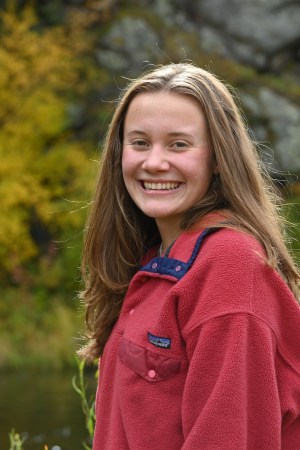 Natalie Muro built a device that gradually releases hydrogen peroxide into a lake to kill harmful bacteria there. Society for Science
Through internet research, Natalie found that hydrogen peroxide (H2O2) would kill cyanobacteria. What’s more, this chemical does not release any dangerous byproducts. It breaks down to form just water and oxygen. So Natalie built a device that slowly releases H2O2 into water to kill algal blooms. She stored the chemical within a pipe attached to a buoy. Her algae-killing gizmo also contains a porous charcoal-like material called biochar. It collects dead microbes. That way, other bacteria can’t dine on their dead brethren for nutrients.
Natalie tested her device in a lake near her home in Colorado Springs, Colo. The lake had been suffering a harmful algal bloom. But after exposure to Natalie’s device, water samples showed the lake had fewer cyanobacteria. These samples also confirmed that other microbes were not harmed by the treatment.
Natalie is currently a senior at William J. Palmer High School. Her research earned her a finalist spot at the 2026 Regeneron Science Talent Search. (That competition is run by Society for Science, which also publishes Science News Explores.) In this interview, Natalie shares her research experiences and advice.
What inspired your project?
Natalie’s teacher told her to research something she loves. She immediately thought of her favorite Netflix series: Outer Banks. The Atlantic coast–based show inspired her past projects on ocean science. This time, Natalie used her passion for water research to help her home state. “I began to research one of the big issues we have, which is harmful algal blooms,” she says.
What was your favorite part of this project?
“I really loved that I got to be able to test [my device] in a reservoir near my house,” Natalie says. “That had been a goal of mine — to actually be able to take my research from the lab into the field. I loved spending the time outside. I loved being able to go to the lake and actually see my device working.”
What were your most important resources?
“The people,” Natalie says. “I have cold-emailed so many professors … to ask if they would meet with me on Zoom so I could bounce some ideas off of them.” Her mom was also a huge help, Natalie adds. “She was there through the early mornings, the late nights, every success, every failure. And I absolutely could not have done it without her support and her encouragement.”
Any advice for research newbies?
“You never know unless you try,” Natalie says. Dare to start a new project, cold-email a professor or test an out-there idea. “Taking those leaps and having some bravery to approach people will get you the farthest in your research.”




 Bengali (Bangladesh) ·
  English (United States) ·