

What it is: A view of the moon from the Artemis II crew
Where it is: Aristarchus Plateau, on the moon's near side
When it was shared: Oct. 8, 2026
What color is the moon? Ask an Earthling, and you'll get a predictably monochromatic answer: white or gray.
But ask the four crewmembers of NASA's Artemis II mission — who spent nearly seven hours circling the moon from just 4,000 miles (6,400 kilometers) from the lunar surface this April — and you'll wonder if they're talking about the same dusty satellite we can see from Earth.
Yellow, brown, green, blue and tan features fan across vast volcanic plains and lurk at the edges of ominous craters, according to the crew's in-the-moment observations, which were shared this week in NASA's Artemis II Preliminary Lunar Science Report. The 130-page document catalogs everything crewmembers Reid Wiseman, Victor Glover, Christina Koch and Jeremy Hansen saw during their historic close flyby of the moon on April 6, drawing from 814 gigabytes of photo, video and audio recordings taken from the Orion crew capsule.
This rainbow of lunar color represents distinct geological features that could inform future missions on where to land and where to explore as the world's space agencies race to set up a permanent presence on the moon.
One spot that particularly enthralled the astronauts (and is featured in the image above) is the Aristarchus Plateau — a broad, elevated region on the northwestern edge of the moon's nearside. The region hosts one of the moon's densest collections of ancient volcanic features, including swaths of dark lava deposits and colorful volcanic glasses.
Koch, mission specialist for Artemis II, was shocked to see distinct yellow shades in the region; she likened the plateau to "a yellow snow-capped mountain," with sunlight-reflecting craters providing the bright "snow." She went on to call the region "a jaundiced cheek of the Moon."
"There are so many colors now," Glover, Artemis II's pilot, added while photographing the area. "There's also a green. I see brown, especially Aristarchus and north toward the north pole. … It kind of flows down from the north in brown streaks."
According to the report authors, these colorful hues "could be associated with orange (titanium-rich) and green (magnesium-rich) glass beads respectively," similar to volcanic glass beads collected by the Apollo 15 and 17 missions on separate parts of the moon.
"Chaos across the entire area"
Another colorful patch of the lunar surface that caught the crew's attention was Orientale Basin — a huge, young and multiringed impact crater that's about three times as wide as Massachusetts, according to NASA. Straddling the moon's near and far sides, this massive bull's-eye is rarely visible from Earth, but it dominated the crewmembers' field of view as they orbited around the side of the moon.
"It has just created chaos across that entire area," Wiseman, commander for the mission, said at the time.
This photo, taken by the Orion capsule's external cameras, shows the lunar terminator, where the dayside bleeds into the nightside. Orientale Basin is the large bull's-eye-like feature near the bottom right of the moon. (Image credit: NASA)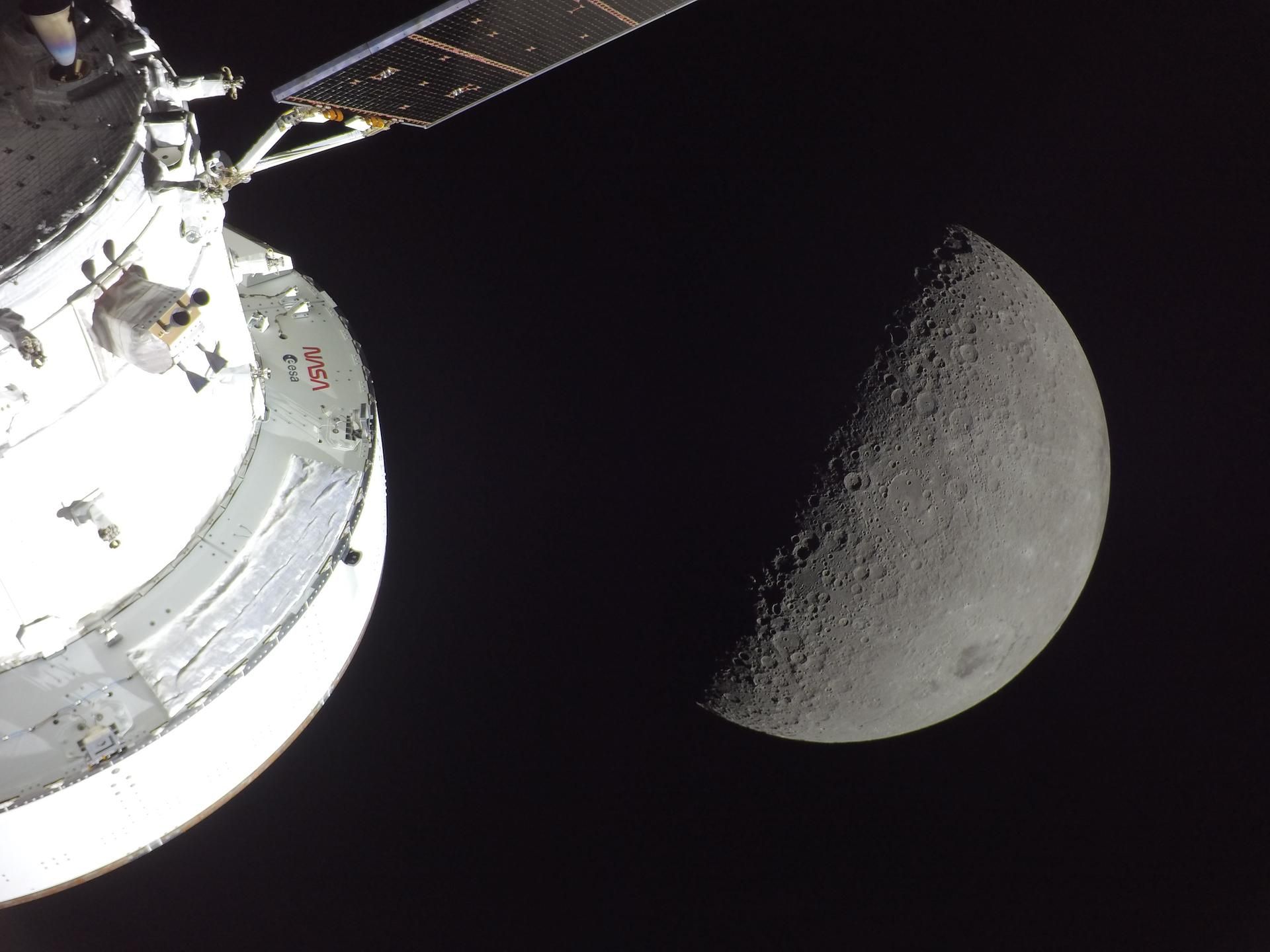
When flying over this sprawling basin, the crew noted gray, brown, tan and green below. The largest, outermost ring in the basin contained "almost swamp-like colors," Koch reported, while Glover spotted what looked like "dusted peaks" and "white on the very edges of [the mountains], the spines, the ridgebacks." Chains of craters parading away from the impact site looked "like bubbles rising from a team of scuba divers below," Koch added.
While these may sound like off-the-cuff observations, the Artemis II crew spent more than two years training to study and describe the moon's geology. Their regimen included visiting craters on Earth, taking lessons individually and in classrooms, conducting simulated flybys and, according to the report, bringing "self-selected reference materials" into the Orion capsule to read on the way to the moon.
Thanks to this training, the crew's observations provided a wealth of scientific information that no autonomous camera or orbiter could, the report said.
"The Artemis II mission demonstrated the exceptional value of human observation and cognition as scientific assets in planetary exploration," the report authors concluded. "Unlike cameras, which capture isolated moments and often narrow subsets of a scene, human observers continuously interpret their surroundings, integrating realtime visual perception with contextual understanding."
Or, to put that in Glover's more relatable words to mission control, "It's quite a wicked view."
How much do you know about the moon? Test your lunar smarts with our moon quiz!




 Bengali (Bangladesh) ·
  English (United States) ·