

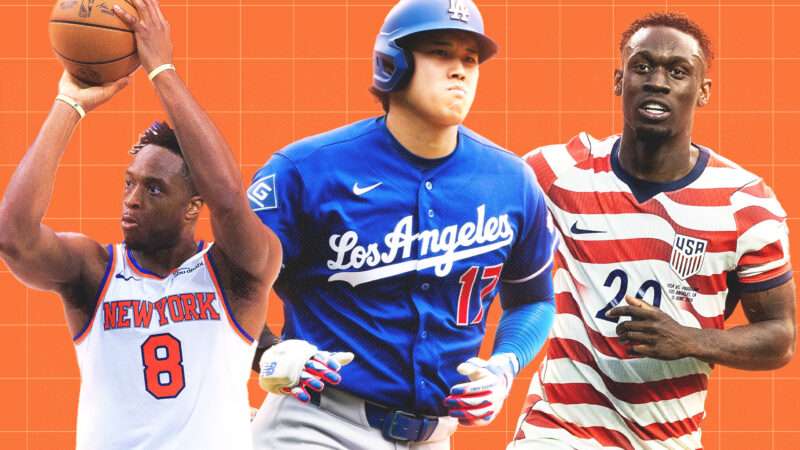
An immigrant saved the now-champion New York Knicks in Game 4 of the NBA Finals and demonstrated why U.S. companies seek the best talent regardless of where someone was born. Every fan expects their team's owner and general manager to draft, sign, or acquire the best talent available. Customers and shareholders also assume a company tries to hire the best people it can find.
Trailing by one point after almost erasing a 29-point deficit in Game 4 of the NBA Finals, Knicks forward OG Anunoby hustled downcourt and blocked a layup by San Antonio Spurs guard De'Aaron Fox. Shortly after, in a now-famous play, Anunoby sprinted to the basket and tipped in a missed shot by teammate Jalen Brunson to secure an improbable comeback victory for the Knicks, paving the way for their first championship in half a century.
A similar story played out in the World Cup last week. The U.S. beat Paraguay 4–1 in their opening match on the strength of two goals by striker Folarin Balogun. Immigration attorney Greg Siskind pointed out that if the U.S. did not have birthright citizenship, Balogun likely would not be playing for the U.S. team in the World Cup. "Balogun was born in Brooklyn, New York to Nigerian parents, but moved to the UK soon after and grew up in London, meaning that he was eligible to play for any of the three nations," according to ESPN. This is nothing new: In the 1950 World Cup, the U.S. team won an improbable victory over England on a goal by Haitian-born forward Joe Gaetjens.
The pool for talented athletes is global. Approximately 25 percent of MLB players are foreign-born, with the Dominican Republic the leading country of origin. In the NBA, 30 percent of players are foreign-born, with Canada and France the leading countries. Foreign-born players have earned the NBA Most Valuable Player award in each of the past eight years, including multiple awards for Giannis Antetokounmpo (Greece), Nikola Jokić (Serbia), and Shai Gilgeous-Alexander (Canada).
Elected officials like to applaud sports teams that employ many foreign-born stars, even as they criticize tech companies and universities for hiring high-skilled foreign nationals. Apple, Google, and other tech firms that hire recent international students on H-1B visas operate in a market environment no less competitive than that of professional sports franchises.
When U.S. companies recruit on college campuses, they find that international students account for 80 percent of full-time graduate students at U.S. universities in computer and information sciences, 75 percent in electrical and computer engineering, 62 percent in mathematics and statistics, and a majority in industrial, civil, and mechanical engineering.
In Texas, Republican Gov. Greg Abbott has prohibited state universities from hiring foreign-born researchers and professors on H-1B visas through May 2027 unless they ask the state government for permission. Attorney General Ken Paxton, the Republican Senate nominee, has claimed the authority to investigate companies using H-1B visas in the state, even though this is considered a federal responsibility. Neither man has complained that Spurs center Victor Wembanyama, born in France, has filled a job that an American might like.
In December, President Donald Trump, a Knicks fan, issued a proclamation banning the entry of nearly all nationals from 39 countries. If the current 39-country ban had been in effect when Anunoby immigrated to the U.S. from the U.K. as a 4-year-old with his father, he could not have done so, since Anunoby's father, a professor, was born in Nigeria, one of the banned countries. (A January U.S. Citizenship and Immigration Services memo defines nationals by place of birth.)
One could argue that a foreign-born professional athlete is more likely to "take" a job than immigrants in other sectors because there is no fixed number of jobs in the U.S. economy, whereas the number of players on a team roster is numerically limited. Despite this, no one hears American athletes complaining that they lost their jobs as power forwards or shortstops because of immigrants. In contrast to limited rosters, the number of U.S.-born workers employed in computer science and mathematical occupations increased by over 2.7 million, or 141 percent, between 2003 and 2024, according to the Bureau of Labor Statistics.
Immigrants create jobs. "Immigrants have founded or cofounded 59% (455 of 775) of America's privately held startup companies valued at $1 billion or more," according to a study by the National Foundation for American Policy, the organization I lead. U.S. unicorn companies with immigrant founders have created an average of 833 jobs each. About 70 percent of the San Francisco Bay Area's unicorn companies have an immigrant founder.
Hiring athletic talent from around the world has enhanced the quality of play and attracted more fans domestically and internationally, boosting team revenues and allowing for higher salaries. "Why is foreign talent so important to the United States?" asked L. Rafael Reif, then-president of the Massachusetts Institute of Technology, in a 2020 New York Times op-ed. "For the same reason the Boston Red Sox don't limit themselves to players born in Boston: The larger the pool you draw from, the larger the supply of exceptional talent."
Los Angeles Dodgers fans learned this lesson during the 2025 World Series. Japanese pitcher Yoshinobu Yamamoto threw 2 2/3 scoreless innings to win Game 7. "That came one day after throwing 96 pitches in the Dodgers' Game 6 win," reported ESPN. "Yamamoto's arms were so tired, he needed help lifting the World Series MVP trophy."
Japan's Shohei Ohtani, likely the world's best-known baseball player, set a record during a playoff game against the Milwaukee Brewers last year by hitting three home runs and striking out 10 batters. Infielder Miguel Rojas, born in Venezuela, saved the Dodgers with a game-tying home run in the ninth inning of Game 7 of the World Series.
More open immigration policies will produce companies better able to compete in global markets, benefiting U.S. consumers, employees, and investors, and expanding opportunities for American students and workers inside the United States. Foreign-born professional athletes are no different than other highly skilled immigrants. We just get to cheer for them on TV and in sold-out stadiums. No sports fan complains that their championship-winning team employs too many immigrants.
The post Sports Fans Don't Complain Their Championship-Winning Team Employs Too Many Immigrants appeared first on Reason.com.




 Bengali (Bangladesh) ·
  English (United States) ·