
 5 hours ago
11
5 hours ago
11 
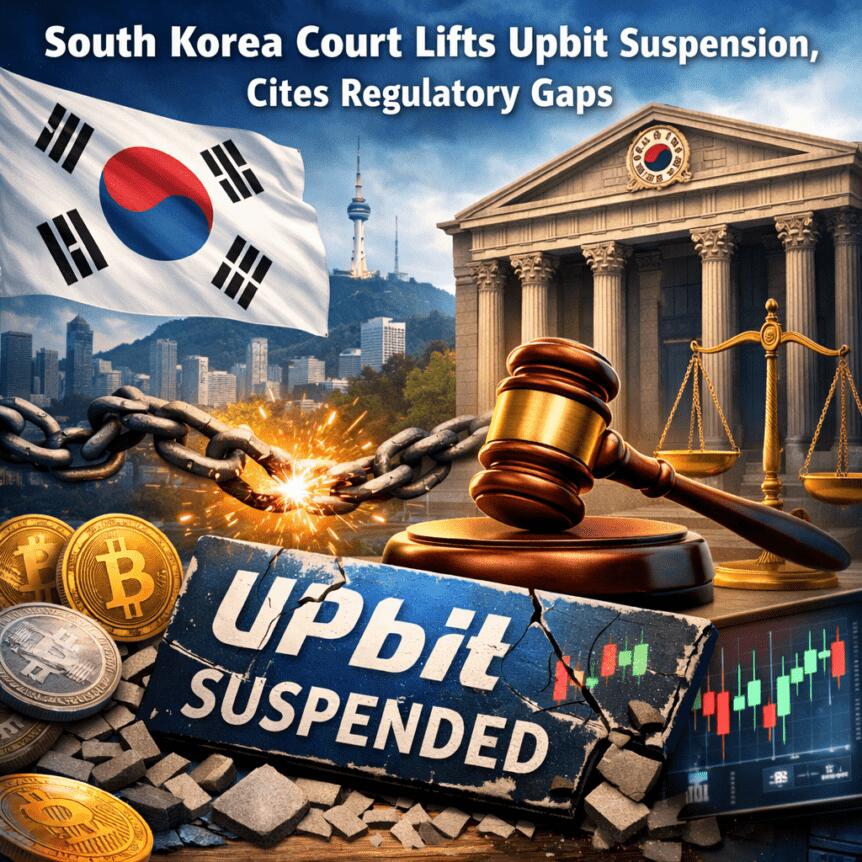
A Seoul Administrative Court has overturned the Financial Intelligence Unit’s three-month partial suspension of Dunamu, the operator of Upbit, in a ruling that reframes how AML rules are applied to crypto exchanges in Korea. The decision, reported by Yonhap News Agency, sides with Dunamu’s challenge to the regulator’s February 2025 sanction, which had blocked new Upbit user transfers for a period of three months.
The court’s reasoning centers on regulatory clarity. It noted that explicit guidelines exist for transfers above 1 million won (roughly $675), but regulations governing smaller transfers were not sufficiently specific to underpin the enforcement action. In essence, the ruling challenges the FIU’s ability to impose major AML sanctions when the underlying compliance standards aren’t clearly spelled out in practice.
Key takeaways
The Seoul Administrative Court overturned the FIU’s three-month partial suspension on Dunamu, affirming Dunamu’s challenge to the regulator’s AML sanction. The court found that while large transfers have clear regulatory expectations, smaller transfers lacked precise guidance, weakening the basis for the enforcement action. The ruling narrows the FIU’s leverage to sanction crypto exchanges when the applicable AML standards are not explicitly defined, potentially affecting how similar cases are pursued in the future. Dunamu had argued that it had already taken proactive steps to address AML concerns, and the court accepted that there was no clear evidence of intent or gross negligence on the part of Upbit’s operator. The decision follows a sustained dispute that began after the FIU’s sanction and a court-granted injunction in March 2025 allowing Upbit to continue onboarding while the case was reviewed.What the ruling changes about AML enforcement for exchanges
At the heart of the case is a tension between regulatory expectations and the practical, day-to-day controls required of digital-asset platforms. The FIU had argued that Dunamu facilitated transactions with unregistered overseas virtual asset service providers (VASPs) and failed to meet customer due diligence standards. It also cited a broader review that flagged hundreds of thousands of suspected KYC violations during Upbit’s license assessment. In response, Dunamu pursued legal relief, arguing that the sanctions lacked a precise, enforceable standard for the actions expected from exchanges.
The court’s decision emphasizes that enforcement actions must be grounded in clearly articulated requirements. When the rulebook is not explicit for certain transaction sizes, penalizing operators on those grounds becomes problematic. The ruling thus narrows the FIU’s capacity to wield large-scale AML penalties in cases where the applicable guidance isn’t demonstrably specific, potentially prompting regulators to refine or clarify AML expectations for smaller transfers going forward.
Regulatory and market implications for Korea’s crypto sector
The judgment arrives at a moment when Korea’s crypto industry has been navigating a tightening but opaque regulatory environment. While the FIU has shown a willingness to sanction exchanges for AML lapses, this ruling signals that the regulator may need to anchor its actions in clearly defined, widely understood standards—especially for lower-value transfers that constitute a substantial portion of daily exchange activity.
For investors and market participants, the decision offers a measure of judicial oversight over AML enforcement, potentially reducing the risk of abrupt, wide-sweeping sanctions when guidance is ambiguous. It also accentuates the importance for exchanges to maintain proactive, transparent compliance programs that can stand up to scrutiny even if regulatory guidance is not perfectly explicit on every transfer tier.
<pObservers will be watching whether the FIU updates its guidelines in response to the ruling or appeals the decision. The core issue is whether regulators can consistently apply penalties without accessible, precise standards to govern smaller-scale transfers. The court’s stance suggests a preference for clearly defined rules over broad, punitive actions in the AML domain, at least in cases where evidence of intent or gross negligence is not strong.
Operational impact on Upbit and user onboarding
The February 2025 sanction had blocked new Upbit users from transferring digital assets as part of a broader AML crackdown. After Dunamu filed suit, the court granted an injunction on March 27, 2025, permitting Upbit to continue onboarding while the case proceeded. With the new ruling overturning the sanction, Upbit’s operations are positioned to return to prior norms, subject to ongoing regulatory oversight and any further developments in the case or in FIU guidance.
For Upbit users and the broader market, this outcome matters beyond a single court ruling. It underscores the delicate balance between enforcing AML standards and ensuring that legitimate trading platforms can operate without prolonged, legally uncertain suspensions. In the near term, exchanges may respond by accelerating internal reviews and tightening KYC and due-diligence workflows to align with any forthcoming clarifications from regulators.
What comes next
The ruling sets a precedent that could influence future regulatory actions against crypto exchanges in Korea. If the FIU chooses to appeal or to issue updated guidelines, the framework for AML enforcement could become clearer, reducing ambiguity around what constitutes compliance for both large and smaller transfers. Market participants should monitor whether the FIU issues new guidance on cross-border transactions, VASP registrations, and customer due diligence, and whether further cases test the boundaries of enforcement against exchanges with robust internal controls but evolving regulatory interpretations.
In the longer term, the case highlights a broader dynamic in crypto regulation: the push for concrete, actionable standards that guide both enforcement and compliance. For operators, clarity reduces legal risk and helps stabilize onboarding and transaction flows. For users, it signals a potential path toward more predictable compliance practices and smoother access to crypto services, provided the regulatory framework continues to evolve with clear, well-publicized guidelines.
Readers should watch for any FIU statements or guideline updates that clarify expectations for smaller-value transfers and cross-border activity, as well as any subsequent court actions tied to this dispute.
This article was originally published as South Korea Court Lifts Upbit Suspension, Cites Regulatory Gaps on Crypto Breaking News – your trusted source for crypto news, Bitcoin news, and blockchain updates.




 Bengali (Bangladesh) ·
  English (United States) ·