

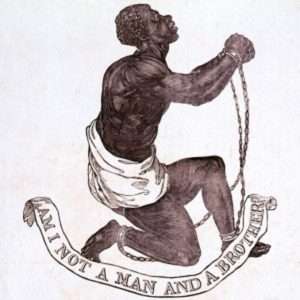
 Josiah Wedgewood's famous 1787 image created for the antislavery movement. (NA)
 Much ink has been spilled over the issues at stake in today's upcoming Supreme Court oral argument in Trump v. Barbara, the birthright citizenship case. There are many reasons why the Trump administration's position is badly wrong. Prominent constitutional law scholars Akhil Amar, Vikram Amar, and Samarth Desai recently published a helpful overview of some key issues at SCOTUSblog. But one key point has, I fear, still not gotten the attention it deserves: all of the standard arguments for the administration's position suffer from the crucial weakness that they are at odds with the main purpose of the Citizenship Clause of the Fourteenth Amendment: granting citizenship to freed slaves and their children. I covered this issue in a recent Lawfare article:
Trump v. Barbara, the birthright citizenship case, is currently before the Supreme Court. At the heart of the case is a Jan. 20, 2025 executive order that sought to deny birthright citizenship to children born in the U.S. whose parents are in the country either illegally or on temporary visas. The case has produced a vast array of amicus briefs as well as the briefs of the parties. But one key issue has not received the attention it deserves.
Accepting the government's position would undermine the central purpose of the Citizenship Clause of the Fourteenth Amendment. For that reason alone, the Trump Administration should lose the case, especially from the standpoint of originalism.
Virtually all informed observers agree that the main purpose of the Citizenship Clause was to grant citizenship to newly freed slaves and their descendants, reversing the holding of the Supreme Court's infamous 1857 Dred Scott decision, which ruled that Black people could never be citizens of the United States. Indeed, the Trump administration's Supreme Court brief in Trump v. Barbara says exactly that: "The Clause was adopted to confer citizenship on the newly freed slaves and their children." But all of the administration's arguments for denying birthright citizenship to children of undocumented immigrants and non-citizens present in the U.S. on temporary visas would, if applied consistently, also have denied citizenship to numerous freed slaves and children thereof.
This reality puts the government's arguments at odds with the original meaning of the Citizenship Clause. Since contemporaries almost universally understood that Clause as granting citizenship to freed slaves, their children, and other Black people born in the United States, any interpretation of "subject to the jurisdiction" that requires denying birthright citizenship to large numbers of slaves and children thereof must be rejected. That is particularly true from an originalist standpoint, which requires adherence to the understanding of the words prevalent at the time of ratification.
The rest of the article goes through the various standard arguments advanced by the administration and its supporters, such as claims that their parents' illegal entry puts children outside the scope of US jurisdiction, arguments based on various notions of "allegiance," domicile arguments, and theories of "complete political jurisdiction." I explains how all of these theories share the same fatal flaw.
The post Slavery, Birthright Citizenship, and Today's Upcoming Supreme Court Oral Argument appeared first on Reason.com.




 Bengali (Bangladesh) ·
  English (United States) ·