

A powerful "Kelvin wave," triggered by this year's super El Niño, is creeping up the Pacific coast of Central and North America and will soon reach California's shores, where it could raise sea levels by up to 1 foot (30 centimeters) for months, researchers warn.
Kelvin waves are a well-known, planetary-scale ocean phenomenon, but this particular forecast has experts worried because it will likely amplify the damage from severe storms, storm surges, flooding and coastal erosion that the record-shattering El Niño is expected to bring this winter.
In general, a Kelvin wave is a swell wave that spans thousands of miles and balances Earth's rotation, David Webb, a physical oceanographer at the National Oceanography Centre in the U.K., told Live Science in an email. But the waves generated during El Niño years are not normal Kelvin waves, because they cause oscillations of a boundary within the ocean as well as a height increase at the surface. In particular, these waves trigger the border between warmer, less-dense surface water and colder, denser bottom layers to move up and down within about 330 feet (100 m). For this reason, these El Niño-driven waves are called internal Kelvin waves.
Internal Kelvin waves are triggered by changes in surface winds around the equator in the far-western Pacific Ocean. Specifically, westerly wind bursts weaken the background trade winds that blow from South America toward Asia, thereby allowing warm water and elevated sea states that occur in the far-western Pacific to slowly "slosh" eastward.
In this case, "the generation process will have involved changes in the winds at different locations and at different times, so it may not be a particularly clean single wave — possibly a bit messy," Webb said.
Once an internal Kelvin wave kicks off, researchers can track its advance along the equator and predict when it will hit the South American coastline. The wave can't go farther east than that, so it spreads into two branches — known as coastal trapped waves — that continue north and south for thousands of miles at a speed of around 6 mph (10 km/h). This means California is not uniquely exposed to the current wave; all of the countries and regions that border the eastern Pacific Ocean are vulnerable, Webb said.
In California and elsewhere, the influence of the internal Kelvin wave will be in addition to the tides, regardless of whether El Niño sparks storm activity there. "What is most likely to be seen is a period, or maybe a few weeks, when the normal [pattern] of tides and tidal currents is distorted, with both high and low tides being higher than normal," Webb said, adding that tides could rise by "tens of centimeters," or about a foot.
A Kelvin wave is a disturbance characterized by higher-than-normal sea levels. Here, we see one hitting the northern tip of South America and propagating northward. (Image credit: Dillon Amaya/North Carolina State University)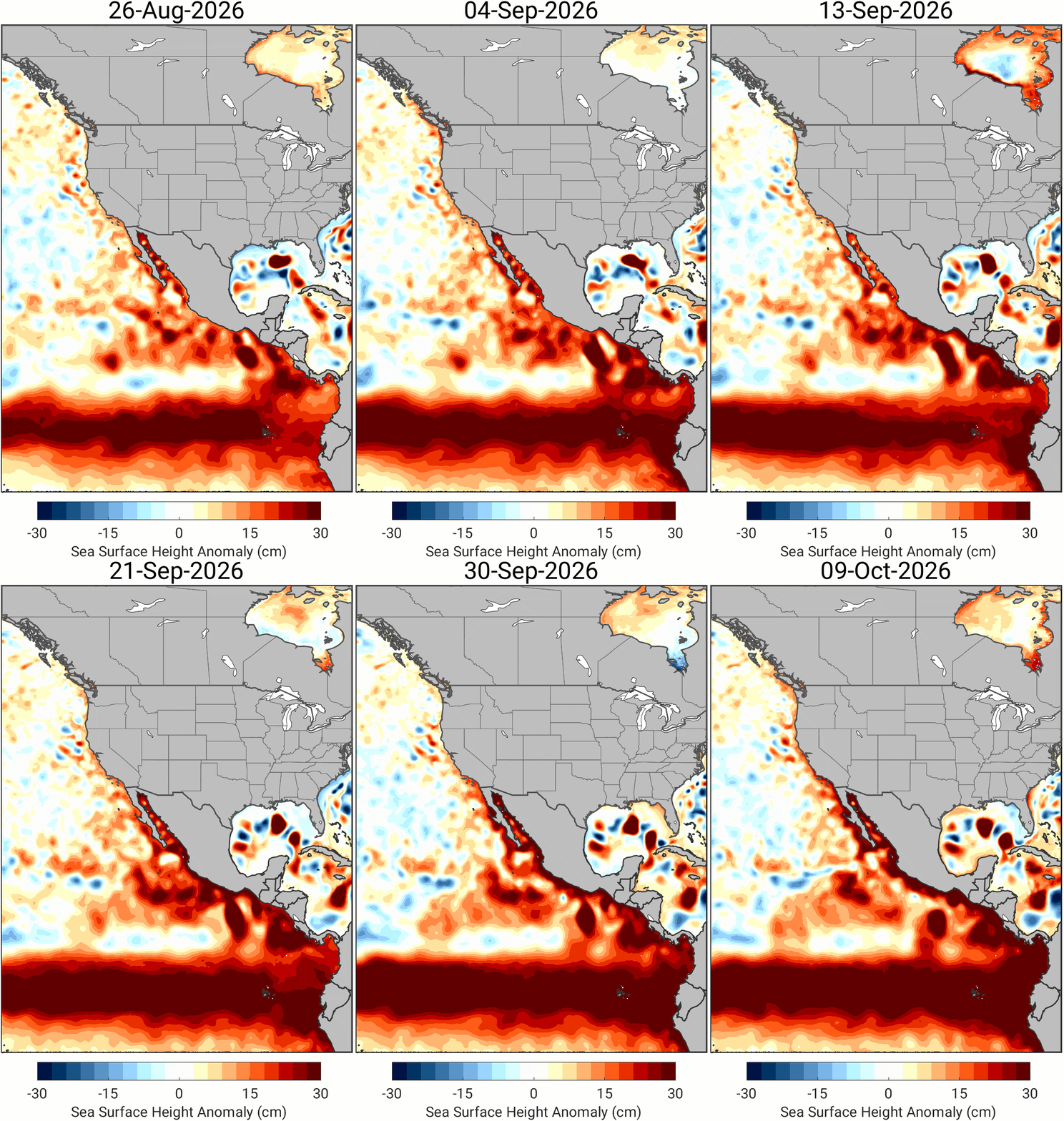
The problem is that higher tides magnify the impacts of storms, which are more likely in some parts of the U.S. during an El Niño, Kate Huckelbridge, executive director of the California Coastal Commission, wrote in a Sept. 11 memo. The memo was sent to warn coastal California homeowners and residents to prepare for extreme conditions, such as flooding.
"A key observation from past El Niño events is that the most damaging storms are often those that coincide with the highest tides," Huckelbridge wrote. "Storms that peak during high tides are far more likely to cause damage than if the same storm peaked during low tide."
Storms alone can raise coastal sea levels by more than 3 feet (1 m), Webb noted, and sea levels have already increased by at least 8 inches (20 cm) due to climate change. Last week, California Gov. Gavin Newsom declared a state of emergency in response to experts' weather predictions so the state could mobilize equipment and resources before storms strike, The Guardian reported Monday (Sept. 28).
Several internal Kelvin waves can occur within a single El Niño event, with the largest waves typically recorded in the winter. However, Webb said he doubts there will be more than one full wave this time.




 Bengali (Bangladesh) ·
  English (United States) ·