
 6 hours ago
1
6 hours ago
1 
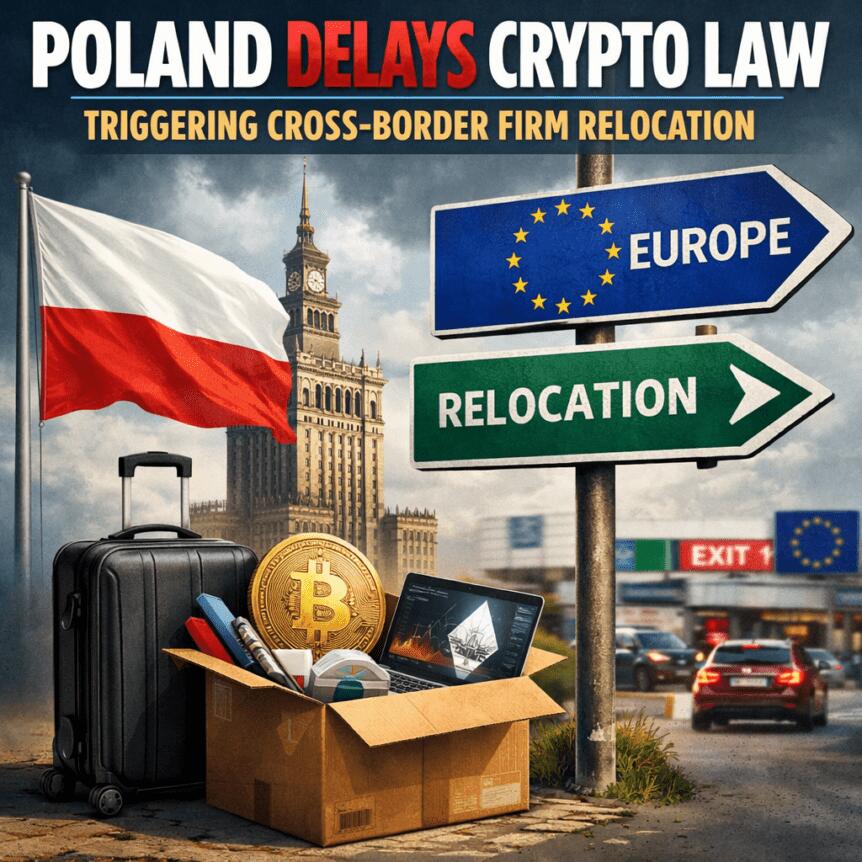
Poland stands as the last EU member state without a domestically enacted enabling act to implement the bloc’s Markets in Crypto-Assets (MiCA) framework, as the Sejm again failed to override a presidential veto on the Crypto-Asset Market Act. According to Cointelegraph, President Karol Nawrocki defended his veto by warning that the draft imposes excessive regulation that could burden small businesses. Critics say the absence of a clear framework exposes the market to fraud and creates a permissive space for illicit activity. The political path forward remains uncertain.
With the MiCA transitional period set to end on July 1, Poland’s lagging implementation stands in contrast to the rest of the bloc. Absent a solution, local firms risk losing a compliant path to operate within the European market, prompting some to relocate their operations abroad in search of a regulatory environment that aligns with MiCA’s standards or speedier licensing processes. The situation illustrates how national politics can influence the EU’s single market for crypto, potentially creating regulatory arbitrage opportunities for Polish firms and shifting competitive dynamics within the region.
Key takeaways
Poland remains the sole EU member yet to enact MiCA-compliant regulation, with a July 1 transition deadline looming. The Crypto-Asset Market Act draft has drawn criticism for its length and scope, including measures perceived as beyond MiCA’s remit, such as restrictions on marketing and the potential for administrative website blocking. The Polish Financial Supervision Authority (KNF) would become the sole crypto regulator under the act, with powers to levy fines and maintain a blacklist of “unreliable” domains; licensing timelines under the KNF have been described as some of Europe’s slowest. Industry groups warn that the Polish approach risks restricting competitiveness and driving firms to relocate to MiCA-friendly jurisdictions like Latvia or the Czech Republic. The policy debate remains deeply fissured across political lines, with multiple vetoes, competing drafts, and public disputes shaping the trajectory of Poland’s crypto regime and its EU interoperability.MiCA transition stalls amid veto cycles
In November 2025, the Sejm passed the Crypto-Asset Market Act, intended to bring Polish law into alignment with MiCA. However, according to Cointelegraph, the government and many industry observers criticized the measure for its breadth and complexity. The Warsaw Enterprise Institute—the business-focused think tank cited as a critic—argued that the Polish bill runs to several hundred articles, whereas other EU members published shorter, more streamlined regimes. The institute also flagged provisions such as a purported ban on certain crypto marketing activities and the possibility of blocking websites by administrative decision, without a court remedy. They contended that such tools would not be justified by MiCA and would disadvantage Polish firms relative to peers in other EU countries.
The proposed regime would vest the KNF with sweeping oversight of Poland’s entire crypto market, including enforcement actions and a formal blacklist of domains deemed unreliable. Critics warned this centralized authority could be slow to react and prone to overreach, especially given the KNF’s existing reputation for protracted regulatory processes. A 2023 European Banking Authority peer review described the KNF as the slowest regulator in Europe for authorizations, a concern echoed by industry observers. In the same period, the Warsaw-based think tank noted Nova data points: the KNF had issued two licenses for brokerages in the last decade and just one electronic money institution license, while Lithuania had registered well over 100 such licenses. These contrasts underscored fears that the Polish regime could place local actors at a competitive disadvantage within the European market. (Source: European Banking Authority peer review via Cointelegraph)
On December 1, 2025, Nawrocki vetoed the law again, arguing the measure’s regulatory footprint was bloated. The government did not override the veto and subsequently reintroduced the identical bill. Nawrocki vetoed again in February, and on April 17 the Sejm failed to override for a second time. The persistence of the veto cycle has kept Poland outside the MiCA-aligned regulatory framework as the July 1 transitional benchmark approaches, according to Cointelegraph’s reporting.
Regulatory architecture and market implications
If enacted, the Crypto-Asset Market Act would centralize oversight within the KNF, granting it licensing authority, enforcement powers, and the ability to maintain a blacklist of domains. That centralization, while aligned with concerns about consumer protection and market integrity, also raises questions about proportionality and due process, particularly given the envisaged administrative tools for domain blocking and potential penalties. The broader EU policy context—MiCA’s aim for a harmonized internal market—implies Poland would still need to reconcile any national features with cross-border supervisory expectations and potential responsibilities shared with EU bodies.
From a compliance and banking perspective, the timing and shape of Poland’s regulatory approach carry material implications. Banks and payment institutions evaluating crypto-related exposure often require clear, predictable licensing regimes and robust consumer protections. Prolonged regulatory uncertainty can complicate onboarding, risk assessment, and liquidity planning for licensed operators, while a slow or opaque domestic framework could push firms to establish or relocate operations in jurisdictions with clearer paths to EU-wide market access.
Political dynamics and cross-border implications
The policy debate in Poland has unfolded amid broader political tensions and contentious public discourse around crypto regulation. Some industry voices portrayed Nawrocki’s veto as a principled insistence on proportional regulation rather than an anti-crypto stance. However, political actors have reacted in various ways to the stalemate. Prime Minister Donald Tusk has accused a local exchange of illicit funding and ties to Russian criminal networks, allegations that feed into a narrative about the risks presented by crypto markets and the political sensitivity of crypto policy. Zonda Crypto, the Polish exchange formerly known as BitBay, has not responded to Cointelegraph’s requests for comment on these claims. The episode illustrates how regulatory design, political alignments, and public narrative can interact to shape the policy landscape and the attractiveness of Poland as a jurisdiction for crypto firms.
Beyond the vetoes, industry participants have sounded the alarm about a potential outflow of businesses. The Warsaw Chamber of Commerce for Blockchain and New Technologies notes that a substantial share of Polish crypto firms have already looked abroad since the regulatory discussion began. Some prominent operators—such as Kanga—have signaled a willingness to relocate to MiCA-friendly environments like Latvia, where faster procedures and relatively lower regulatory burdens are cited as advantages. The chamber’s president has asserted that Polish firms may lose critical scale without a domestic pathway, while regulators emphasize the need to preserve tax bases and domestic innovation. The government’s own messaging has highlighted the risk that overregulation could push companies to neighboring jurisdictions, including the Czech Republic, Lithuania, or Malta, thereby eroding Poland’s domestic crypto ecosystem.
The evolving dynamic suggests a broader policy question for Poland: should the country pursue a tightly regulated, MiCA-aligned regime with clear consumer protections and supervisory certainty, or accept a continued regulatory fragmentation that risks market fragmentation and capital flight? As July 1 nears, the decision will have immediate commercial implications for firms operating in Poland and longer-term strategic consequences for Poland’s role in Europe’s evolving crypto market.
The Polish president’s office and parliament are still weighing options, while industry participants monitor whether a revised legislative approach or an alternative regulatory package will emerge before the MiCA transition window closes. The path forward will help determine whether Poland remains a hub for crypto innovation or becomes increasingly peripheral to the EU’s integrated regulatory regime.
Closing perspective: As the MiCA deadline approaches, Poland faces a defining choice about regulatory design, implementation speed, and alignment with EU standards. The coming months will reveal whether a scaled, proportionate framework can be enacted to sustain domestic innovation, support compliant banking relationships, and preserve Poland’s standing as a crypto market within the European single market or whether regulatory fragmentation will continue to push firms toward neighboring jurisdictions.
This article was originally published as Poland delays crypto law, triggering cross-border firm relocation on Crypto Breaking News – your trusted source for crypto news, Bitcoin news, and blockchain updates.




 Bengali (Bangladesh) ·
  English (United States) ·