

Scientists have proposed a new tabletop device to detect the subtle way Earth's daily spin on its axis twists the space-time around it — an effect predicted by Einstein's general relativity.
If built, the sensor could measure the quantum effect known as frame dragging with the same precision as the best satellite experiments, but in minutes instead of years, the researchers proposed in a new study.
The research, published Sept. 17 in the journal Physical Review Letters, aimed to address a classic mismatch in physics. Picture a ring of clocks bolted to a spinning merry-go-round. You synchronize each clock with its neighbor around the ring. Then, you compare the last clock with the first. They don't match.
"It is impossible to synchronize that collection of clocks when you're in a rotating frame," Kai-Isaak Ellers, a physics graduate student at the University of California, Berkeley (UC Berkeley) and first author of the study, told Live Science.
Gravity's a drag
A photo of scientists working on NASA's Gravity Probe B in 2003. This device measured Earth's frame-dragging from space, confirming Einstein's predictions with an 18% margin of error. (Image credit: NASA)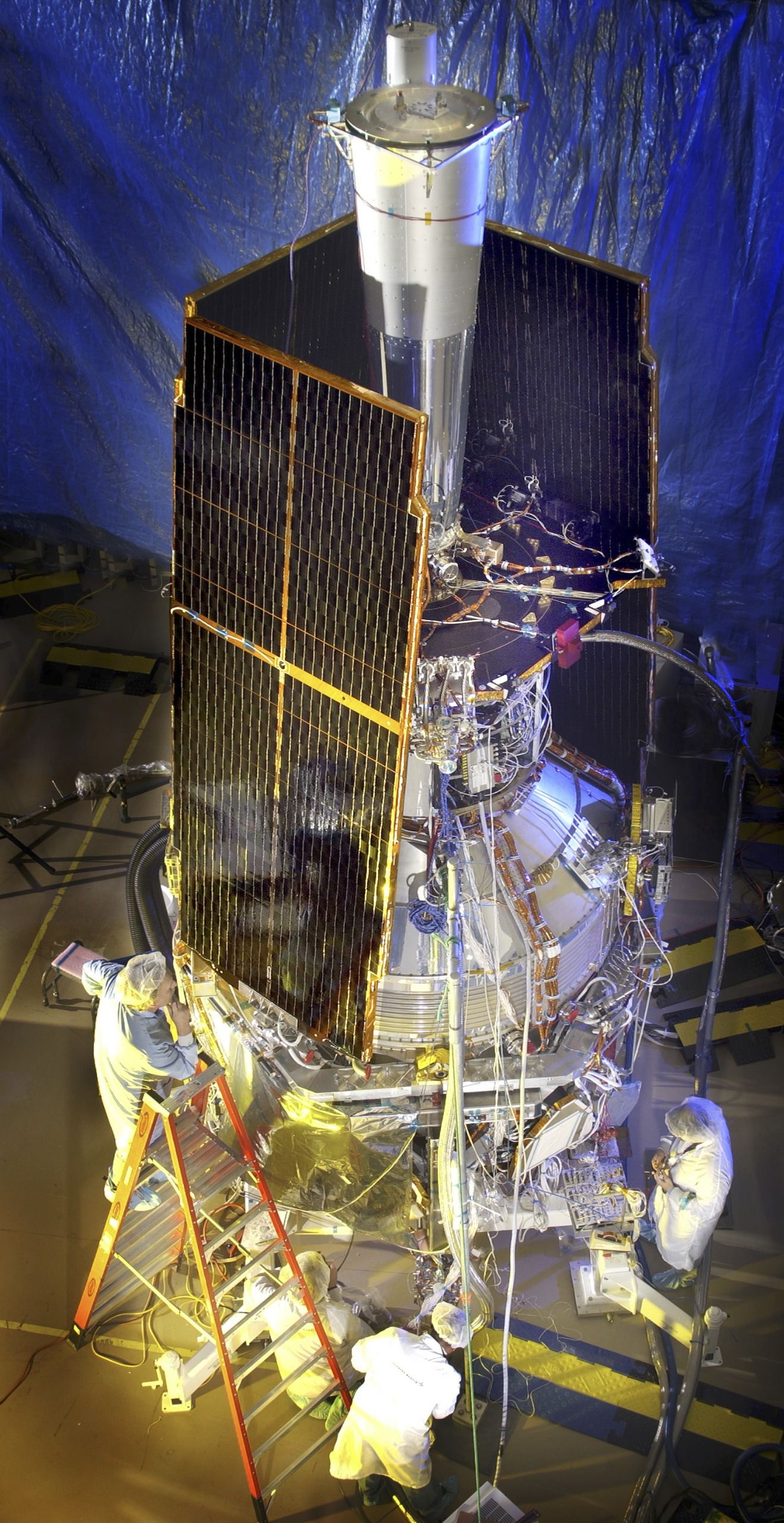
Einstein's theory of general relativity predicts that a massive, spinning object drags the fabric of space-time along with it, just like a spoon twirling in honey. The effect is clearly visible around supermassive objects, like the Milky Way's central black hole. But around Earth, the effect is very faint.
So far, scientists have measured Earth's frame dragging only from orbit. They tracked how the twisting of space-time slowly shifts spinning gyroscopes or the paths of satellites. In 2011, NASA's Gravity Probe B satellite, which carried four gyroscopes, confirmed Einstein's prediction with a margin of error of about 18%. Satellites tracked with lasers have since done even better. In July, researchers reported in the journal Nature that the LARES-2 satellite had shrunk that margin of error to just 0.2%.
However, that took about three years of laser tracking. Researchers also had to account for the fact that Earth bulges at the equator and its mass is spread unevenly, which gives the planet’s gravity small irregularities that tug on satellites far more strongly than frame dragging does. To subtract those tugs, the team relied on detailed maps of Earth's gravity made by other satellites.
Measuring frame dragging more precisely is a way to stress-test general relativity. Several alternative theories of gravity predict a slightly different amount of twisting, and a lab-based measurement would also be free of the modeling assumptions that satellite experiments depend on, Ellers said.
A quantum loop
The new device is a loop of superfluid helium-4 — helium chilled until it flows without friction and behaves like a single, giant quantum object. The loop is interrupted by a thin barrier riddled with tiny holes, called a Josephson junction. Superfluid helium can slip through the holes, but ordinary liquid helium cannot.
"That's where the quantum behavior comes from," said K. Birgitta Whaley, a quantum physicist at UC Berkeley and a co-author of the study.
As Earth spins and drags space-time, it nudges the quantum state of the helium flowing through the junction. That nudge shifts the frequency at which the helium sloshes back and forth in the loop, which the researchers could detect.
A visualization of Earth's uneven gravity field taken by NASA's Gravity Recovery and Climate Experiment in 2009. The lumpiness of our planet's gravitational field makes it harder to precisely measure relativistic effects. (Image credit: NASA)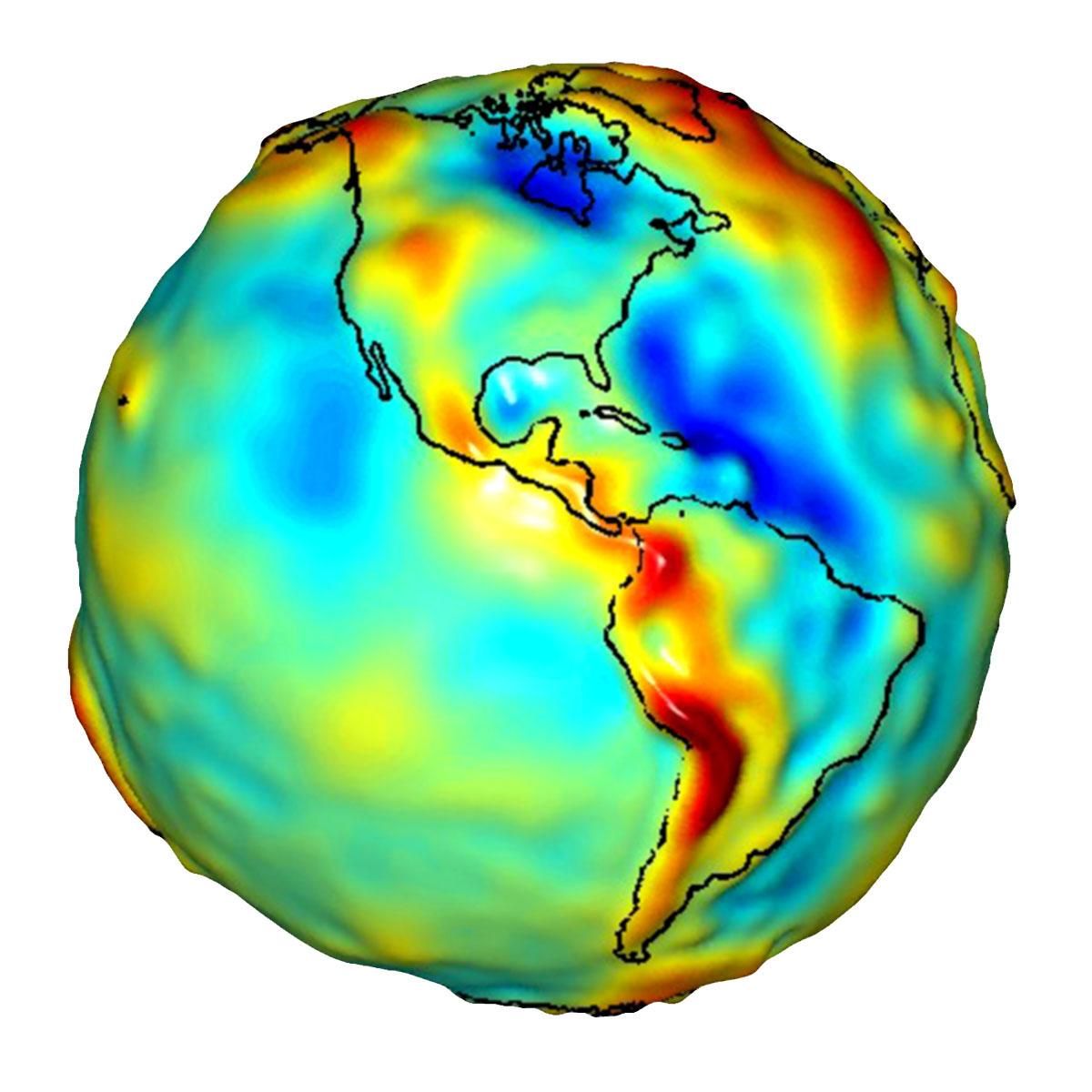
Superfluid devices, many of them built at UC Berkeley, have detected Earth's rotation since the late 1990s. But the helium-4 versions built around a Josephson junction, like the new design, have worked within about a hundredth of a degree of 2.17 K (minus 455.76 Fahrenheit, or minus 270.98 Celsius), the temperature at which helium-4 becomes a superfluid. At that temperature, a lingering fraction of "normal" helium mixed in with the superfluid adds noise.
Instead, the team calculated how the device would behave at a few thousandths of a degree above absolute zero. Below 0.7 K, the noise changed character, and the team found it drops sharply as the helium gets colder. One key finding in the new paper is the result of the team's thermal noise analysis, which showed how sensitive these devices could be at millikelvin temperatures, Elles said.
The catch is the barrier. Earlier helium-4 devices used holes about 90 nanometers wide. Working at these frigid temperatures demands much smaller holes, about 1 nanometer across — roughly the size of a helium atom. Keith Schwab, a physicist at Caltech and co-author of the study, and his collaborators are developing such materials, but they haven't been built into a working sensor yet.
If they can be, the researchers calculate that the device could measure frame dragging to 0.2% precision in about 35 minutes. If its vibrating membrane were made from the lowest-loss crystals, such as quartz or sapphire, that could drop to about one second, they said.
"This seems to be a very serendipitous discovery that at millikelvin, we can get this high sensitivity," Whaley told Live Science.
The signal corresponds to a time difference of about 10-35 seconds between helium flowing one way around the loop and the other — the same mismatch as the clocks on the metaphorical merry-go-round.
"The interesting thing about it is just how small it is," Whaley said. "It's not so far off from the Planck time," about 10-44 seconds, the shortest slice of time before the known laws of physics are expected to break down. This experiment is still a billion times too large to reach that limit, Whaley said. But future helium experiments could help explore whether time flows smoothly, like a ramp, or ticks forward in tiny, indivisible jumps, like the frames of a movie.





 Bengali (Bangladesh) ·
 English (United States) ·