
 21 hours ago
2
21 hours ago
2 
TLDR
Brent crude rose 1% to $87.90 and WTI gained 1.6% to $82.56 on Friday A drone struck a tanker in the Strait of Hormuz, adding to supply uncertainty The US and Iran remain at odds over control of the waterway OPEC and the IEA both cut their oil demand forecasts for the year Wall Street edged higher after US inflation data came in at 0.1% for JulyOil prices are on track for their first weekly gain in three weeks, pushed higher by ongoing uncertainty around the Strait of Hormuz. A fresh drone attack on a tanker in the waterway has kept traders on edge about global supply flows.
Brent crude was up around 1% on Friday at $87.90 a barrel. West Texas Intermediate rose 1.6% to $82.56. Both benchmarks were up around 5% for the week.
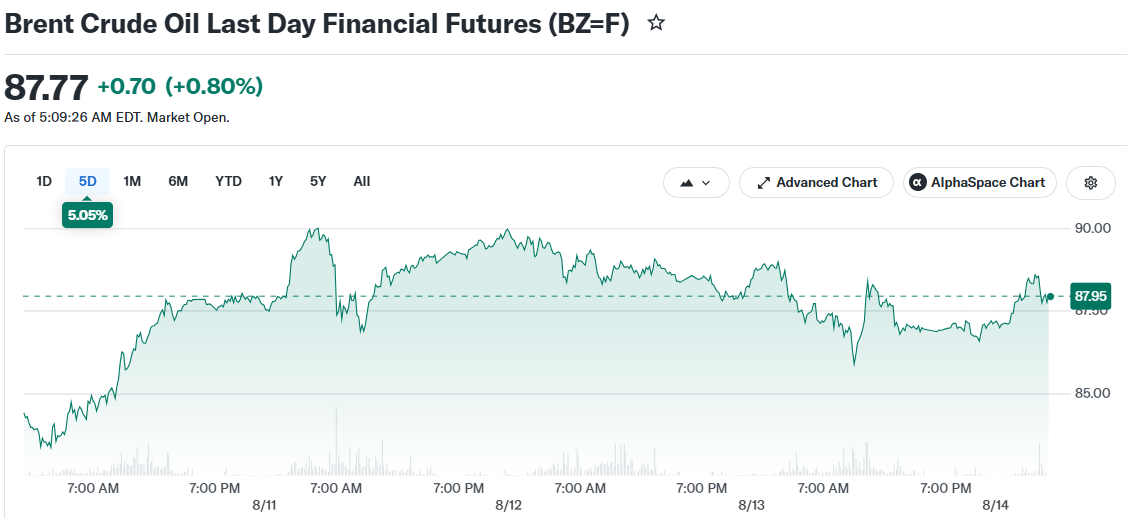 Brent Crude Oil Last Day Financial Futures (BZ=F)
The United Kingdom Maritime Trade Operations agency confirmed a tanker was hit by an uncrewed aerial vehicle while attempting to leave the strait. The vessel suffered minor damage and the crew were reported safe. No environmental damage was recorded.
BREAKING:
IRGC struck an oil tanker with a drone after it attempted to pass through the strait of Hormuz without Iran's authorization. pic.twitter.com/JrCTX74MoK
— Current Report (@Currentreport1) August 14, 2026
The UKMTO advised ships to take caution when transiting the strait.
About one-fifth of the world’s oil and liquefied natural gas passed through the Strait of Hormuz before the Iran war began in late February. Iran has said it controls the waterway and closed it to commercial shipping. The US says it has been facilitating some sailings.
US Pressure Mounts on Iran
US Defense Secretary Pete Hegseth said on Thursday that Washington could maintain a naval blockade of Iranian ports indefinitely. Treasury Secretary Scott Bessent warned of economic measures against Iran unlike anything seen before.
President Donald Trump suggested this week that sanctions will eventually force Iran to accept US demands, including ending its nuclear program and reopening the strait. Iran’s parliament, meanwhile, has proposed banning vessels from the US, Israel, and other “hostile countries” from using the waterway.
Despite the supply tension, oil’s weekly gains were limited. Both OPEC and the International Energy Agency cut their demand forecasts for 2026, citing sluggish economic growth, high prices, and tight supply.
Markets React to Inflation Data
On Wall Street, stocks moved higher mid-week after US consumer prices rose just 0.1% in July, in line with expectations. The mild inflation reading eased fears that the Federal Reserve might raise interest rates next month.
The S&P 500 rose 0.26% to 7,748.50. The Nasdaq gained 0.54% to 26,588.49. The Dow Jones Industrial Average slipped slightly, down 0.04%.
Money markets showed roughly a 50% chance of a Fed rate hike before the inflation data was released. The soft reading reduced that pressure.
AI cloud company CoreWeave posted strong results after the close on Tuesday, giving a lift to other AI infrastructure stocks.
Gold rose 0.92% to $4,407.12 an ounce, touching its highest level in over two months. The Bank of Japan is also being watched, with markets pricing in nearly a 60% chance of a rate hike at its September meeting.
The dollar index edged up 0.17% to 99.97.
Talks to end the Iran war continue, though no restart of formal negotiations appears close. Investors have remained relatively calm. Analysts at Schroders said their base case is a “gradual but messy de-escalation” that keeps some floor under oil prices.
The post Oil Prices Rise for First Weekly Gain in Three Weeks as Strait of Hormuz Drone Attack Adds Supply Risk appeared first on CoinCentral.




 Bengali (Bangladesh) ·
  English (United States) ·