

Japan's space agency has decided to switch destinations and objectives for the final act of its Hayabusa2 mission, due to the spacecraft suffering trouble with its ion thrusters.
The veteran Hayabusa2 spacecraft launched back in 2014 to collect material from the asteroid Ryugu. Since delivering the samples to Earth in December 2020 via a reentry capsule, the main spacecraft has been conducting an extended mission of exploration and in July made a super-close flyby of the two-headed asteroid Torifune.
But Hayabusa2's continued adventures are now set for a premature end. The spacecraft was scheduled to rendezvous with, and attempt to land on, the tiny, 36-foot-wide (11 meters) near-Earth asteroid 1998 KY26 in 2031, but trouble with the aging spacecraft's engines has forced a change of plan.
But Hayabusa2's continued adventures are now set for a premature end. The spacecraft was scheduled to rendezvous with, and attempt to land on, the tiny, 36-foot-wide (11 meters) near-Earth asteroid 1998 KY26 in 2031, but trouble with the aging spacecraft's engines has forced a change of plan.
The spacecraft will instead target 2015 BM510, another tiny asteroid. And there will be no landing: Hayabusa2 is scheduled to make a high-speed flyby of the near-Earth object in April 2028.
The decision was announced at a Japan Aerospace Exploration Agency (JAXA) press conference on Tuesday (Nov. 17), a day after a Cabinet Office space policy subcommittee meeting. The final functioning thruster out of Hayabusa2's four ion engines suffered a malfunction in mid-August, according to JAXA officials, while a sensor detected unexpected erosion of the spacecraft's surface during its long voyage in space.
"The deterioration of the onboard equipment ... is becoming increasingly evident," Japan Times quoted Yuya Mimasu, team leader of the extended mission, as saying.
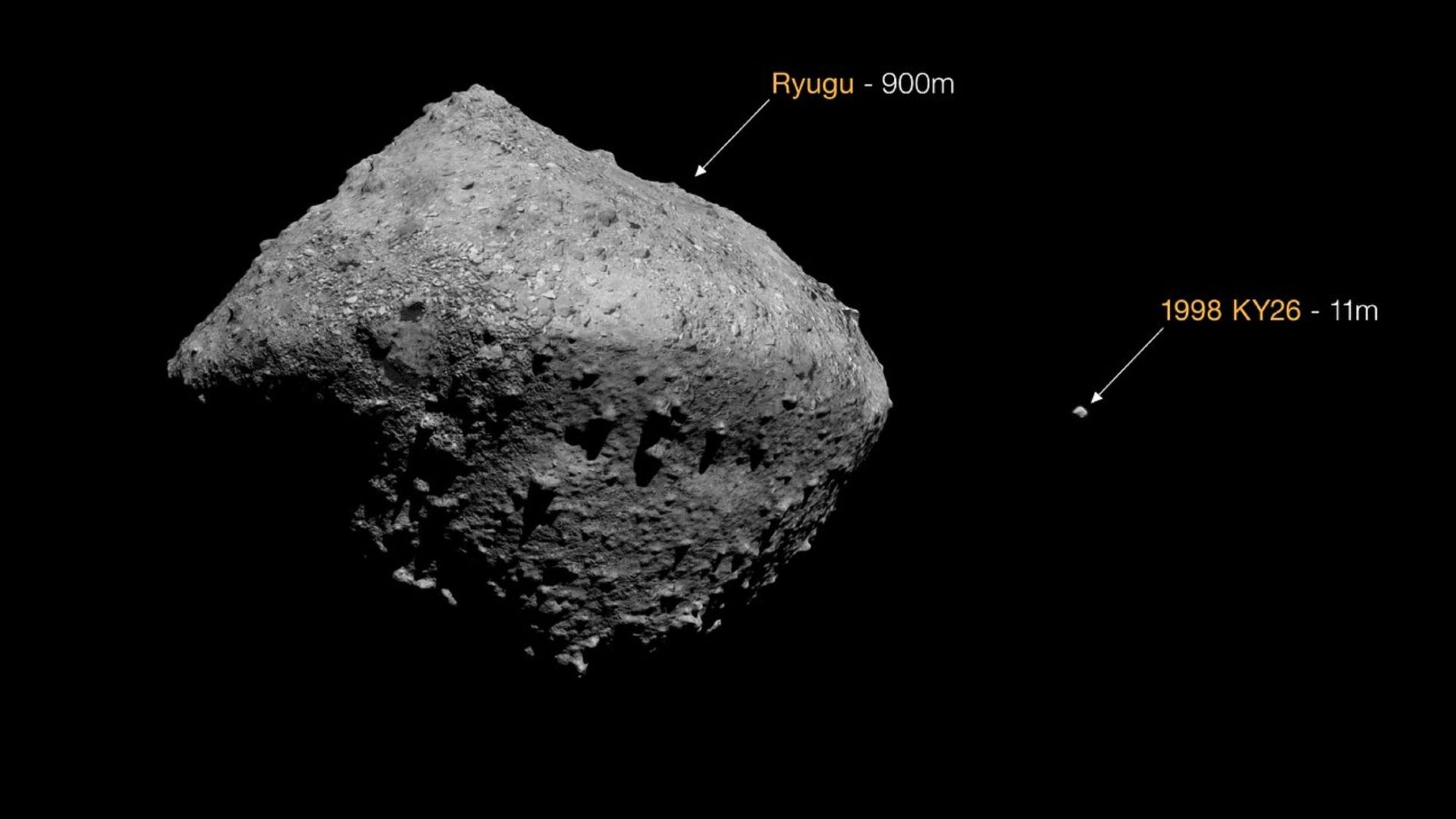
Despite losing the opportunity to land on KY26, the Hayabusa2 mission has been a huge success for JAXA, and the new direction promises its own intrigues. Asteroid 2015 BM510 has already attracted interest; it's the primary target of a proposal for the European Space Agency's mini-Fast mission series. Scientists describe the body as a D-type asteroid, meaning it's thought to be organic-rich and comet-like, and may have originated in the outer solar system.
Around the same time as Hayabusa2 conducts its high-speed flyby in April 2028, JAXA is also scheduled to launch its next asteroid mission, Destiny+. Launching along with ESA's Ramses mission to study Apophis, Destiny+ will first make a flyby of the infamous asteroid ahead of its very close approach to Earth in 2029 before heading to asteroid 3200 Phaethon, the parent body of the Geminid meteor shower.



 Bengali (Bangladesh) ·
 English (United States) ·