

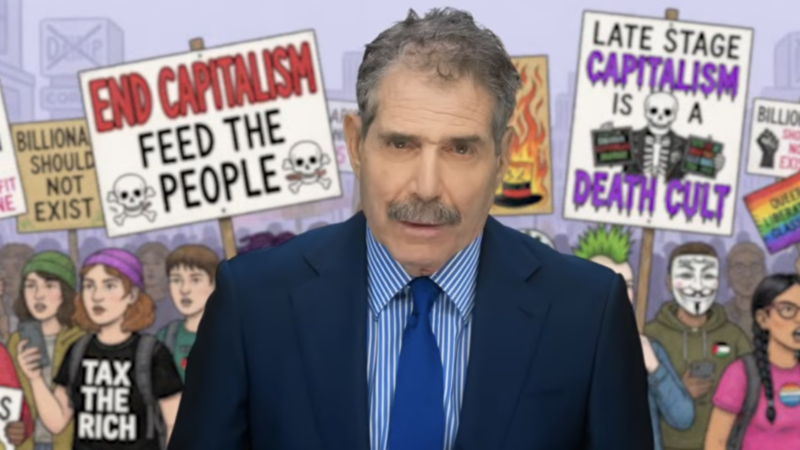
Prices rise. People blame capitalism.
Politicians promise "solutions."
President Donald Trump wants to cap credit card interest rates.
My socialist mayor wants to freeze rents.
Sen. Elizabeth Warren (D–Mass.) wants politicians to decide what prices are "excessive."
So I was surprised to see economist Donald J. Boudreaux's new book titled The Triumph of Economic Freedom.
"Economic freedom is losing!" I shout at him in my new video. "Republicans and Democrats vote against it."
"Free markets are on the ropes," he replies. "But when you look at history, you see that when economic freedom is allowed to flourish, it does triumph….It's really important that people step back and look at economic history…[to see that] the more we move away from free markets, the worse things become."
We should have learned that from the Great Depression.
Schools now teach children that President Franklin D. Roosevelt's New Deal "brought the United States out of the Great Depression."
Not true, says Boudreaux. "He created government programs all right, but they did not pull us out of the Depression. Unemployment in the 1930s was never below 10 percent."
When farmers complained about low prices, FDR blamed an oversupply of food. So the government paid farmers to destroy crops.
"People were hungry and they were destroying food!" complains Boudreaux. "How was that good?"
"It raised prices," I say. "Farmers wouldn't go bankrupt."
"People can't eat prices! They have to eat food."
FDR's other "solutions" included higher taxes on the rich and more regulation of businesses—proposals we hear today.
"By introducing these new unprecedented programs," says Boudreaux, "the New Deal made investment in America a risky project. That kept private investors on the sidelines."
Why wouldn't they invest?
"FDR is criticizing businesspeople and blaming [them] for all that ails America," replies Boudreaux. "Those businesspeople were saying, 'I'm not going to trust my property to you.'"
The Depression continued for more than a decade, until, according to the Library of Congress, "Mobilizing the economy for world war finally cured the depression."
That's a myth, too, says Boudreaux.
"Unemployment fell. That's not hard to do when you conscript 2.5 million men into the military. But If you look at the actual performance of the economy, that didn't recover until the late 1940s."
It recovered, says Boudreaux, because "Republicans won the 1946 election, and they were more pro-investor, pro-business than the Democrats." And FDR died. "Harry Truman was less vigorously opposed to capitalists….So investors were finally confident to come back into the playing field."
Seventy years later, politicians from both parties created the "Great Recession" by having government subsidize mortgages. When the mortgage bubble burst, home prices collapsed, banks lost big, and millions lost jobs.
"What the government did was impose policies that made homeownership seem affordable to people who couldn't afford it and compel banks to back those mortgages," explains Boudreaux. "When things went down…you had this calamity."
Politicians blamed that recession on "an unregulated free market."
It's a fallacy, says Boudreaux, "that deregulation led to the Great Recession. There was very little deregulation."
He says the "reason the Great Recession lasted as long as it did is because Barack Obama kept saying hostile things about markets and businesspeople."
Obama did shout things like, "If you've got a business, you didn't build that!"
"Negative words from the White House kept investors on the sidelines, kept unemployment higher than it would otherwise have been," says Boudreaux.
Obama's policies didn't help either. He expanded unemployment benefits, boasting it "made a difference in the lives of 12 million Americans!"
"Yeah, it did," says Boudreaux. "It kept them unemployed a lot longer…because people were being paid not to work."
Today, politicians and pundits continue to claim capitalism is a problem and government must step in to make it more fair.
"They don't know what they're talking about!" says Boudreaux. "Government's 'solutions' actually made things worse."
Free markets do work. If politicians just let them.
COPYRIGHT 2026 BY JFS PRODUCTIONS INC.
The post No, FDR Did Not Pull America Out of the Great Depression appeared first on Reason.com.



 Bengali (Bangladesh) ·
  English (United States) ·