

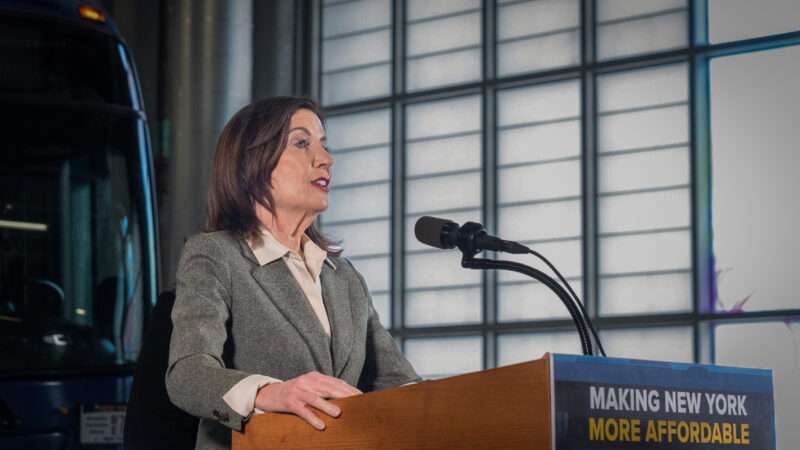
In 2022, Democratic New York Gov. Kathy Hochul urged Republicans to leave the state and move to Florida. Lots of people took her advice, and not all of them the people she wanted to expel. Earlier this month, she was reduced to begging "high-net-worth" former state residents to move back and pay the expensive tax tab to fund her state's spending choices.
It's a rare and glorious sight when politicians shoo those who dislike their policies out the door only to subsequently beg them to return.
Hochul Directed Political Opponents To Go to Florida. Many New Yorkers Did.
At a campaign rally in 2022, Hochul directed Republicans to "just jump on a bus and head down to Florida where you belong, OK. Get outta town. Get outta town. Because you don't represent our values. You are not New Yorkers."
Florida, notably, has become in recent years an example, along with Texas, of GOP policy frequently contrasted with Democratic jurisdictions and their larger governments.
Message received. Last year, New York's independent Citizens Budget Commission (CBC) reported that "New York City lost 102K residents and their $13.7B in personal income to Florida from 2018-2022 on net." Detailing reasons for the migration, the CBC report noted, "those leaving the region most commonly move to Florida, California, and Texas….Notably, Florida and Texas have lower taxes."
Drawing on U.S. Census data, the Empire Center observed that "the state as a whole was down by 238,000 residents or 1.2 percent over the four-year stretch [from 2020 to 2024], even as the U.S. population rose by 2.6 percent." New York City has been especially hard hit by outmigration: "The most popular destination for departing New Yorkers was Florida."
This is all very awkward for state officials. New York State Comptroller Thomas P. DiNapoli observed in a February 2026 report that "the trajectory of State spending has been steep, and is projected to continue to increase faster than inflation and projected revenues." Those revenues are certainly lower than they would have been had more people chose to remain in New York rather than heed advice to leave.
Hochul may not openly regret her words, but she certainly rues the consequences. On March 11, she spoke with Politico's Nick Reisman, who questioned her about proposed tax increases currently being negotiated between the state legislature and the governor's office.
Now, Hochul Wants "High-Net-Worth" Refugees to Return
"I need people who are high-net-worth to support the generous social programs that we want to have in our state," responded Hochul. "Now, there are some patriotic millionaires who stepped up. Okay, cut me the checks if you want to be supportive. But maybe the first step should be to go down to Palm Beach and see who we can bring back home because our tax base has been eroded."
That would be Palm Beach in Florida, of course. That is, as we remember, Hochul's preferred destination for people with political views at odds with hers. Many New Yorkers have made the move and found their new digs very welcoming.
"These differences were especially striking in 2021 when 221,000 U.S. residents migrated to Florida versus 352,000 New Yorkers moving from that state," Mark Duggan and Emma Hou of the Institute for Economic Policy Research at Stanford University reflected in a 2022 analysis of Florida's vigorous growth and increasing clout in recent years when compared to New York's anemic experience. "Some speculate that Florida's lower taxes (and no personal income tax) along with limited government are better for fostering economic growth and a brighter future than New York's model of higher taxes and stronger regulation."
Remote Work Makes It Easy To Flee High Taxes
Added Duggan and Hou: "Research summarized in a recent article by Henrik Kleven and co-authors strongly suggests that high state and local taxes can lead to more migration out of a state and/or less migration into a state."
That 2020 paper by Kleven and company found that "certain segments of the labor market, especially high-income workers and professions with little location-specific human capital, may be quite responsive to taxes in their location decisions."
Hochul seems to be aware of people's natural propensity to flee the tax man. In her conversation with Reisman, she continued, "I have to look at the fact that we are in competition with other states who have less of a tax burden on their corporations and their individuals. And I would say remote work changed everything. There were people who could only work in an office in Manhattan or work in New York State and they were captives to our state. They were going to stay. We saw that that's not the case. Wall Street, businesses looking at Texas? They're not going there because they have a nicer governor, I know that for sure. But they're going there because of the tax rate."
In fact, a February 2026 Partnership for New York City report found that "in 2024, Texas surpassed New York as the state with the most financial services employees, excluding insurance and real estate" and that "financial services recruitment in Texas surpassed New York's with 9% more job postings in 2025." New stock exchanges are launching in Texas, challenging Wall Street dominance, and the state is drawing businesses that relocate from New York and (also high-tax) California. Factors such as a friendly business environment and updated legal code "combined with no personal or traditional corporate income tax" make Texas attractive, though a longer trip than Hochul's recommended bus ride.
High Taxes Have Always Repelled 'Middle- and High-Earning Households'
The opportunity offered by the growth in remote work to live where you want rather than where your job is physically located has certainly accelerated flight from high-tax jurisdictions, but this is not a new phenomenon. A 2024 paper by Traviss Cassidy, Mark Dincecco, and Ugo Antonio Troiano found that across the U.S., from 1900 to 2010, "the introduction of the income tax induced significant outmigration to non-income-tax states by middle- and high-earning households."
Last year, the Tax Foundation's Katherine Loughead drew on data from the Census Bureau and moving companies to conclude that "Americans are continuing to leave high-tax, high-cost-of-living states in favor of lower-tax, lower-cost alternatives."
So, mugging people with high taxes and expecting that they would indefinitely suffer the abuse was never a brilliant idea. But in an era when people are increasingly mobile, if you mug them and then challenge those who disagree with an expansive view of the state to leave, you run the risk that they'll do just that.
Then, like Kathy Hochul, avaricious politicians find themselves begging those who've settled into less-vampiric environments to come back and suffer some more.
The post New York Gov. Hochul Begs 'High-Net-Worth' Refugees To Return and Be Taxed appeared first on Reason.com.





 Bengali (Bangladesh) ·
  English (United States) ·