

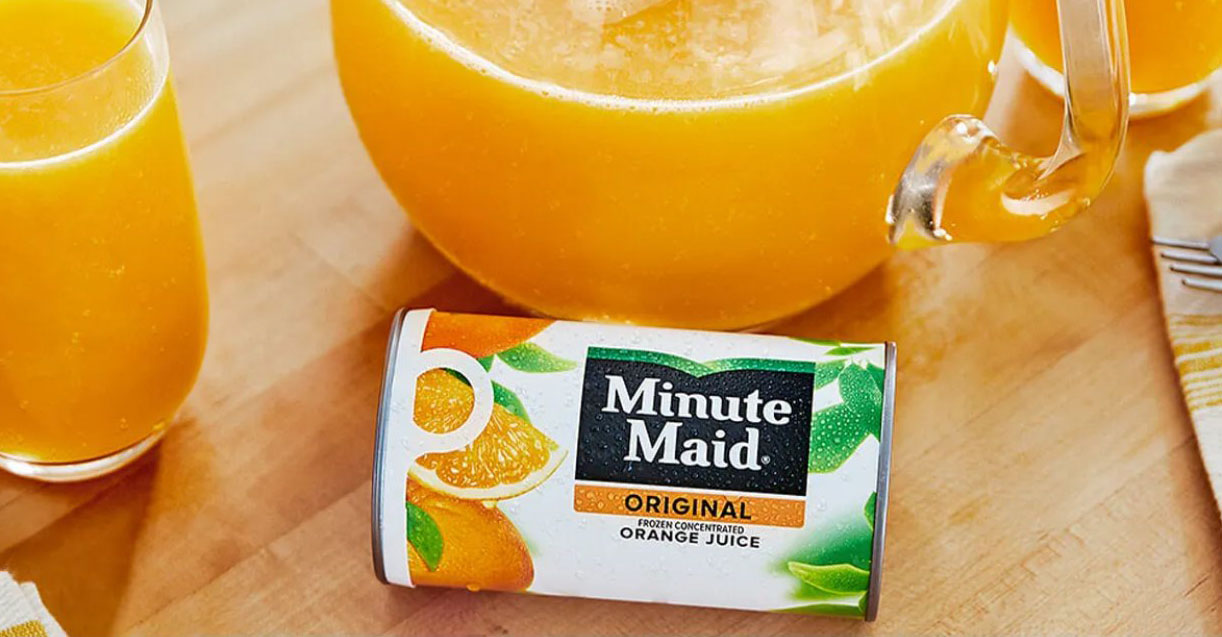
This citrus news broke quietly a few weeks ago but I’m just seeing it now so let’s give it a squeeze. First, a minute to recap the origins of popular juice brand Minute Maid: the story begins with World War II, when the Florida Foods Corporation (FFC) won a $750,000 contract from the US Army to make 500,000 lbs of powdered orange juice. The dehydration technology was a game changer for shipping food and medical supplies abroad. Though the war ended before the contract was fulfilled, FFC took the powder and developed a frozen concentrate, the first Minute Maid beverage, which was so named to highlight how easy it was to make. Anyway, as soon as they hit the streets, the frozen cans of Minute Maid orange juice were a splash hit with civilians. It’s hard to appreciate now, but being able to have OJ at home — regardless of where you lived or what season it was — was a BFD. And that’s how Minute Maid was born, with frozen can juice. Only now parent company Coca-Cola has announced they’re discontinuing the heritage product:
Coca-Cola is discontinuing Minute Maid’s frozen canned orange juices and lemonades after 80 years as consumer demand declines.
Minute Maid frozen products will be discontinued in North America in the first quarter of 2026, with in-store inventory available while supplies last, a Coca-Cola spokesperson told Food Dive. The brand offered frozen concentrated cans of orange juice and lemonade, with flavors including raspberry lemonade, pink lemonade and limeade.
“With the juice category growing strongly, we’re focusing on products that better match what our consumers want,” the spokesperson said.
Minute Maid’s frozen concentrates were the primary way Americans drank their morning orange juice in the 1950s and 1960s. The product allowed for consumers to conveniently enjoy orange juice no matter the season, and the brand was an early pioneer in the emerging frozen food industry.
As pasteurization processes advanced, frozen juices from concentrate were quickly overshadowed by ready-to-drink varieties, which didn’t require thawing. By the 2010s, the demand for frozen concentrate largely dried up, according to the Wall Street Journal, representing just 7% of the overall orange juice market.
Today, Minute Maid offers orange juice, lemonade and other fruit drinks, as well as sugar-free varieties. It’s also entered the alcohol category as demand grows for hard lemonades and iced teas.
While Coca-Cola’s juice business has gained market share recently, partially thanks to the success of Minute Maid’s sugar-free variety in North America, the broader juice industry has struggled with declining consumption as more consumers gravitate toward functional beverages.
I must admit, I have never imbibed one of these frozen juice cans. So I contacted a source who was familiar with the product (my mother), and she vividly recalled her own mother excitedly serving freshly-defrosted OJ. When asked directly if she herself drank the beverage, my mother replied, “Not if I could help it.” People have very strong opinions about orange juice concentrate! Still, like I said earlier, the technology was revolutionary at the time. And there’s no denying that bringing orange juice into people’s homes was a good cause. But — and it pains me to say this as someone with a vintage soul — the concept really does seem dated now, yes? Plus over 80 years, the market has become oversaturated with all the fruit juice varieties. (#SomePulp, RIP Tony Soprano.) But thank you for your service, frozen juice concentrate! We might never have achieved Sunday brunches drowning in Mimosas were it not for this first crucial step.
And now I’d like to conclude this brief tour of food science history with one final question/observation: the brand name was coined to emphasize how easy the juice was to make, so why is it Minute Maid instead of Minute Made, hmm? And why do I fear the answer has something to do with sexism…
Photos via Coco-Cola.com and credit Getty Images




 Bengali (Bangladesh) ·
  English (United States) ·