
 1 hour ago
4
1 hour ago
4 
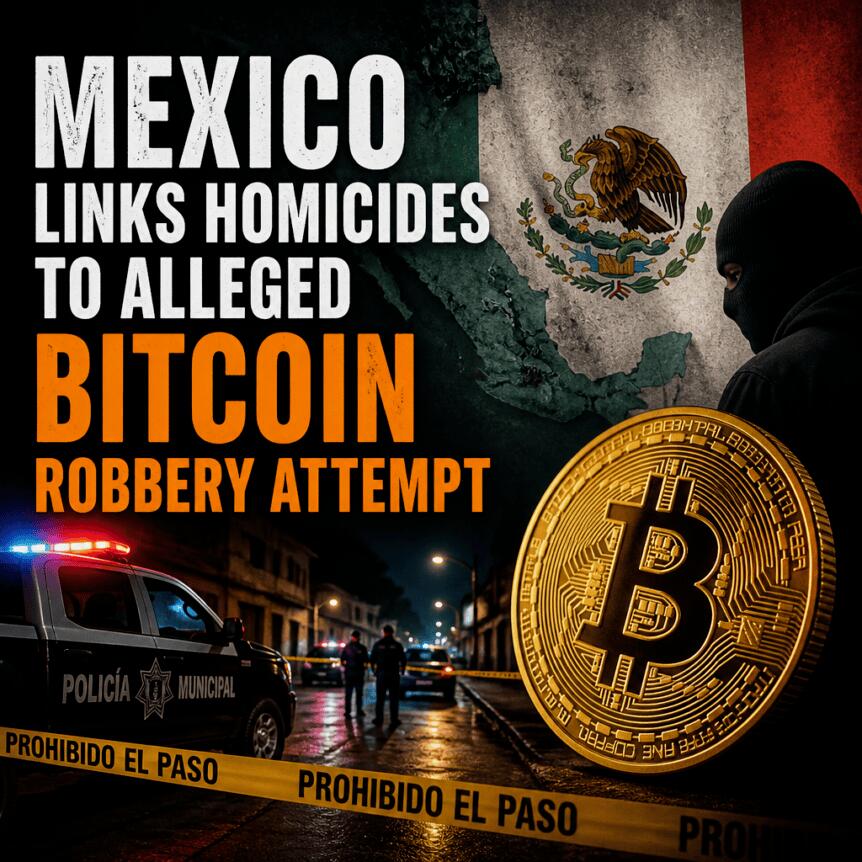
Investigators in Mexico say two suspects charged in the killing of four people allegedly targeted a “cold wallet” they believed held millions of dollars in Bitcoin. The case has drawn renewed attention to the growing trend of violent “wrench attacks,” in which criminals use coercion—often physical attacks or threats—to obtain crypto wallet access.
According to La Jornada, prosecutors in the State of Mexico (FGJEM) allege that Diego Sebastián and Gerardo—surnames withheld—were involved in the Sept. 2 murders in Atizapán de Zaragoza. A court hearing is scheduled for Wednesday, where a judge will decide whether sufficient evidence exists to continue criminal proceedings.
Key takeaways
FGJEM alleges the suspects sought access to a Bitcoin cold wallet believed to contain millions, after entering the victims’ home. The case centers on the killings of Jonathan Meléndez, his pregnant wife, their daughter, and an employee, with the family’s dog also reported killed. If convicted, FGJEM statements reported by La Jornada suggest each homicide victim could carry a sentence ranging from 25 to 70 years. Blockchain security firm CertiK reports a rise in wrench attacks in the first half of 2026 compared with the same period in 2025. Chainalysis estimates indicate wrench attacks have generated more than $30 million in stolen crypto during H1 2026.A domestic attack allegedly driven by expectations of large Bitcoin holdings
La Jornada, citing an FGJEM update, reports that two suspects were arrested following the Sept. 2 killings of Jonathan Meléndez, a keyboardist for rock band Camilo Séptimo; his pregnant wife; their daughter; and an employee at their home. The outlet also reports that the family’s golden retriever was killed during the incident.
The FGJEM announcement of the arrests was posted on X on Sept. 2, according to the case coverage referenced by FiscalíaEdomex. Prosecutors described a motive that, in this instance, appears tied directly to crypto custody: La Jornada says the suspects believed a “cold wallet” contained millions in Bitcoin.
Earlier reporting in the same case indicates prosecutors allege one suspect had a business relationship with one of the victims and used that connection to enter the home. Mexico’s security secretary, Omar García Harfuch, made similar points in a Sept. 2 X post, according to his account.
Next court step in Mexico’s State of Mexico case
As described by Diario de México, the two defendants are scheduled for a Wednesday hearing. At that session, a judge will decide whether there is enough evidence to proceed with criminal charges.
La Jornada also reports that, under FGJEM’s statements, the suspects could face penalties equivalent to 25 to 70 years in prison per homicide victim if convicted. The severity underscores how investigators are framing the alleged crime not only as murder but also as an effort to coerce access to cryptocurrency holdings.
Violence and coercion remain a major risk for crypto holders
This Mexican case fits a broader pattern known as “wrench attacks,” a term used in blockchain security reporting to describe violence or threats aimed at forcing victims to hand over cryptocurrency or provide access to their wallets.
Crypto security firm CertiK told Cointelegraph that the first half of 2026 included 20 publicly reported home invasions targeting crypto owners, up sharply from just a single incident reported in the same period in 2025. CertiK also identified 52 wrench attacks worldwide in H1 2026, up 33.3% from 39 incidents during the same timeframe in 2025.
Those figures align with other analytics estimating real-world losses. According to Cointelegraph reporting that cites Chainalysis estimates, criminals stole more than $30 million in crypto through wrench attacks in the first half of 2026.
Where the threat appears to be heading
CertiK’s reporting, referenced in the same coverage, also indicates wrench attacks increased in the prior year. It states that wrench attacks rose by 75% in 2025, reaching 72 verified cases worldwide. In that breakdown, France recorded the most incidents in 2025 with 19 confirmed cases, while Europe accounted for about 40% of global attacks.
Looking at the longer arc of coercion, Cointelegraph notes earlier cases involving wallet access demands after kidnappings and killings. For example, Russian outlet Fontanka reported in late 2025 on the murder of convicted crypto fraudster Roman Novak and his wife following an apparent kidnapping and demands for wallet access, as described by Fontanka.
While these incidents differ in geography and circumstances, the recurring theme is consistent: when criminals believe crypto is stored in a form that can be compelled—whether via a physical wallet setup or credentials that can be coerced—violence becomes a tool, not a byproduct.
For readers following the intersection of crypto and real-world security, the Wednesday hearing in Mexico will be the immediate development to watch. Beyond the court outcome, the larger question for the industry remains whether wrench attacks will keep expanding in frequency—and whether victims and wallet holders will adapt custody and security practices quickly enough to reduce the risk of criminals targeting physical access points to funds.
This article was originally published as Mexico Links Homicides to Alleged Bitcoin Robbery Attempt on Crypto Breaking News – your trusted source for crypto news, Bitcoin news, and blockchain updates.




 Bengali (Bangladesh) ·
  English (United States) ·