

Measles is officially back in the United States after the disease had been eliminated from the country for more than 25 years.
The U.S. officially eliminated measles in 2000, meaning that at that time, the country had gone over a year without continuous domestic spread of the disease. Travelers would occasionally bring measles into the country, sometimes sparking significant local outbreaks, but these didn't tip enough dominoes to lead to ongoing domestic transmission.
That status has now changed, the Wall Street Journal reported Friday (Nov. 13). The Pan American Health Organization (PAHO), which is the regional office of the World Health Organization for the Americas, has reevaluated the United States' measles elimination status and determined that it should be revoked. With this decision, the U.S. joins several other nations that have seen a local return of measles, including the U.K. and Canada.
The decision follows a series of major measles outbreaks that kicked off in January 2025. Nearly 2,300 cases were reported nationwide in 2025, and so far in 2026, almost 5,412 confirmed cases have been confirmed, although both tallies are likely undercounts.
"When January 2025 picked up, I felt like this might be the point of no return," Maimuna Majumder, a distinguished scholar in the Computational Health Informatics Program at Boston Children's Hospital, previously told Live Science. "I do want to just stress that measles elimination has always been a tenuous prospect, and it is, by design, tenuous," she added.
It takes work to keep an eliminated disease from resurging. The effort rests largely on keeping vaccination rates above a critical threshold — because the measles virus spreads so easily, at least 95% of the population needs immunity via either vaccination or past infection to prevent large outbreaks from occurring and fueling uncontrolled spread. National measles vaccination rates have been falling in recent years, with just 10 states reporting rates above the immunity threshold among kindergarteners for 2025-2026.
Experts point to several factors to explain the trend, including declining funds and staff for public health efforts and wavering public trust in vaccines and scientific expertise. The appointment of vaccine skeptic Robert F. Kennedy Jr. as health secretary and the loss of long-standing federal health leadership further fueled the trend, they say, as vaccine guidance has been changed in ways that likely sow confusion and the federal rhetoric around vaccines now frames their safety and effectiveness as open questions when they are actually well-established.
Measles infections can have serious consequences, including long-term disability and death. (Image credit: CDC/ Rebecca Martin, PhD)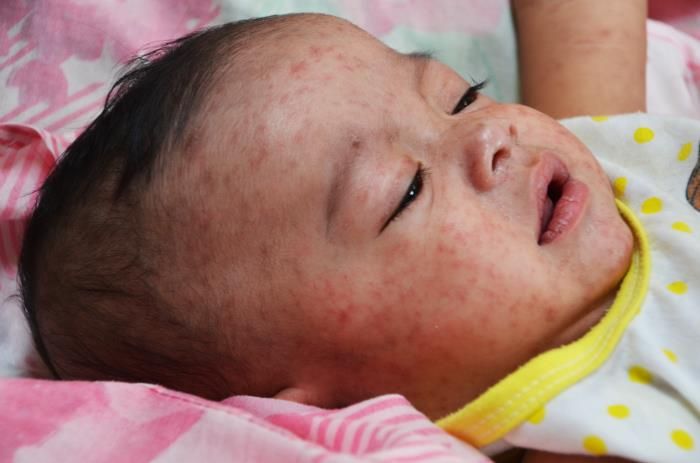
The nation's first measles-related deaths this year were reported in Pennsylvania in August, and five more have followed, according to state health officials. (Some of these deaths have not been confirmed by the federal government.) A death reported in Wisconsin and another in New York have brought the current total to eight, per states' counts.
In the U.S., about 1 to 3 out of every 1,000 measles cases results in death. Pennsylvania has recorded just over 1,500 cases, so its number of reported deaths is higher than expected, hinting that the state's true case rate has not been fully captured in the data.
In survivors, measles can cause long-term health problems, including brain damage and immune amnesia, in which the immune cells tasked with remembering past infections have their "memories" wiped.
The PAHO's meeting to reevaluate the United States' status was originally scheduled for April but was pushed to November.
To regain its measles elimination status, the U.S. must go 12 months without continuous spread of the virus.
Disclaimer: This article is for informational purposes only and is not meant to offer medical advice.





 Bengali (Bangladesh) ·
 English (United States) ·