

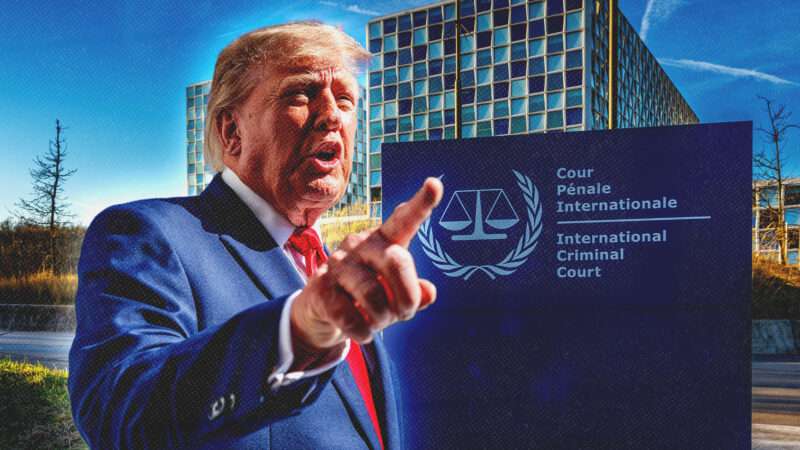
The Nobel Peace Prize announcement last week was an awkward moment in U.S.-European relations. The Nobel Committee in Norway awarded the prize to Navi Pillay, a South African judge who used to lead the International Criminal Court (ICC) in The Hague. Hours later, U.S. Secretary of State Marco Rubio announced yet another round of economic sanctions against the court, vowing to "end the ICC." Dutch Prime Minister Rob Jetten, whose country hosts the ICC, told reporters that he would use "every available means to protect the functioning of the court." And several other U.S. allies issued statements supporting the ICC.
Just before the Nobel showdown, a lawsuit by Americans challenging the anti-ICC campaign moved forward. Matthew Smith, a researcher who provided information to the ICC about atrocities in Myanmar, and Akila Radhakrishnan, a lawyer who had been helping the ICC prosecute the Taliban's crimes against women, have sued President Donald Trump over Executive Order 14203, a February 2025 measure banning Americans from providing "services" to the ICC. Smith and Radhakrishnan argue that the order violates their First Amendment right to share facts and analysis. On September 28, a judge ruled that there is a "strong likelihood" that this is correct, allowing the case to proceed.
The campaign against the ICC has many ironies. One is that Rubio himself used to sing the court's praises. As a senator, he cosponsored a 2022 resolution demanding that the ICC prosecute the Russian invasion of Ukraine and applauding the tribunal's mission "to uphold the rule of law, especially in areas where no rule of law exists." A bigger irony is that, in the name of protecting national sovereignty, the administration is trying to restrict both the decisions other nations can make and the ability of Americans to communicate across borders. And Trump has made it clear that these actions are to protect a foreign country.
Executive Order 14203 begins by condemning the ICC's "illegitimate and baseless actions targeting America and our close ally Israel." (In fact, the ICC has not issued warrants against Americans, only Israelis.) Rubio is "not trying to defend me. He's trying to defend Bibi and various other people," Trump said at a July 2026 cabinet meeting, using a nickname for Israeli Prime Minister Benjamin Netanyahu.
The ICC does not have any power beyond what members give it. The court was created by the Rome Statute of 1998, in which 137 countries agreed to cooperate to prosecute genocide, crimes against humanity, war crimes, and the crime of aggression. The United States and Russia signed but then later withdrew their signatures. Unless the U.N. Security Council made a unanimous referral—which would require Russian and U.S. consent—the new court in The Hague could try only crimes involving the citizens or territory of Rome Statute parties. The ICC also asserts that it won't try crimes that are already covered by domestic courts.
The ICC is often confused with an older institution in The Hague, the International Court of Justice, created in 1945 to resolve disputes between U.N. members. Unlike the ICC, the International Court of Justice has no ability to prosecute individuals.
Despite leaving the Rome Statute, the U.S. government worried that its officials could be prosecuted for their interventions in foreign countries. In 2002, President George W. Bush signed the American Service-Members' Protection Act, nicknamed the "Hague Invasion Act," which authorizes "all means necessary and appropriate to bring about the release of any U.S. or allied personnel" in ICC custody. After becoming Trump's national security advisor in 2018, the ultra-hawkish former Bush official John Bolton declared the ICC's very existence "an assault on the constitutional rights of the American People and the sovereignty of the United States."
In 2020, the ICC began investigating atrocities in member state Afghanistan, raising the possibility that it could indeed fulfill Bolton's fears of prosecuting Americans. Trump declared a "national emergency" and froze the bank accounts of two ICC officials. (So far, the court has issued warrants only against members of the new Taliban government, and the prosecution says that it "prioritizes" prosecuting crimes by the Taliban and the Islamic State group.) Beginning in 2023, at the urging of member state Ukraine, the court has issued warrants against Russian officials, including President Vladimir Putin, for their actions on Ukrainian soil. President Joe Biden shared intelligence about the Russian invasion to support the ICC prosecution.
Most controversially, the ICC recognized Palestine as a state in 2015. The move followed a 2014 war between Israel and Hamas, a Palestinian group opposed to the official Palestinian Authority. The U.S. government mobilized to protect Israel from any legal action. President Barack Obama tried to pressure Palestinian Authority President Mahmoud Abbas out of seeking ICC membership, and Congress passed a law automatically cutting off aid to Palestinians over any move "that subjects Israeli nationals to an investigation for alleged crimes against Palestinians."
Following the October 2023 attacks by Hamas and the subsequent Israeli invasion of Gaza, the ICC issued arrest warrants against leaders on both sides. Of course, Hamas officials didn't plan to travel anywhere that they could be prosecuted, and all three leaders named by the ICC ended up dead anyways. On the other hand, the ICC warrants could potentially block Netanyahu from traveling anywhere in the First World. Letting Netanyahu visit Europe again became a major focus of Israeli diplomacy.
And U.S. diplomacy. "This court is for Africa and thugs like Putin," the late Sen. Lindsey Graham (R–S.C.) reportedly said, according to former ICC prosecutor Karim Khan. Biden called the warrant against Netanyahu "outrageous," accusing the court of making a false "equivalence" between Israel and Hamas. But the Biden administration tread carefully about attacking the ICC head on, given its importance to Ukraine. Netanyahu said in a 2024 interview with former Trump administration official Morgan Ortagus that he was "surprised and disappointed" that Biden wouldn't support "bipartisan" sanctions against ICC officials.
The second Trump administration was far more eager. Last month, U.S. Ambassador Matthew Whittaker demanded that all NATO countries pull out of the ICC, warning them that "we will be watching closely who stands with America." And thanks to Executive Order 14203, these threats have teeth. The Trump administration has been overturning individual ICC judges' lives under the order, which bans the ICC from interacting with the U.S. economy. Canadian judge Kimberly Prost, for example, reported that her bank account and credit cards were frozen, along with her accounts with Amazon, Google, and Expedia. In July 2025, the State Department sanctioned three Palestinian charities that had urged the ICC to investigate Israeli air raids.
The administration even used Executive Order 14203 to target the Italian academic Francesca Albanese, who has no official role with the ICC but wrote a report for the UN Human Rights Council recommending prosecutions of people and companies involved in the Israeli war effort. Albanese's husband, who works at the World Bank in Washington, had his apartment seized by the U.S. Treasury. The couple was banned from visiting their American daughter.
In other words, any public figure of consequence anywhere outside America who calls Netanyahu a criminal can be relentlessly persecuted by the U.S. government. That sure sounds like the kind of one-world government that Bolton and Rubio have warned about, using its powers against offenses far lighter than the crimes the ICC investigates. And unlike the ICC, the U.S. Treasury's sanctions enforcement arm gives neither the accused the right to defend themselves in court nor other countries the right to opt out.
The real question is how far the administration will go preventing American citizens from talking to the court. So far, American companies (and even non-American companies) have obeyed U.S. sanctions against ICC judges. This handful of customers, it seems, is not worth being fined or losing access to the U.S. dollar system. But individual Americans may also want to talk to the court because they have information about war crimes in Ukraine or the Congo, and the U.S. government has tried to push the limits of how it defines sanctionable services.
The Trump administration has "raised a Sword of Damocles over the heads of Plaintiffs and others who wish to communicate with the ICC but are chilled from doing so," lawyers for Smith and Radhakrishnan told the court. "Whether Plaintiffs or others like them may speak to the ICC without falling afoul of the Order and Regulations depends on what they say."
The post Inside the Trump Administration's War on The Hague appeared first on Reason Magazine.





 Bengali (Bangladesh) ·
  English (United States) ·