
 5 hours ago
2
5 hours ago
2 
Women’s stories feel different to me. People say that if only women ruled the world, there would be no more war (a lovely thought, and one I’ve been returning to lately) because women are socialized to revert first to empathy, to the collective rather than the fiercely individual, to taking care of other people and thinking of their needs, sometimes to a fault. We see that in the lens they bring to their fiction. Women in war hold families together; women in fiction often emphasize the vulnerable, rather than the physically strong. And they act—as the International Prize for Arabic Fiction (IPAF) called the women in Amira Ghenim’s A Calamity of Noble Houses—as “custodians of memory,” preserving a version of events that course-corrects accepted patriarchal accounts.
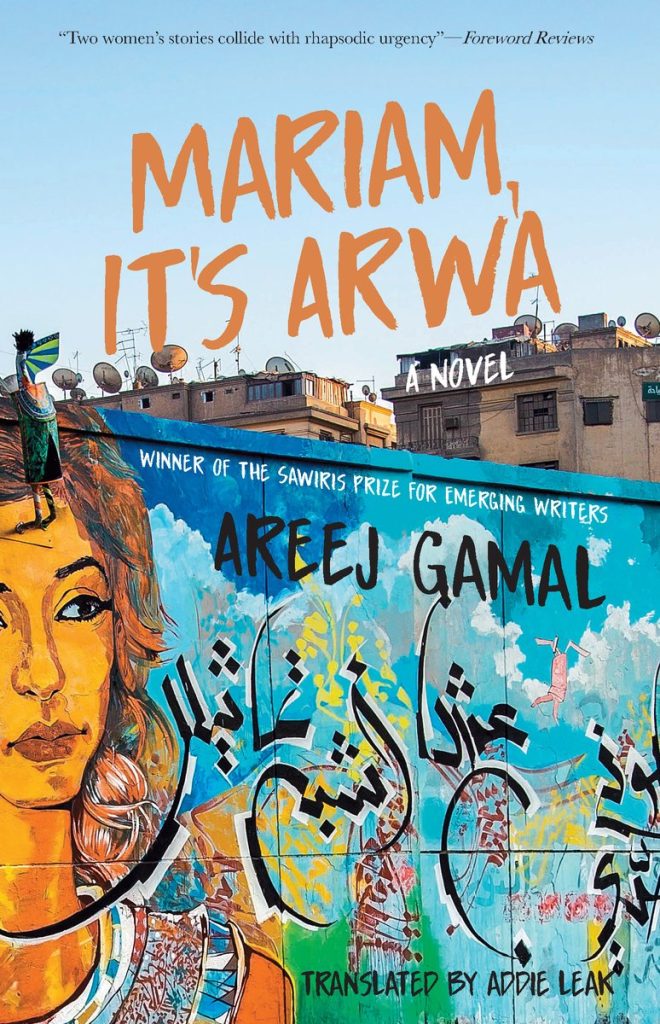
Over four years, I had the privilege of reading and translating Areej Gamal’s Sawiris Prize-winning novel Mariam, It’s Arwa. The book, emphatically and sublimely female, is about a multiplicity of revolutions, the most literal of them appearing in its frame plot, during the Arab Spring in Tahrir Square and Cairo’s streets. The novel spans generations of women: the mother who falls in love across class and religion and risks everything to follow her heart; the daughter who leaves an unhappy home and emigrates to Germany to find herself; the abused grandmother who has internalized the idea that a woman is nothing if she doesn’t bear a son; and the mother who nearly dies in her quest to make that dream a reality. And of course, the two main characters’ love is its own revolution—a remaking of the world as a more inclusive place in spite of itself, even if their world is one small apartment on Champollion Street. It’s my favorite kind of book: a book by a woman about women taking their lives into their own hands. One that centers women at the forefront of revolution/war and social change.
While my definition of “revolutionary” here is broad—encompassing societal revolution and personal rebellions against tradition—I admit that war is at the forefront of my mind. As I’m writing this, the normal city sounds in Amman, Jordan, where I am, are interspersed with emergency sirens, occasionally fighter jets and explosions. The US and Israel are attacking Iran, which is attacking back, and we are war-adjacent. More or less safe—we hope—but affected, as is the entire region. It’s hard not to see echoes of this chaos appearing in some of the novels on this list. But when I look around, I’m grateful to see echoes of the heroines’ tenacity and resilience, as well. These novels have much to teach us about the importance of knowledge-gathering and memory, seeking out joy in the midst of crisis, and rejecting any entity that tries to write our stories for us.
Woman at Point Zero by Nawal El Saadawi, translated by Sherif Hetata
Nawal El Saadawi (1931-2021), the Egyptian writer, medical doctor, and psychologist, has often been compared to Simone de Beauvoir and Virginia Woolf—an outspoken feminist and activist whose writing had a dramatic impact on generations. Jailed under Sadat for “crimes against the state,” she wrote about authoritarianism, feminism, and capitalism, and Woman at Point Zero—what the British-Palestian writer and lawyer Selma Dabbagh calls a “small volume of fury”—is one of her seminal works. The main character, Firdaus, is in prison awaiting execution after killing a man. As she tells her story, it is difficult not to feel both anger and empathy. There are few points of hope in the book, in which money is the only source of autonomy for a woman and prostitution near-inevitable for one born without, yet it is through landmark novels like this one, with its fierce condemnation of patriarchal society, that change is possible. Pleasant? No. To say that the book needs a content warning would be an understatement. Important? Incredibly.
The Granada Trilogy by Radwa Ashour, translated by Kay Heikkinen
I first read William Granara’s translation of Granada, the trilogy’s first book, as part of a book club, where members were heartbroken that the subsequent parts were untranslated. Now, for the first time, the whole trilogy is available in English. The story begins in 1492, when the Arab kingdom of Granada falls to the Christian Castilians, and the Moorish presence in Spain becomes unstable. The text follows a Muslim family as it tries to make sense of the forced conversions, book burnings, job loss, immigration, rebellion, and Inquisition until, one hundred years later, their descendants are deported en masse. The women in the book stand out, particularly Salima, a great lover of books and a healer, and Maryama, her sister-in-law, who is clever, defiant, and compassionate, a rallying point for the community in chaotic times. Women are at the core of this book, conserving knowledge and holding their families together.
Planet of Clay by Samar Yazbek, translated by Leri Price
Told in lyrical, often cinematic prose from the perspective of a neurodivergent young woman named Rima, Planet of Clay depicts the Syrian Civil War and the aftermath of the chemical attack and siege on Ghouta. Rima, who does not speak, spent much of her childhood in a school library and has a deep love of books and painting. We find her lost in her thoughts when the book opens, trapped in a cellar with only boxes of paper and a pen, recording her story as she runs out of food. The war has stripped her of all the people she loved, and she cannot grasp why. “We are toys made out of clay, small toys, quick to break and crumble,” she writes. Still, this careful storyteller sees beauty at times when others don’t look for it, using her imagination to make sense of and find light in a dark world.
A Calamity of Noble Houses by Amira Ghenim, translated by Miled Faiza and Karen McNeil
Set in 1930s Tunis, A Calamity of Noble Houses was shortlisted for the IPAF in 2021. It begins with Tunisian revolutionary Tahar Haddad, author of Our Women in the Shari’a and Society, and places her in the context of two upper-crust families, the conservative Ennaifers and the more progressive Rassaa family. Here, Haddad, a real historical figure from humble origins who was instrumental in shaping the future of women’s rights in Tunisia, falls in love with the young Zbaida Ali Rassaa, who becomes the wife of Mohsen Ennaifer. When dubious accusations of an affair surface, tragedy strikes. The novel decenters Haddad to tell the story of the two families as narrated by eleven different characters from disparate social classes who, together, paint a rich portrait of a nation in flux, spanning several decades.
Passage to the Plaza by Sahar Khalifeh, translated by Sawad Hussain
In 1987, during the First Intifada, a curfew is imposed in a Nablus neighborhood, and three women are trapped inside the same house. Nuzha, its owner and daughter of a prostitute, is furious at society and the whispers that her mother was a spy for Israel. Sitt Zakia, a middle-aged midwife, uses faith as a barrier against the political violence surrounding her. And Samar, the optimist, is a university graduate studying how the Intifada has affected Palestinian women’s lives. Together, they hatch a plan to thwart Israeli soldiers’ effort to barricade the street. Like Mariam, It’s Arwa, this novel doesn’t gloss over the multiple fronts of the ongoing revolution. When it was published in 1990, the novel was criticized for daring to depict domestic violence on the part of Palestinian freedom fighters. But Khalifeh makes it clear that these women’s oppression is twofold: both Israeli Occupation and the patriarchy itself.
Minor Detail by Adania Shibli, translated by Elisabeth Jaquette
A finalist for the National Book Award and longlisted for the International Booker Prize, Minor Detail won the 2023 LiBeraturpreis, but the awards ceremony was indefinitely postponed in solidarity with Israel after the October 7 Hamas attacks—a move that drew criticism from numerous organizations. The novel is a haunting meditation on war and memory that includes two intertwined stories. The first begins in 1949, when an Israeli battalion massacres an encampment of Bedouins in the southern Negev and abducts a Palestinian teenager whom they rape, kill, and bury. The second is the story of a young woman from Ramallah, born twenty-five years to the day after this crime, who sets out to uncover more details about it, encountering obstacle after obstacle as she attempts to access archives that will give her information about her country’s past. This is knowledge-seeking as revolution at its best.
Blood Feast by Malika Moustadraf, translated by Alice Guthrie
In Palestine, Searching for the Remains of My Grandmother’s Village
An excerpt from “The Hollow Half” by Sarah Aziza

Malika Moustadraf was a force of nature and an icon of feminism who passed away in 2006, at just 37 years old. A “rebel realist,” as she called herself, Moustadraf’s prose is so embodied that it often turns the stomach. It details what translator Alice Guthrie calls “an unflinching look at the worst traumas of the female experience in patriarchal society, shot through with wit, wordplay, and razor-sharp political commentary.” Her stories fearlessly take on abject poverty, religious hypocrisy, pimps and incels, a girl’s horrifying first period, cybersex, and the failure of the Moroccan medical system to help those in need. Moustadraf was maligned in her time due to her literary activism, and her two books had fallen out of print in Arabic at the time of her death; it’s thanks in large part to Guthrie’s tireless advocacy that her writing is now available again in both Arabic and English.
The Story of Zahra by Hanan al-Shaykh, translated by Peter Ford
I bought my Arabic copy of this book for the cover art: a girl in a swing, her eyes closed, a daisy covering her mouth. Then I read about Zahra—“flower” in Arabic—a girl who yearns to be close to her mother, who, in turn, uses Zahra as a shield in her love affair. Originally published in 1980, this classic of the Lebanese Civil War is about a young woman seeking to establish her own identity, one who spends years escaping. First from an authoritarian father and disappointing mother to West Africa—where she has a miserable marriage—then back to war-torn Beirut, where she begins an affair with a sniper. The book tackles childhood trauma, assault, the complex emotional landscape of emigration, and the stigma surrounding female sexuality. Unlike Firdaus in Woman at Point Zero, Zahra experiences and embraces pleasure—a point of hope, if not ultimately of salvation.
The post 8 Revolutionary Novels and Stories by Arab Women appeared first on Electric Literature.




 Bengali (Bangladesh) ·
  English (United States) ·