
 2 hours ago
2
2 hours ago
2 
In a three-act whirlwind, autopoetic, hybrid play about the unborn ghosts of daughters lost to sex-selective elimination, Soham Patel’s The Daughter Industry delivers a genre abundant staging of social and economically produced gender woes. From sissy boi to high femme princess, seven players perform a complex yoga routine, lip sync, and engage in karaoke sing-offs to examine the bind of moving through a society that privileges the birth of those assigned male at birth, and figuring out where that leaves those who were determined, before birth, to be less socially viable. Hence the daughter industry, which churns out unborn ghost after ghost.
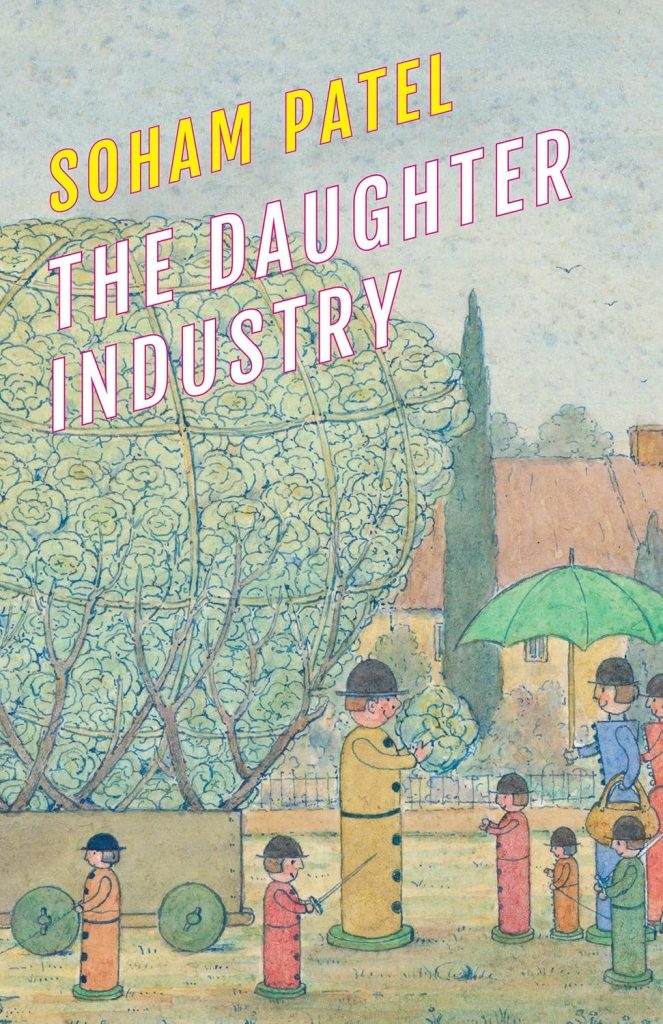
Despite the gravity of this subject, The Daughter Industry is lovingly choreographed by Patel’s recognizable charm, humor, and playfulness as a writer—traits which their players embody as well. Moody Scorpios and fastidious Virgos abound in this book, and gender becomes both a marker of where you are in this place and time as well as a moving target. The cast gives us this rich gender discourse while going into happy baby pose.
While Patel’s formally inventive deep dive into sex selective elimination takes on the South Asian Diasporic context, I am rocked by how we are all culturally implicated in this violent industry of assigned sex and the subsequent roles we are to perform, particularly as daughters. And yet, I am grateful for the ways Patel reminds us that there are still tender ties to our gendered upbringings. Our bodies are continuously yearning for answers, belonging, and to be free. Talking with Patel, I am reminded that the search for genres and forms that can hold these complicated questions is just as meaningful as the ways we make choices about how we embody our gender(s) in this lifetime.
Over email, Patel and I talked about the inextricability of genre and gender “bending” in The Daughter Industry, as well as the various bends, folds, and stretches that accompany the book’s elaborate yoga routine, and more.
Muriel Leung: The title of your latest collection is quite a legendary multi-genre assemblage: The Daughter Industry: A Hauntological Confession, Alternative History, Speculative Autopoetics in Three Acts with Seven Players. In so many ways, the charge of this genre-defiant work is consistent with its gender-defiant message, something we see in the gender bending and multiplicitous cast list (“all unborn ghosts”), and the opening poem “In My Dotted Suit and No Dupatta,” in which the speaker moves through having found their gender to “I hadn’t yet found my gender.”
Can you share the story behind this title (and illustrious subtitle)? How does the title mirror the intertwined relationship between genre and gender you’re thinking through in this work (especially the ghostliness of it all)?
Soham Patel: I’ve thought about the word “daughter” all my life because my parents gave me a name that’s traditionally assigned to sons. I know they wanted a boy and actually, when I was twelve or thirteen, one of my uncles started calling me Sohambhai (bhai meaning brother). It was a term of endearment while also him lowkey poking fun at my T-boy expressions. Gender’s always been a little confusing to me, but I don’t necessarily mean confusing as a bad thing. It’s a curious thing. That led me to the question “what makes a daughter?” and that’s where industry—that idea of making or manufacturing—plays into the title. Sex selection is an industry that eliminates daughters before they are born.
This is why the book is also a hauntology. It sees the ghosts of unborn folx, past, present, and future. One poem early in the collection is built around a speaker describing seeing a ghost. It also works within the tradition of confessional poetry: intensely vulnerable, controversial, conversational. I saw that ghost, and that was one of the starting points of this book. It’s an alternate history that examines a world where these victims of sex selection, these would-be daughters, (maybe) could have been born. I am making many selves through a poetics that imagines new realities about welcoming genders beyond the binary.
ML: That makes me think of Kazim Ali’s coining of the term “genre queer,” referring to the way genre, much like gender, is reflective of the myriad possibilities for embodiment and presentation.
There are seven players in the book, each of uncertain astrological placement and equally uncertain lineages, whose drama is told through a three-act structure, harkening Western dramatic forms, and also calling upon conventions of Indian theatre. What forms of play/performance did you feel called to draw on for the structure of this drama?
SP: The players allow me to draw on persona as form, messenger speech, and dramatic monologue. I wanted a multigenerational troupe of many genders to tell this story. Sai is masculine-presenting and serves as the solid older bro. Sajani is the matriarch. Suvali is the handsome femme sister who leaves town then comes back home. Sasmita’s younger and thinks this whole problem is audacious. Shasha/Sheetal, they’re kind of shy and obedient but not really. Sarah participates in heteronormativity and defends son preference while she understands it’s fucked up.
The elders’ discourse is more narrative while the younger ghost’s language use is more conceptual, they use documentary forms and are a bit more playful with the book’s topic and with each other. They’re irreverent but still they learn about the graveness of their situation and their playfulness eventually, by Act III, influences their elders.
ML: How realistic that there would be hierarchy even among the unborn! Why then a verse play? What does the use of verse in play form allow you to do?
SP: Making it a verse play took the pressure off of me and let them talk to each other. The three-part structure is based on the ayurvedic doshas: The first act is grounding, the second act is fire, a kind of metabolism, and the third act is air that’s evaporating not simply in acceptance, more at peace and accounting for the trace elements left by the sex selection processes. I tried this three-part structure in my first two books and I like how it forces some order on my chaotic ways of thinking,
I also draw on Kathakali theatre’s incorporations of music and dance and its elaborate use of tiny gestures, physical expression, and audience interaction. In the book, the players invite generative participation from readers by practicing yoga, staging a flash mob, throwing drag shows and lip synch revelries. Since a play gives the book a life beyond the page, I want The Daughter Industry to belong to other people and for them to imagine how these ghosts should occupy a stage of their own creation much like in the tradition of V.’s The Vagina Monologues.
ML: All this dynamism feels antithetical to the predetermined death issued by sex selective elimination. I feel the veils of this reality and the spirit realm become porous through every yoga pose and lip sync.
Earlier, you had mentioned your personal connection to the word “daughter.” I’m thinking of the title of your book again, where an industry of daughters indicates that “daughter,” much like girlhood, boyhood, or gendered roles or social positions are all manufactured through the joint production of culture, market mechanisms, and even proximity to or literal death. How has writing this book altered, if at all, your relationship to the term “daughter”?
SP: Daughter is speculation in the same way investments are. “Daughter” can be considered an asset that has a transactional value like a dowry or a diamond engagement ring or the wedding’s rehearsal dinner bill or covering the sangeet reception’s open bar. Both daughter and son function as commodities. In the book some of that function gets shuttled through poetry about trade, marriage, and parenthood. Writing the book also altered my relationship to the term daughter because it got me thinking about the term son with more complexity. I became more patient with both terms. For example, the work made me more sympathetic to the real pressures that are put upon sons within the context of son worship and patriarchal structures. This allowed for more room to give love to the boys and men in my life, that’s why I dedicate this collection to them.
ML: From a Chinese cultural context, I think too of what it means to not be just the eldest daughter but a “daughter-son” fulfilling both roles, given my disabled younger brother’s inability to fulfill traditional social and economic responsibilities as the son. I’ve always known that daughters are treated as commodities, but I think less about how sons participate in this gender economy too, so your explanation also helps me think more compassionately about the overall system we’re indoctrinated into.
Your mention of speculation, which is a market term as well as a literary one, also suggests play and imagination. I see this in the syntactical restlessness of your work. Lines that are playful at times, and at other moments emphasize with great seriousness the stakes of gender violence taking place through interrogation of medical language, religious tradition, and treatment of women as property. How do you know when it is appropriate to crack a joke on the page versus pushing forward a critique?
SP: At a certain point these ghost voices spoke to me and I became their interlocutor. As I moved in the world, I saw it through them and now they live with me and influence how I am thinking. Sometimes when I am watching TV with my wife, I point at a character and say something like, “He’s such a Sai,” “She’s totally giving Suvali,” etc. Sasmita’s likely cracking most of those jokes because for them, witticism can at once offer relief and put forward a critique. Shasha/Sheetal treat crisis with a cool irreverence too, sometimes they simply perform documentary poetics as they repeat the terrible things they overhear with a tonal disdain. Sajani, Suvali, and Sarah are more elegant and conditioned by these traditional forces that almost, but don’t quite, silence them.
ML: I think most people think of ghosts as fixed presences, static in their desires and post-life haunting. But these seven players change their minds, challenge the system of sex selection, confront the contradictions within their own beliefs, and learn that their own relationship to gender influences their positions. I imagine it’s a balancing act to write this book and to see how these different unborn ghosts impact each other.
As this manuscript began as your University of Wisconsin Milwaukee PhD dissertation, can you speak to how these players’ journeys have evolved over the years?
SP: Pronoun preferences and normalizing nonbinary genders became everyday language I didn’t have access to when I started writing these poems in 2010. Mine transformed from “she” only to include “they” which of course reshaped the use of “I” in my collection of lyric poetry about gender, reproduction, and the ghosts of sex selection. And while I read plenty and saw so many media representations, I still knew nothing firsthand about some topics the book approaches, and still [don’t], never will. Childbirth, for instance, or some experiences of both boyhood and girlhood.
I took a full-time job as an editor straight after completing my PhD. That day job transformed the book’s nighttime revision process in that I newly understood I could cut and reshape the drafts without losing the book’s essence, and I could think about audience more expansively. In the detached role of an editor, I discovered an intellectual and emotional freedom that had been impossible to access before. I also became a step-parent to two beautiful teenagers and that made my relationship fuller with the work. This major shift made me understand Suvali and Sajani’s perspectives on parenting with more accuracy as they now were informed by my lived experience. The speaker of these poems—persona, pantomime, the self of lyric I or otherwise—is always learning and language changes in their worlds every day.
ML: You’ve also published other collections that grapple with gender through ecological considerations—to afar from afar; ever really hear it, winner of the Subito Prize; all one in the end—/water. How do natural elements, from the blended forms that frame each act to the movement and scattered placement of humans that is diaspora, shape this work?
SP: Act II attempts a decentering of the human as it makes a thematic shift to exploring the reproductive practices of some animals. I watched all the videos in Isabella Rosselini’s Green Porno series many times as part of the research for adding this new vector into the book. Her animated shorts were such a great resource and offered a framework for challenging anthropocentric notions of gender.
Something I like about this book is that the work from all my books shape and influence it. The critical race theory and maudlin nostalgia from every really hear it is there, the question of home and belonging from to afar from afar appears, and the ecological crisis born from surveillance paranoia and corporate greed inevitable in our late capitalist structure that worries all the way through all one in the end—/water shores up in this book too. Flood subjects culminating.
ML: Indeed, this kind of spillage abounds and has cumulative force in The Daughter Industry! The collection takes us through a yoga routine—Sid (Sidhangana) does a series of prone poses, then serpent or cobra pose, savanasa the next, chants om, and goes into dead man’s pose—set to a playlist that includes pop classics like Whitney Houston’s “I Will Always Love You” and Destiny Child’s “I’m A Survivor.”
One of my most cherished memories of you is witnessing your rendition of Gloria Gaynor’s “I Will Survive” at AWP Literaoke in Tampa, Florida. I think at some point during your belting of the line, “You’d think I’d lay down and die,” you fell to your knees, and then in the next moment, staggered up with “No, not I, I will survive.” I believe you got some standing ovations, or it could just have been me waving my sweater like a propeller in the air. How do your daily practices and pop culture affinities make their way through the book? And what are some additional poses and songs you would like to add to the karaoke queue?
SP: Oh, I like this game! Add Madonna’s “Vogue” where we can strike a pose while singing along with that queer anthem and “I’m Every Woman,” Chaka Khan, 1978. Besides warrior one and two, I didn’t explicitly fit many triangle poses into the book. These always reshape my days into better ones when I do them, so let’s add some. Right now, as I’m composing these answers (it’s a Sunday, the first day of February in 2026), I just want to rest a bit in child’s pose because I’ve been watching on my phone so many people I love living through all the unrests brought by apocalypse, the start of a civil war, and the end of an empire. So I need to calm my nervous system daily or else I won’t survive. I’d love to start a running queue for any reader of the book interested in participating.
The post Reviving the Unborn Ghosts Lost to Sex Selection appeared first on Electric Literature.




 Bengali (Bangladesh) ·
  English (United States) ·