

In his second inaugural address, President Donald Trump pledged to crack down on illegal immigration: "All illegal entry will immediately be halted, and we will begin the process of returning millions and millions of criminal aliens back to the places from which they came." The administration set a minimum goal of 3,000 deportations per day.
There was a problem. At the time, Immigration and Customs Enforcement (ICE) operated or contracted with more than 200 disparate facilities across the country, from federal detention centers to county jails, and it had the resources to detain only about 41,000 people at a time. To reach its daily deportation goal, the government would have to scale up its capacity. So this year the Department of Homeland Security (DHS) has gone on a real estate shopping spree, spending hundreds of millions of dollars on warehouses across the country. The plan: to transform them into detention centers for undocumented migrants.
It is inhumane to store human beings—people who in many cases have not been convicted or even accused of anything more serious than civil immigration violations—in warehouses like so much freight. It is also far too costly, both in tax dollars spent and in harms imposed on the communities where these holding centers are being built.
Congress Gave ICE $45 Billion To Build Detention Centers
The 2025 One Big Beautiful Bill Act gave ICE the money to hire 10,000 new immigration officers, plus $45 billion for "single adult alien detention capacity and family residential center capacity." A Homeland Security press release announced that this funding "provides ICE with enough detention capacity to maintain an average daily population of 100,000 illegal aliens and secures 80,000 new ICE beds."
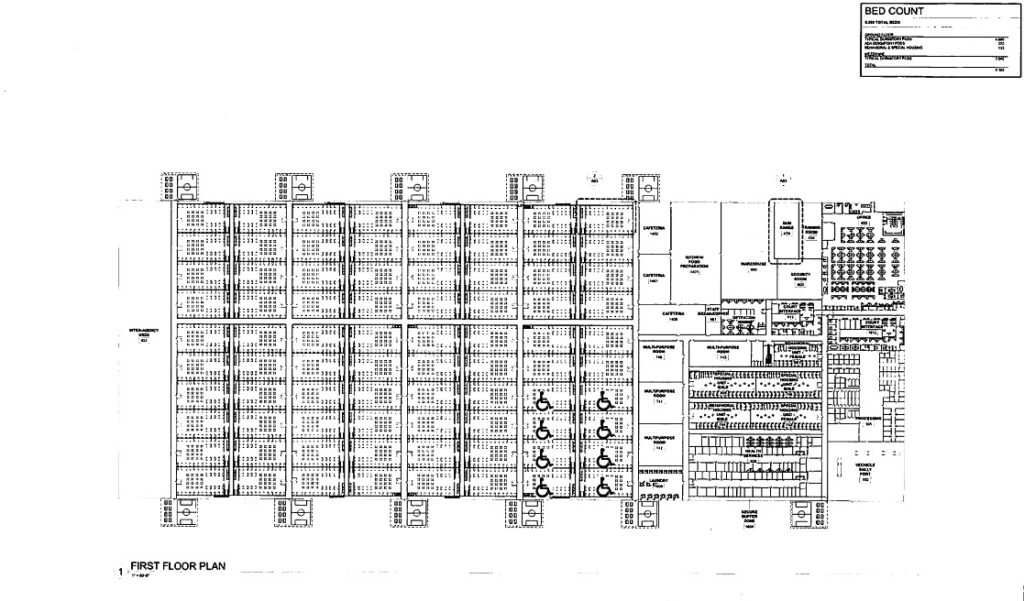
The department immediately started buying up industrial warehouses across America. According to DHS documents, the plan is to streamline operations to 34 dedicated facilities with a total detainee capacity of 92,600. This would include "the acquisition and renovation of eight large-scale detention centers and 16 processing sites." The processing sites would hold up to 1,500 detainees for a few days at a time. A blueprint in a DHS report shows elaborate centers with kitchens, cafeterias, laundry facilities, gun ranges, and housing for up to 10,000 detainees. Homeland Security claims these will be ready for use November 30.
 U.S. Immigration and Customs Enforcement
The administration doesn't like to call these facilities warehouses. They "are not warehouses—they are detention facilities," recently departed DHS spokesperson Tricia McLaughlin told The Washington Post in January. An ICE spokesperson tells Reason that "these will be very well-structured detention facilities meeting our regular detention standards." But no matter how they dress it up, ICE acquired industrial properties with empty warehouses designed to store and transport freight, with the intent to use them for storing and transporting people.
It's not like ICE's "regular detention standards" are anything to be proud of. There have been numerous reports across the country of inhumane conditions in ICE facilities. In just 50 days at Camp East Montana, a detention center at Fort Bliss, Texas, "migrants were subjected to conditions that violated at least 60 federal standards for immigrant detention," The Washington Post reported in September. Three detainees at the camp died within six weeks, and the Associated Press reported that the staff were taking "bets…over which detainee would be next to die by suicide." In March, officials shut down access to Camp East Montana after 14 detainees tested positive for measles, before announcing a new contractor would take over.
It's also worth noting that as of February 7, 2026, about 74 percent of the people held in ICE custody—50,259 out of 68,289 detainees—had no criminal convictions, despite Trump's repeated pledge to go after the "worst of the worst." David J. Bier, director of immigration studies at the Cato Institute, similarly found that of all the people ICE detained from October 1 through November 15, 2025, only 5 percent had been convicted of a violent crime, 73 percent had no criminal convictions of any kind, and 47 percent had no charges pending either.
The Trump Administration Is Overpaying for ICE Real Estate
The warehouse detention centers won't be cheap.
Take the facility that the DHS bought in Surprise, Arizona. It paid $70 million for the warehouse. The agency estimates that it'll cost another $150 million to retrofit the building into a processing site, plus $180 million to operate it for its first three years. That's $400 million for just one spot, projected to house up to 550 detainees at a time.
The feds have often paid more than the properties appear to be worth. In January and February alone, ICE "bought industrial space totaling more than 6.8 million square feet…for at least $894 million, often paying a premium for the real estate in the once white-hot U.S. industrial market that is now dealing with a downturn in demand," reports CoStar. "ICE appears to be paying an 11% to 13% premium, with some properties trading at over 30% of recent comparable trades in the market." That $70 million warehouse in Surprise? The tax assessor gave it a valuation of $46 million.
"You paid $129.3 million for a facility in my state that was assessed at less than half of that, at $62 million," Sen. Cory Booker (D–N.J.) told then–DHS Secretary Kristi Noem during a Senate oversight hearing in March.
ICE bought one 235-acre plot—in Social Circle, Georgia—for $128.5 million. Its prior owner, a real estate developer, paid $29 million for the property in 2023 and built a warehouse there, an improvement the tax assessor valued around $26 million.
"In Oakwood, Georgia, the government paid $68 million for a warehouse and surrounding land that was appraised in 2025 for a combined $7.1 million," adds USA Today. "Experts in federal property acquisition said DHS may be paying high prices to compel developers and commercial landowners to sell their property despite local opposition." You can do that when you have billions to play with.
GOP Congressman Says Georgia Town Doesn't Have 'Sufficient Resources'
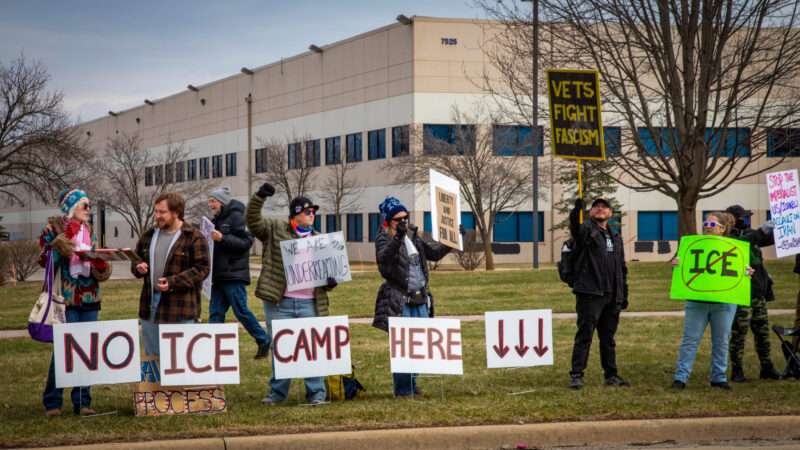
Indeed, there has been considerable local opposition—even in otherwise sympathetic locales, where neighbors worry about the effect a sudden influx of guards and detainees could have on the existing infrastructure.
Many of the chosen sites are in rural areas. Social Circle has just under 5,500 residents, according to the U.S. Census Bureau, but the detention center that ICE plans to build there would hold up to 10,000 detainees. When fully staffed and at capacity, it would triple the local population.
"Sites undergo community impact studies and a rigorous due diligence process to make sure there is no hardship on local utilities or infrastructure prior to purchase," an ICE spokesperson tells Reason.
ICE's infrastructure analysis said the center in Social Circle would generate about 1 million gallons of wastewater per day. The area is currently served by a wastewater treatment facility with a 1.25 million gallon daily capacity, and the city had already committed to build a new plant. But as city officials have warned, the "current wastewater system processes 660,000 gallons a day and is already operating at capacity. It cannot accommodate an increase in usage of this magnitude."
They added that the 1.25 million gallon facility is located in another county and does not service the site or any part of the town. And while the city did plan to build another treatment plant, construction would take 18 months—and even then, it would process only 1.5 million gallons per day.
The planned processing center in nearby Oakwood, slated for 1,500 beds, would run into the same problems. City manager B.R. White tells Reason the town is already near its wastewater treatment capacity, and a new ICE facility would compete for already-strained resources.
Both are Trump-friendly areas. The president won more than 70 percent of each county's votes in 2024. But political partisanship is not enough to overcome logistical hurdles.
"The City of Oakwood supports ICE's mission of apprehending and detaining individuals with criminal records," says a statement from the mayor and city council. "Our concern is not with the agency's lawful role in public safety. Our concern is with the proposed location and the process by which this site was selected, which occurred without consultation, coordination, or impact analysis involving any local governing body."
"Although I am aligned with the mission of ICE…I agree with the community that Social Circle does not have the sufficient resources that this facility would require," Rep. Mike Collins (R–Ga.), a stalwart Trump supporter who represents the city in Congress, wrote on Facebook. "I have asked DHS to continue evaluating the impacts that the facility would have on Social Circle and to ensure we can accomplish the mission without negatively impacting this community."
DHS Uses Fuzzy Math To Justify Purchases
Local officials don't just worry about what an ICE facility will do to their plumbing. They worry about what it'll do to the local economy.
When ICE builds a detention center in a rural area, it takes a place where a business could have gone instead. ICE purchased a property in Romulus, Michigan, to turn into a processing site with 500 beds. According to state Sen. Mallory McMorrow (D–Detroit), the government "outbid an auto supplier" to purchase the property.
ICE outbid an auto supplier to acquire a warehouse they intend to turn into a detention facility.
Hundreds of community members joined in support of the Romulus City Council - who voted unanimously on a resolution opposing this detention center. pic.twitter.com/Mb2nDelmlZ
— Mallory McMorrow (@MalloryMcMorrow) February 26, 2026
It also removes tax revenue from the local government's coffers. In 2025, that warehouse in Surprise, Arizona, yielded $341,000 in tax revenue. White tells Reason that the Oakwood property would have generated over $771,000 in total annual tax revenue—including $113,800 for the city and $435,000 for the school system. Eric Taylor, city manager of Social Circle, says the city's share of taxes from that property was $166,000. But the federal government is exempt from paying property taxes, so each of those properties will become an empty spot on the town's balance sheet.
ICE claims detention warehouses will be a boon to local economies. To do this, officials use the same industrial-policy arguments that state and local governments use when pushing to subsidize factories or stadiums.
An ICE spokesperson tells Reason that the agency expects the Oakwood facility to "bring 1,520 jobs to the area," "contribute $159.2 million to GDP," and "bring in more than $34.3 million in tax revenue." The detention center in Social Circle, meanwhile, would net 9,800 jobs, $1 billion in GDP, and $221 million in tax revenue.
"The numbers they toss out are a little like economic forecast numbers, which can be massaged," says White. "I would ask that they validate them. Show us your work, show us how it impacts us directly."
"They say they've done an economic impact analysis for our area," adds Taylor. "I have not seen it yet; I've been asking for it. But if it's anything like…their engineering analysis, I don't know that I would trust their numbers."
They're right to be skeptical. While it's certainly possible that the facilities will have some beneficial spillover effects, governments routinely promise big benefits to justify economic development subsidies—if we give money to this company, it will build a factory here, creating jobs and generating economic growth—that then fail to materialize. Taxpayers come out worse off.
This is just as true for detention facilities as it is for factories and stadiums. "Prisons bring substantial and persistent gains in public employment," according to a study by Janjala Chirakijja of Monash University published in The Review of Economics and Statistics. "However, additional jobs at the prisons generate little spillover effects on private sector employment and fail to provide a major boost to local economic activity."
Even if ICE's projections were accurate, there'd be little reason to believe these will be permanent jobs. In a press release, Rep. Andrew Clyde (R–Ga.) touted the Oakwood facility as "a major economic investment." But while an ICE spokesperson tells Reason the Oakwood processing site "and its construction" would "bring 1,520 jobs to the area," Clyde wrote that it "will support a total of 1,520 jobs during retrofit and up to 429 jobs each year of operation" (emphasis added). This makes more sense: Oakwood is expected to house 1,500 people, and a facility with one employee per detainee would be absurdly overstaffed. By comparison, federal prisons average one guard for every nine inmates.
Similarly, ICE says the warehouse it bought in Romulus, Michigan, "and its construction" will bring 1,458 jobs—nearly three times the number of detainees it plans to hold. The number of permanent jobs will certainly be far fewer.
This scenario is even worse than your average industrial-policy boondoggle. When cities or states subsidize private companies' projects in the hopes of creating economic growth down the line, any jobs that result from it are at least private sector jobs and will not be forever financed by taxpayers. Even if everything ICE promises comes true and the Romulus center supports 1,400 jobs, those jobs would be completely funded by the federal government, and by extension your taxes.
Courts Could Slow Down, or Block, ICE Warehouses
How can these communities keep the government from setting up an immigration warehouse and drying up their resources?
They have few options. "We're limited in a lot of ways just because of the Supremacy Clause of the Constitution, which says the federal government is not subject to the regulations of state and local governments," says Taylor of Social Circle. "Our zoning code doesn't allow a detention facility anywhere in the city, to start with. But since the federal government is not subject to zoning, you can't go after them and say, well, we don't allow that here."
But it might be possible to stymie the feds in other ways. "The little town of 5,000 people could waste the federal government's time going to court," says M. Nolan Gray, senior director of legislation and research at California YIMBY.
Gray is a fierce critic of zoning—he wrote a book called Arbitrary Lines: How Zoning Broke the American City and How to Fix It—but he's open to using such otherwise troublesome laws to kick out the feds. "My very principled position on local control is that I support policy being dictated by the level of government that will maximize human freedom and prosperity," he tells Reason. "I think local government should have the right to say, no, we don't want to have a federal concentration camp for immigrants in our backyard."
"The real thing that they can do," says Gray, "that would really cause an issue is just massively delay all of the things that the city is going to need to do for the facility. If the city controls water and other utilities, city inspectors and city engineers are going to have to go out and do that work. And they can do it slowly and in a hostile manner, or they can do it promptly. There's so many mechanisms like that where if a local government was really of the mind that we just don't want this, there's so many different ways they could slow it down and fully derail it."
In other words, cities can exert pressure by doing what governments so often do: bog projects down in red tape.
Many Republicans Oppose Hosting ICE Facilities
After ICE purchased a warehouse near Williamsport, Maryland—a town with a population of less than 2,000—state Attorney General Anthony G. Brown sued in federal court to halt construction, arguing that the federal government had acted "without any public input and ignored the requirements of the National Environmental Policy Act." On March 11, U.S. District Judge Brendan A. Hurson granted a temporary restraining order to halt construction "given the exigent circumstances identified in the motion, including the likelihood of irreparable harm resulting from the [state's] environmental concerns."
That's not the only way local opposition has had an effect. In February, ICE revealed plans to build a processing site in Merrimack, New Hampshire. Gov. Kelly Ayotte, a Republican, announced two weeks later that after "productive discussions" with area officials, "the Department of Homeland Security will not move forward with the proposed ICE facility in Merrimack." That same week, Sen. Marsha Blackburn (R–Tenn.) announced on X that DHS "will not move forward with a proposed ICE facility in Wilson County." Also in February, a developer declined to sell ICE a property in Kansas City.
In other words, even many Republicans don't want ICE facilities in town.
In April, the Associated Press reported that DHS is "pausing" the purchase of new warehouses "as it scrutinizes all contracts" from Noem's tenure. (Trump fired Noem in March amid reports of profligate spending.) The A.P. added that "warehouse purchases that were already made are also being scrutinized." But the government had by that point spent over $1 billion on 11 industrial properties across the country. Even if DHS abandoned warehouse projects going forward, Congress still apportioned tens of billions of dollars for them, which newly confirmed Secretary Markwayne Mullin can spend.
The post ICE Is on a $45 Billion Building Spree. Can Small Towns Support These New Migrant Warehouses? appeared first on Reason.com.




 Bengali (Bangladesh) ·
  English (United States) ·