

 The author and Georgie in San Miguel de Allende, Mexico, in 2025
I have always prided myself on having a sixth sense for deception, an ability to spot the lie buried in the casual comment or the discrepancy in a story that exposed what someone is working to hide. I figured that’s what made me a great thriller writer.
In 16 books published over 25 years, I’d been constructing elaborate plots where people led double lives and hid horrible truths with both blatant lies and simple misdirection.
My protagonists were always law enforcement – inspectors and detectives, a medical examiner – sharp-eyed women trained to see through shiny veneers to notice the small inconsistencies that eventually cracked the case.
And yet, for two and a half years, I missed the most obvious plot twist of my life: my husband was having an affair with his massage therapist.
The irony isn’t lost on me. Somedays, the irony is suffocating.
It was a Friday afternoon in December 2022 when I found out. Our kids were home from college for the holidays, and our family was preparing to head to Mexico to join my sister and her family for a week of sun, sand and margaritas.
I discovered his affair not through any brilliant investigative work nor the careful attention to detail I so prided myself on. Instead, the discovery came from a charge on a credit card statement – a session with a couples counsellor we hadn’t seen in almost a decade – that caused an uncomfortable pit in my stomach.
I sometimes wonder whether the appearance of that pit meant that suspicion had been planted before then – whether there was a part of me, deep and buried, that sensed the rot beneath the carefully maintained façade.
When I reached out to my husband, his phone was turned off. For more than two hours, the pit grew as he remained unreachable and our adult children began to sense something was wrong. When his phone finally came back online, I confronted him with the charge and asked what was going on.
“I’m almost home. Let’s talk then,” he responded. So casual. So calm.
When he arrived, he asked if we could talk without the kids.
“What’s going on?” I demanded when we were alone. “I’m not in love with you anymore,” he said in the same tone you might mention the oil light has come on in the car.
“Who are you in love with?” I asked.
Love was energy; it didn’t just dissipate into the ether. It went somewhere else.
“There’s no one else,” he told me.
 The author and Georgie in San Miguel de Allende, Mexico, in 2025
He acted normal for the next 24 hours. In weak imitation, the kids and I tried to act normal, too, to prepare for our trip and the small Christmas celebration we planned before leaving.
The following morning, Christmas Eve, we were set to depart for our vacation when I woke at 4am with the memory of something my husband said when our friends divorced: “A man never leaves his marriage unless there’s someone waiting for him.”
I roused him at 4:04am and asked again, “Who are you in love with?” When he didn’t answer, I started to guess. I got it in two. On the first guess, he protested loudly. On the second, he went silent.
That was answer enough.
“How long?” I asked. If I’d written the scene, I like to think I’d have been more creative, but creativity evaporated in the panic of that moment.
I shouldn’t have been surprised that he lied again. It took more than three weeks to get him to admit that the relationship had been going on for almost two and a half years. Three years later, there are details that never quite squared and lies that were never ironed out.
As a thriller writer, I’ve spent countless days imagining the worst things people can do to each other. I’ve sat in coffee shops and on airplanes and at my desk and invented murders, betrayals, psychological torture.
I’ve been inside the heads of liars and manipulators and people who destroy others without remorse. That experience made me believe I understood human darkness with a clarity others lack. But understanding it for the benefit of a story and living through it are entirely different things.
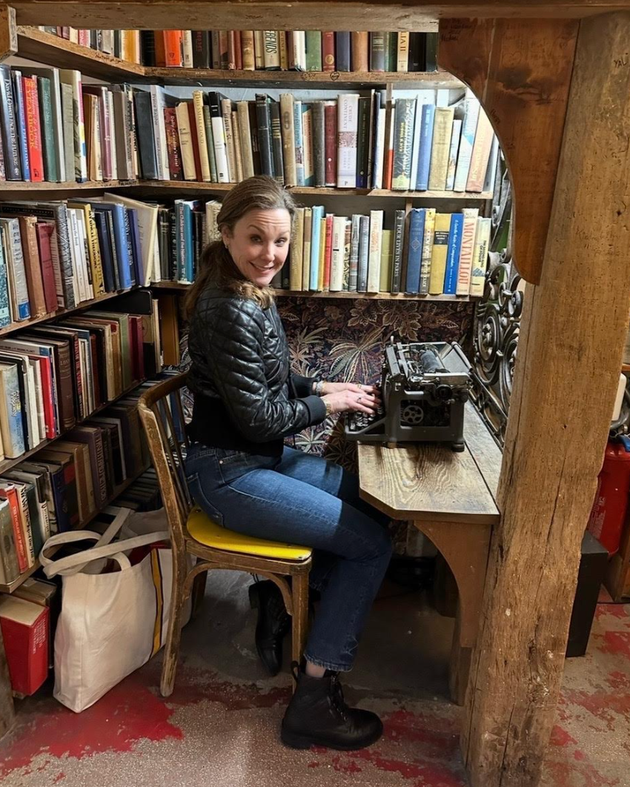 The author at Shakespeare and Company, Paris, in 2024
For days after I found out, I moved through my life like a stranger. Every object felt suspicious, every memory potentially false. Had he been thinking about her when we were in Nashville for my birthday the month before? Was he texting her from our bed when I was in the kitchen and setting up the coffee machine for the next day? How many times had he said “I love you” while mentally planning his next Friday massage appointment?
“Really? Your massage therapist?” I asked once, during one of those miserable circular conversations where nothing gets resolved and everything gets worse. “A 50-year-old man and his massage therapist. It’s so cliché.”
The comment clearly stung, as if I’d insulted his creativity rather than his fidelity.
“We were friends first. She listened to me,” he said.
“I listen to you,” I said like a petulant child.
“You’re in your office, working, or you’ve got your nose in a book for the podcast.”
He wasn’t entirely wrong.
Once our kids had left for college, I’d shifted my focus to my writing and working harder than ever as my career took off. I’d stopped working on the marriage. My shiny new toy was the book; his worked out the kinks in his neck, ones put there by 30 years with me.
That December, I was neck-deep in a manuscript about a detective investigating a pregnant surrogate who goes missing. It was a book I’d been so excited about six months earlier, one I’d been confident was my darkest, most psychologically complex book yet.
After I learned my husband’s secret, I couldn’t write a word.
Every time I sat down at my desk, I’d cry or stare at the blank page, wondering why I bothered. What did these pretend murders matter? What did my clever plot twists signify when I’d missed the biggest one in my own life?
Beyond the logistical fears about my own future was another terrifying realisation: I no longer wanted to write the detective book. Overnight, I’d lost interest in stories about detectives solving crimes, justice being served through shootouts and the court system, about the bad guys getting caught and punished. Suddenly, those seemed too neat, too fake, like fairy tales and not the Grimm’s variety.
Real betrayal, I learned, doesn’t get solved in 300 pages. Real deception doesn’t wrap up with a satisfying twist where everything makes sense and the protagonist emerges stronger and wiser. Real betrayal sits there, ugly and unresolved, in the middle of your life while people take sides and you fill the garage with items you once cherished and no longer want to see.
I started thinking about the kinds of stories that had never interested me – messy ones where the protagonist doesn’t figure everything out and there are no clear villains, just people making terrible choices for complicated reasons. Stories set in the ugly places I’d never wanted to go until now.
When I found my way back to the page, I rewrote the surrogate story, cutting the point of view from the detective, and placing the biological mom at its centre with her best friend from high school as the surrogate who vanishes four days before the baby is due.
In this new version, the story focuses on these women who were friends in high school and the complications of their long, intense friendship.
Though there is a big moral question at the centre of the book, as well as a fun, juicy plot, it was the interactions between the characters themselves that allowed me to explore the messy reality of life that I was living through while writing.
My divorce was finalised at the end of 2023, a few months after I got a new agent, six months before my agent sold that book, Pinky Swear, at auction for release earlier this year. It was the hardest book I’ve ever written and the best.
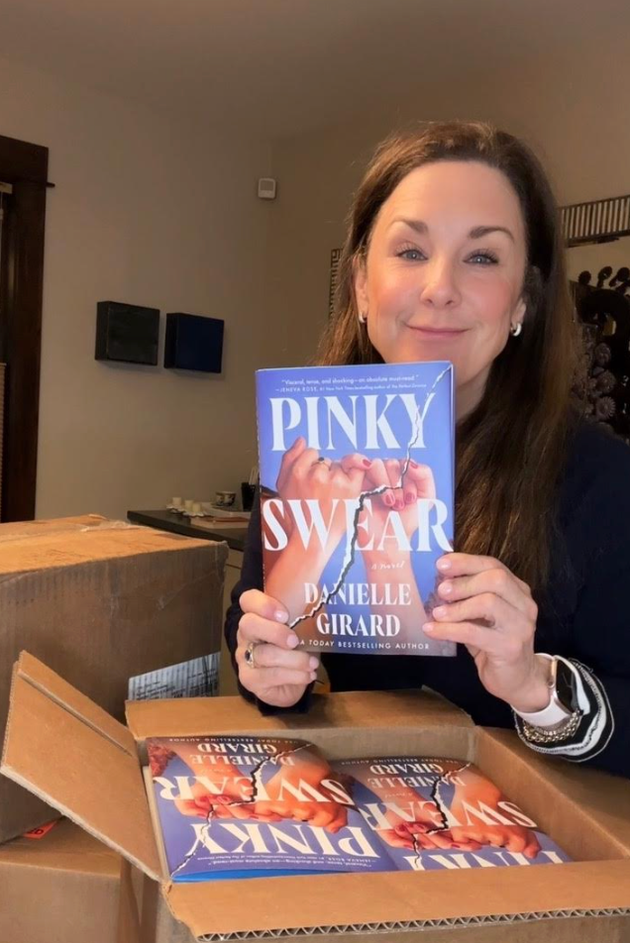 The author at home with "Pinky Swear"
The one I’m writing now is trickier, more complicated. It’s about a woman who discovers her husband’s long affair with a massage therapist.
My husband was married to a thriller writer for almost 30 years. This can’t come as a surprise to him. Still, this is not a memoir. There’s a murder, for starters. But there are echoes from my own experience in the details, like the secrets that begin small and seem harmless ... until they’re not.
While the main character is not me, the protagonist is walking in my own, uncomfortable shoes, trying to construct a narrative to make sense of chaos, and working to find a path forward when the narrative crumbles.
Every time I drive downtown, I scan the cars, the street, the store or restaurant for my ex-husband and his girlfriend. I still haven’t seen them together, though I know that they are. I wonder what I’ll feel when I do – a fresh wallop of despair? Closure? I have run the scenario a hundred times, and I still don’t know.
What I do know is that the writing I’m doing now feels like what I should be doing. Not because detective fiction isn’t important or valuable, but because I’d been using it as a way to imagine I could manage the outcome and somehow avoid the terrible things that happen to people who I imagined weren’t as studious or as prepared.
For months, I’d been plotting elaborate lies and deceit in that first draft of Pinky Swear while missing the simple, stupid truth: that the person sleeping next to me was a stranger. That I was so good at inventing characters for mysteries, I’d forgotten to be curious about the one I’d married.
I see now what those books were really about: control. The illusion that if you’re smart enough, observant enough, careful enough, you can see the betrayal coming. You can solve the crime. You can write your way to safety.
But you can’t. Life isn’t a thriller, and there’s no genius detective who’s going to figure it all out – no satisfying final chapter where all the pieces fit. At least, not in my life. Instead, there are just little clues I recognised far too late about the person I thought I knew becoming someone I never knew at all.
The book I’m working on now – the one about the woman who discovers her husband’s two-and-a-half-year affair with his massage therapist – will be called Happy Ending.
It won’t be neat or easy, but it might be happy. I hope it will be.
Danielle Girard is the USA Today bestselling and award-winning author of several novels, including the Annabelle Schwartzman series and Pinky Swear. She is also the creator and host of the Killer Women Podcast, where she interviews the women who write today’s best crime fiction. A graduate of Cornell University, Danielle received her MFA in creative writing at Queens University of Charlotte, North Carolina. When she’s not traveling, Danielle lives in the mountains of Montana.
Do you have a compelling personal story you’d like to see published on HuffPost? Find out what we’re looking for here and send us a pitch at [email protected].







 Bengali (Bangladesh) ·
  English (United States) ·