

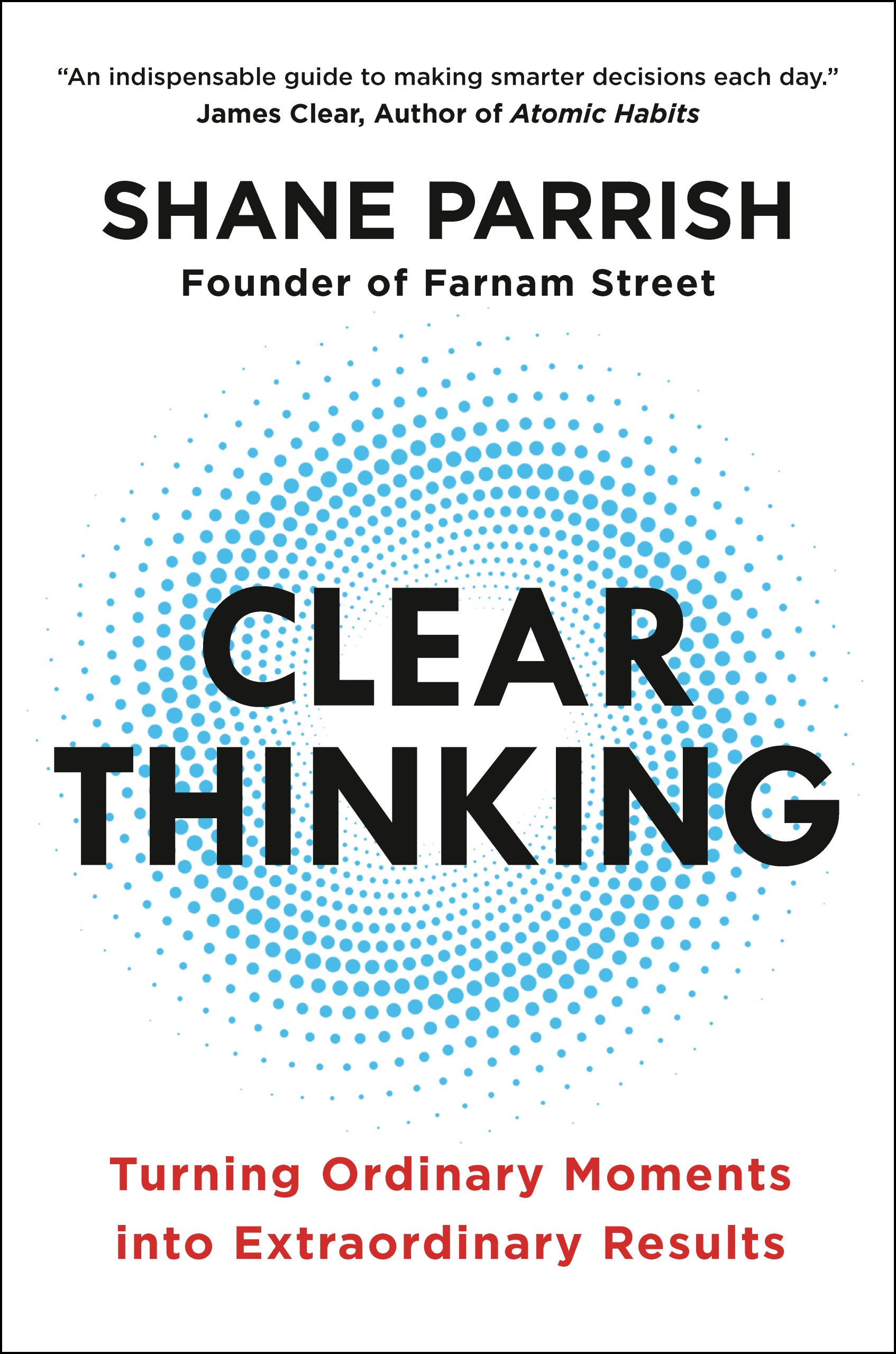
Most of us think good decisions happen in the moment. Shane Parrish says they’re already decided before you sit down. And, most of them end up being bad, because you waited too long to make them good.
Shane Parrish spent years inside Canadian intelligence, making real-time decisions where the stakes were other people’s lives, long before he founded Farnam Street and The Knowledge Project podcast. He’s the author of Clear Thinking: Turning Ordinary Moments into Extraordinary Results, and has quietly become the person elite investors, athletes, and Silicon Valley leaders turn to when a single decision carries outsized weight.
In this conversation, you’ll explore:
Why the position you’re in before a decision matters more than the decision itself, and how Warren Buffett almost never finds himself in a bad one The four hidden “defaults” that hijack your thinking before you notice The three-word phrase Shane uses with his own kids to defuse an argument before it escalates Why “doing your best” almost never happens in the hour it counts, and what actually determines the outcome A simple night-before, morning-after trick for spotting the blind spots in any decision you’re about to makeWhatever season of life you’re in, this conversation will change how you see the ordinary moments that quietly decide everything else.
You can find Shane at: Website | Instagram | Episode Transcript
Next week, we’re sitting down with Angela Duckworth to talk about why the advice to just make the best of your situation might be exactly backwards, and how the people and things within arm’s reach are quietly shaping who you become before you ever get a say. Be sure to follow Good Life Project wherever you get your podcasts so you don’t miss any upcoming episodes!
Check out our sponsors and resources: Visit Our Sponsor Page
_____________________________________________________________________________________________________
Episode Transcript:
Jonathan Fields: [00:00:00] So we often tell ourselves that making our best decisions and that doing our best is about effort in the moment. It’s about what happens when it’s decision time, crunch time. Shane Parrish says that is backwards. By the time you’re sitting in the chair at the event or in the meeting, the outcome was already decided days before by hidden factors. And once you see why, once you see them, your own excuses, they just stop holding up. And this best of conversation, you’ll discover why the position you put yourself in before a decision matters even more than the decision itself. We’ll talk about the four hidden defaults emotional, ego, social and inertia. Steering your choices without ever asking your permission. We’ll explore the three word phrase that Shane uses with his own kids, even to stop a fight before it starts. We’ll talk about a simple night before and morning after trick that exposes the blind spots in any hard call, and why chasing the shortcut to what you want almost always costs you the very thing itself. A guide is one of the most trusted voices on how to think clearly. Shane Parrish, founder of Farnam Street and author of Clear Thinking. So excited to share this best of conversation with you. I’m Jonathan Fields and this is Good Life Project.. And we’ll jump right in after this short break.
Jonathan Fields: [00:01:23] I’ve been following your work for quite a while now, and, um, you seem to have this deep devotion maybe bordering on obsession with how we make decisions and then how we build actions around those decisions. And I want to dive deep into a lot of your thoughts around this, but I’m also curious, you also have a long career in Canadian intelligence, starting there actually shortly before nine over 11. Um, I’m wondering if there’s a tie in between that time and you having sort of like a front and center seat to what happens when decisions go really well, and the opposite as well. Yeah, I think you nailed it.
Shane Parrish: [00:02:13] Like the focus on decision-making came as a byproduct of starting there. But before we get there, let’s rewind. So I’m a 21-year-old kid. I come out, I get my dream job, I get to work for an intelligence agency. Like, how cool is that? You know, I get to go around telling people I can’t tell you what I do. It’s, you know, I’m mysterious. All of a sudden, people take, you know, people like me better because I’m mysterious. And, you know, everybody thinks it’s like James Bond, but it’s not like that. And I’m just like, oh, this is really cool. And then I start work and two weeks later, like September 11th happened and it just caught everybody in the world by surprise. And we didn’t, um, you know, for the first day, it was just this thing where everybody was like, frozen. And then the next day everything changed. And I think, you know, I worked with a group of dedicated people. And, you know, we basically didn’t leave the building for about six years. We worked six days a week, 12-hour days. We sacrificed family. There was other people sacrificing so much more than we were sacrificing. I mean, we weren’t on the front lines. We weren’t, you know, getting shot at, but we were doing everything that we could to sort of like, help our country and help the United States and help all these other countries that were allies with.
Shane Parrish: [00:03:34] And we were so small that everybody just got thrust into these roles all of a sudden with responsibilities that they weren’t really ready for. And I remember just waking up one day, you know, we had an operation the night before and it was particularly challenging, and I’m making these decisions and you’re making them in real time. And I’m like, I’m 26. The decisions that I’m making affect troops in theater. They affect my country. They affect other countries. I’m like, what? Nobody. Nobody’s ever taught me how to make decisions. Like I’m not qualified for this job. So I went in the next day and I was like, hey, uh, you know, to my boss, I was like, I don’t, I don’t, I don’t think I’m really qualified for this. Like, you know, here’s my thought process for what happened last night. And, you know, I don’t think I can do this. Like Canadians deserve better. And he’s like, they deserve better everywhere. Like you’re all we’ve got like that. You got to step up. And that’s what we need you to do. And that sort of started this passion for studying. How do we make decisions and not textbook decisions? Not like academic decisions where you pull out an Excel spreadsheet because nobody ever really does that. But how do you make real-world decisions, and what are the tools available to you to help you do that, and how do we think through that?
Jonathan Fields: [00:05:00] Yeah, I mean, it’s fascinating for you to have that experience because I think like you described, very few people actually study decision-making. You know, it is actually a field of study. Like you could go into decision theory, but most folks who go into that, um, end up in academia. You know, it is a deeply sort of like in your head process. It’s fascinating. There is actually a strong body of research around it. Um, and yet, you know, a lot of people actually, they stay in the hallowed halls where it’s about like, what can we show in a laboratory which is valid? There’s a use for that. And yet, as so many of us know, you know, like what works in a laboratory falls apart the minute it hits reality, the minute it actually hits the real world where the variables are just completely different, where, you know, like human beings actually have to interact in a non-controlled way in a non-controlled setting. Everything melts down, you know? So you are essentially living and working in a real time laboratory, but the consequences of everything that you did didn’t just affect what happened in the lab or what paper you were working on. You were affecting lives at scale, um, in your late 20s. I’m wondering beyond just feeling like I’m, I’m not skilled at this yet, just emotionally what goes on in you when you’re showing up every day? Because it’s, it feels like there’s a burden that you’re bearing there.
Shane Parrish: [00:06:36] Yeah. Luckily, and I want to emphasize this, I worked with a group of dedicated people who were doing everything they could in that environment, sort of enables you to get through. And you’re so busy, you really don’t have time to pause and think about what’s going on or what you’re sacrificing, or sort of like the cost, if you will, on your body and yourself in terms of your emotions. You just suppress everything and you put your head down and you go to work. And it doesn’t matter whether you feel like it, it doesn’t matter whether you’re sick, it doesn’t matter. Um, there’s people counting on you and that sort of pulls you through in a very powerful way. And that’s not to say that it’s not without cause, uh, because there are certainly a lot of cost to doing that, but you don’t think about it in the moment. All you can think about is sort of putting one foot in front of the other going forward. And, you know, some days it was like, it’s sort of like running a business, right? You wake up and you get out of bed and it’s like you’re stepping on glass and it hurts and it sucks.
Shane Parrish: [00:07:42] And then the day is over and you wake up the next day and it’s the same thing, but you have to keep going and you have to pull yourself through. And the story that you tell yourself in your mind. I believe firmly that the story we tell ourselves is the most powerful story in the world. And the story you tell yourself is going to make you not get out of bed or get out of bed. And it doesn’t matter if there’s glass on the floor. You have to find a way to keep going. And for everybody, that’s different. For me, it was the group of people I was working with. I didn’t want to let them down. Uh, you know, they’re relying on me, and I have to get up. I have to go to work. Even though I don’t feel like it. I’m tired. I haven’t slept a full night in years. Um, you know, I’m working all these odd hours, but that was sort of what was required for the moment. And then when it stops, then you can think about it and you sort of like look back and you’re like, how did we even get through this? Um.
Jonathan Fields: [00:08:39] Yeah, as you describe those, you know, like when it stops, um, is sometimes a fictional threshold. Totally.
Shane Parrish: [00:08:46] Yeah.
Jonathan Fields: [00:08:47] You know, it’s like, is it this year? Is it next year? Is it like, did I miss it? Um, because I didn’t feel it, but it feels like it’s just sort of like this treadmill that keeps going and going and going.
Shane Parrish: [00:08:57] Well, it’s so interesting because the people who thought it was going to stop in like three months or six months or nine months, those are the people who got burned out. The people who knew it would eventually stop but never put a timeline on it. Like the outcome is sort of known, like we will return to normal, but we have no idea when that is. Those are the people who sort of carried through and were able to push through. But if you expected things to go back to normal in three months and they didn’t, well, then month, four, month, five month, six month seven just becomes like an anchor. It’s so much more weight getting out of bed. It’s so much harder. And then the story starts to you start to tell yourself you’re burnt out and then you become burnt out in a way.
Jonathan Fields: [00:09:39] Yeah. So when you find yourself in this scenario and, and you’re thinking to yourself, okay, this is I’m learning on the job. Um, I’m feeling like I’m not entirely sure that I know how to actually make calls that are going to be helpful and not harmful. Um, and the calls that you’re making in real time when you show up at work every day are affecting human beings. How do you then say yes to a process that lets you learn the skills and the wisdom, the knowledge, the, the practices that you need to learn to eventually feel more comfortable making those really important decisions when the stakes are high. Um, what’s the process for you, for you to basically say, I need to get better at this? Um, but there’s nobody who’s showing up saying, I’m going to teach you this. Um, so I need to step into this myself. Um, how do you begin that process?
Shane Parrish: [00:10:35] I just fumbled through it. I mean, I started following people around at work, going to meetings that I wasn’t invited to, following senior people around, trying to talk through problems with people, uh, just to learn like, how do you and the questions I ask changed, right? Instead of what to do, I started asking like, how do you think about this? What variables matter? Where does this go wrong in your experience and try to learn from people? And then I, you know, I did what everybody does. I go back to school, did an MBA. I thought that might help. Didn’t help at all. Uh, and then I sort of started talking to people outside of work, outside of government, outside of intelligence agencies, people who, you know, for lack of a better term, are masters at real world decision making. And none of these people have taken a decision making course. None of these people use all these spreadsheets or complicated processes that everybody else used. And the idea was, what can I learn from them? And why do they consistently make better decisions than other people? And that’s not to say they don’t make mistakes, but they consistently about above average. And how does that happen? Is that luck? Is it chance or is there something that they’re doing that’s different than other people? Mhm.
Jonathan Fields: [00:11:48] So as you’re sort of, um, going out and trying to figure this out and just talking to anyone who will share these things with you, at some point, you start to form ideas. It sounds like the data set starts to build in your brain, and you’re starting to see patterns and you’re starting to see common things. Um, and you start to share that, um, you start to share it with other people. And it sounds like in the early days, you start to share it almost as a blog. Um, and that gets noticed. Um, and then it gets noticed more and more and more and it turns into this kind of phenomenon, the knowledge project where, um, the thing that you started on the side, um, becomes something where people all over the world are turning to this as a source for thinking better, thinking smarter, being more accurate and insightful in what they’re doing. When you began that, was this more of a personal project for you, or it was just a repository for what you were discovering or was your intention? I want to become a conduit to share what I’m learning.
Shane Parrish: [00:12:57] It was definitely not to become a conduit to share what I was learning with other people. To put things in context, when I started, I wasn’t allowed a public profile. I wasn’t allowed a LinkedIn page, a Facebook page, I wasn’t. You googled me. You got nothing. I didn’t exist, and I started keeping notes about what I was learning. But I’m learning things in different places, right? I’m traveling. I’m, uh, you know, I’m on my phone. I’m in all these different locations. I don’t want to lose track of what I’m learning. So I started a website. It was a series of digits. Nobody would ever go to these series of digits for a website like, and I memorized them. So like, I can go there. And then I didn’t password protect it. So I could easily, like read what was the last stuff that I wrote. And I could like spaced repetition with this. So I had this, this website, completely anonymous. I mean, it wasn’t completely anonymous, but relatively anonymous, really hard to source who was doing it. Uh, and I just started taking notes about what I was learning and trying to connect ideas in a way that like, okay, this person’s using this language. How does that make sense? This person’s using this language, but you know, they’re really saying the same thing, but they’re just coming at it from a different approach. Or the terminology is different. Well, if I can triangulate that multiple people who I respect, who are making decisions in the real world are saying the same thing, well, maybe there’s something to that, and maybe that carries a lot of weight. And then that’s something I should emphasize more of and try to learn, because maybe that has a lot of stability and maybe that knowledge doesn’t expire. And I like learning things that don’t expire because then I can use them for the rest of my life. And so that’s sort of how I got started.
Jonathan Fields: [00:14:38] At some point, this readership becomes really substantial. Um, there’s a piece that comes out on you in the New York Times, a profile, um, which I guess is 2018 ish, if I recall correctly. Um, which, which positions you as sort of the, um, you know, the, the practical decision making coach and consultant and wizard, especially for a lot of people in the world of high stakes finance and Wall Street. Um, on the one hand, you know, I would imagine how cool I’m profiled in the New York Times. I’m wondering how that landed with you.
Shane Parrish: [00:15:16] It was never a thing that I ever held up to get credibility or to, um, get attention. And three, I don’t like attention, despite what I do for a living, sharing knowledge and sort of being out there and having a large presence. I don’t like all the attention. I like the attention ideas, You know, the tagline to what we do is mastering the best of what other people have figured out. And so it’s, it’s never about me and what I’m doing. It’s always about what ideas do we have that can help other people and move them forward. And I think if there was a benefit to the New York Times piece, it really just exposed us to a lot more people because we at the time that came out, we had a primarily Wall Street audience. I think we had hundreds of thousands of readers at the time, but it was mostly like male Wall Street audience. And post that, it changed. You know, we acquired a large following in sports. We acquired a large like Silicon Valley following. Basically, what connects all of these things are people who have leverage in decision making, where a small difference in your ability to make a decision has a massive impact on the outcome could mean the difference between making the playoffs and not making the playoffs in sports or winning the World Series and not winning the World Series and in finance.
Shane Parrish: [00:16:39] You know, if you’re a 90.1 on decision making and you go to a 90.2, well, that can have massive, massive consequences, positive consequences, because everything is so leveraged and the same in Silicon Valley just by the nature of the business and how things operate. A small difference in your ability to make decisions can have a massive impact. And it was sort of a different form of self-help, if you will. Like it wasn’t about, uh, you know, here’s a prescription and do these ten things. It was like, here’s some ideas. And if any of them stick for you, that’s great. And why don’t you try using them? Because we think of these books that people write, including myself. And we think that if we just follow the book, we’ll be fine. But everything that works in that book works within a context of an ecosystem. It’s like taking an animal from one ecosystem and trying to put it into another ecosystem. And, you know, we’re surprised when it doesn’t thrive. And the real key is understanding like why it works and why it works in that environment. Will it work for me? And how do I determine if it’s going to work for me? Do I want to modify that? And if not, that’s great. Just leave it and go to the next idea.
Jonathan Fields: [00:17:53] And we’ll be right back. After a word from our sponsors.
Shane Parrish: [00:17:57] That one of the critical aspects of decision making is the situation you find yourself in at the moment. You make a decision. The position you are in at the time you make the decision. If you put Warren Buffett in a bad spot, he’s going to make terrible decisions, but he never finds himself in a bad position. And so when you’re in a good position, almost every decision path leads to victory. And when you’re in a bad position, almost every decision you can make leads to failure. And things go from bad to worse really quickly. And so what we don’t think about is how do we position ourselves to take advantage of circumstances rather than being mastered by those circumstances? So if circumstances are forcing you to make a decision, you almost never make a good decision. And so how do we avoid that? But that that requires positioning yourself before the point of decision making.
Jonathan Fields: [00:18:57] Yeah. I mean, it’s interesting you use the word position. And, um, I want to deconstruct that a little bit because I don’t know if I’m entirely clear on what you mean by that. Like, what are the, when you talk about position and this is a lot of what you’ve, you’ve written about, it’s I think elements of this are like a chunk of some of what you write about in your new book. Um, when you talk about the, it’s almost like set and setting and people like the environment around you, but also the people that you surround yourself with. Yeah. Um, and sometimes there’s a conscious choice that goes into that. Other times you find yourself in a particular environment, but and your ability to make thoughtful and intelligent decisions that are as close to being. To whatever, you know, like the illusion of objectivity that we can garner is in the moment in time, um, that lets us feel like we’ve been like, you know, we’ve, we’ve made a rational decision, um, that a lot of this actually a lot of the process of getting to that place of making a good decision happens before you’re in the moment of making a good decision. Um, and a lot of it has to do with like the circumstances that you find yourself in leading up to it. Um, because that container profoundly influences the choice that you’ll end up making. Is that kind of it or is there more that I’m missing there?
Shane Parrish: [00:20:23] Yeah, I think you nailed it. Like if, if mortgage rates rising forces you to sell your house. You’re not. You’re probably going to lose money. But if you had bought a smaller house, you would be able to withstand more of that before you’re forced by circumstances into a bad decision. It’s the same as like if you identify the best investment opportunity in the world, but you have no cash to take advantage of it, you might as well have not identified it. So how do you position yourself to take advantage of that? Well, you have to save money long before the opportunity comes around and you have to have patience. And so if you want to think about decision making, there’s sort of three key aspects to it. The position you find yourself in. Can you manage your defaults, your emotions, mostly inertia, groupthink, all of these things sort of. And we have biological defaults. Like we’re territorial, you know, we’re self-preserving or self-preserving. We’re hierarchical. Can you manage these default. You can’t eliminate them, but can you manage them? Can you put yourself in a good position using rituals, safeguards, all these other things to dampen their effect? And then can you think independently and you can’t think independently unless you have the first two.
Shane Parrish: [00:21:41] You can’t think independently if you’re forced by circumstances into a bad decision because it’s the illusion of a decision, right? You’re literally being forced. And then things go from bad to worse really quickly. So you want to avoid that. You want to avoid the bad decision before you ever make a good decision. And that means, you know, it’s counterintuitive, but you have to go a little bit slower. You have to think long term instead of short term. I have this saying that a lack of patience changes the outcome. Often we know how to get exactly what we want, and we know what it takes to get what we want, but we think we can speed that up, which is why there’s such a big industry around shortcuts and hacks and overnight success and all of this stuff. It’s because we want to change. We don’t want to change the outcome. We’re seeking the outcome, which is part of the problem to begin with. But we’re seeking the outcome, and then we just want to make it happen really quickly. And the gap between where we are and the outcome that we desire is huge. And when the gap is huge, we think, oh, that’s going to take a long time.
Shane Parrish: [00:22:45] It’s going to take a lot of work. Uh, you know, that’s like decades away. I don’t, I don’t, I don’t have decades. I want it tomorrow. And then we do all these things and we take all those risks that we don’t even know we’re taking. We put ourselves in a bad position and all of a sudden we don’t get what we want. Um, and I think a better approach is like just focusing on the process to get what you want and make sure what you want is worth wanting. I think that that’s a big thing that a lot of people miss. Um, but like, we know the key to sort of financial independence, it’s saving money every month, putting it away in an index fund and dollar cost averaging. And if you do that for 40 years, historically, unless something massively changes in the next, you know, 100 years or so, you will acquire enough wealth to be financially independent. But we don’t want that. We want the Bitcoin. We want the stock that’s going to go parabolic. And so we chase these things that we don’t understand. And we’re not making up arguably not making good decisions in those moments.
Jonathan Fields: [00:23:50] Know that that time gap is something that is, um so fraught. And think about it in.
Shane Parrish: [00:23:58] Multiple ways, right? Like a lot of our problems are driven by short term ism, right? So if I’m working with somebody, which is something people can probably resonate with who are listening to this, and I have to have a difficult conversation with them. Now, if I approach that conversation with, I’m right and you’re wrong, I’m gonna, I’m gonna, I might win. Maybe I am right, so I win. But if I approach that, I’ve. I’ve jeopardized our relationship at that moment. Right. So I’ve if you think of relationships as four permutations, there’s win win. There’s win lose, there’s lose lose and there’s lose win. Those are the four permutations that are possible in any relationship you have in life. And what do we know about relationships? Well, relationships compound trust compounds. But what do we need for that to happen. It needs to be a win win and we need a long time. So if I approach that conversation with somebody and I win the moment, I lose the decade and I lose all the advantages of compounding. Now, if I approach that that conversation, I still want to have that conversation. And it’s a difficult conversation. But if I approach that conversation as if I’m going to be working with that person for the next 20 years, I guarantee you that conversation is going to go much different.
Shane Parrish: [00:25:22] You approach that conversation as if that’s your partner or your spouse. That conversation is going to look very different than if you approach that. Like, that’s a coworker, like somebody who’s disposable because nobody wants to be on the losing end of a relationship. I want to know you’re on my team, and this is why so many people, I think, have jobs, right? Instead of think of it as a career. And when I have a job and everything’s transactional, well, I’m going to be transactional. You’re going to treat me transactional. I’m not going to get the opportunities I want because why would I go all in with somebody who’s transactional? And so you have this like sort of circle that we create and we can’t really get out of. And the way to get out of it is to start thinking longer term about all of our relationships. How do I get everybody else to win? I want to win, but I want everybody else to win. And where do we find those win wins? Because if it’s not win win, we can’t compound it. It has. It’ll it won’t last. And that’s not to say everything has to be win win. Sometimes you are engaging in a pure transaction, but win win means you’re not nickel and diming your customers, right? It means you’re not taking the last dollar on every deal.
Shane Parrish: [00:26:34] It means you’re leaving something on the table for your counterparty, because you want your counterparty to be around in a while, and you want to work with them for a long time, and maybe that maybe you don’t end up working with them for a long time. But if you approach things with that mindset, everybody starts acting differently and it takes a while. You can’t just do it once and think that people are going to change their behavior. But if you approach all of your relationships like that for 6 to 8 months, you’d be really surprised at how people start treating their career. Not like a job. It’s not 9 to 5 anymore. I’m not clocked out. I’m thinking about I want it to be better. Why? Because I’m in the boat with you rowing. I want to be all in with you. I want to go in with you. And when somebody’s all in, what happens, right? It’s not a job anymore. Now I’m nonlinear. It’s not X, I’m like five x. I’m ten x because I’m thinking about you. I care about you. I’m anticipating things and it changes everything.
Jonathan Fields: [00:27:32] Yeah. I mean, it’s interesting because we started talking about, um, extending the time frame. Um, but what became implicit in that was making the transition from transactional to relational and centering humanity and dignity, um, over like winning whatever is the short term metric. Um, it just kind of like it has to be a part of that process. When you start thinking much more long term and you’re not living in a vacuum, you know, you’re going to be in relationship with other people. So that has to come into it. And there’s this inadvertent, you know, like side effect of bridging the gap between you and other beings, like changing the quality and the nature and the depth of your relationships. Um, which would have this additional ripple effect of not just making better decisions and having better long term outcomes, but also fundamentally letting you live a better life because you’re more connected on a genuine level to the human beings around you. And there is this trust that you referenced earlier, um, that is reinforced over time and it becomes less, you know, a thing that you throw out as a way of team building a more the fiber of, you know, like the, and the context and the subtext of your relationship, which feels more real. Um, so it’s interesting to sort of like track the ripple effect of, of what seems to be, oh, I’m just going to move from short term to long term. It’s like, no, actually, it actually changes so many things.
Shane Parrish: [00:29:05] Yeah, totally. But we’re sort of conditioned societally almost and encouraged to win the moment, but we don’t realize we’re losing the decade and the generation, and we don’t even realize it. Once we start to get feedback that we’re not getting the things we want, we’re hard to work with, people aren’t going all in with us. They don’t want to work with us. Uh, you know, things are transactional. That’s all feedback that you’re treating your relationships, not all of them. Because, I mean, some people are going to be the opposite. But if people are very reciprocal. So if you go positive and you go first. Nine times out of ten they’re going to go positive back. Now you’re going to get that one person who takes advantage of you.
Jonathan Fields: [00:29:54] Yeah of course.
Shane Parrish: [00:29:55] And you’re going to change all of your behavior because of that one person. But I guarantee you that those nine people who are going to go all in with you way more than account for that one person who might take advantage of you, because you’ll find that out quickly. And you can just sort of eliminate that or reduce it or put a box around it. But you really want to focus all your time and energy on these, these nine people instead of that one person.
Jonathan Fields: [00:30:25] And we’ll be right back after a word from our sponsors. You also mentioned these things. Um, you describe this default. Um, and this is part of a conversation where you really kind of go into like, what is it that actually stops us from thinking clearly from making better decisions? And you describe, um, what you describe as these four sort of defaults, um, rooted in sort of just the human like human nature, human biology, uh, you know, the emotional default default to, to feelings over facts, the ego default really like the.
Shane Parrish: [00:31:00] That’s what we were just talking about. Right? Exactly the moment, right?
Jonathan Fields: [00:31:03] It’s like it’s all about self-worth and group status, like rather than something else, uh, social default, which is really kind of like similar, like conforming to the group norms around you. Um, and then you, you talk about, and I think a lot of people hear this like, okay, yeah, like I get those first three. And then you describe this fourth one, um, that you, you call it the inertia default. Um, which I think is fascinating. I think it’s something that we don’t really think about as much as the first three. It’s not just intuitively just like, oh yeah, I get that. Take me a little bit more into this.
Shane Parrish: [00:31:36] Well, we, uh, the crux of it is we just tend to continue doing whatever we’ve done because there’s a huge risk of changing what we’re doing. And I think part of it comes down to fear, which is something you’ve explored a lot on the podcast, fear keeping us in place. So inertia becomes we’ve always done it this way. These are the arguments, right? We’ve always done it this way. Inertia can work for you or against you. It’s a very powerful, very powerful sort of, uh, physics principle, but it applies to your life. So the inertia of a routine is very powerful counterbalance to human behavior. My kids don’t want to do homework. The routine that we established, and it took about a month to establish this is you come home, you shower, you come downstairs and you start your homework, and we do it every day. And for the first month, I had to tell them to do it. But then it became a routine. It became a habit. And then it started working with them. And then the inertia was so strong, them doing that every day, that ritual that I could leave and they would do it anyway. And I think that we have these things in our life where we do things, you know, inertia can be I don’t go to the gym. I don’t ever go, I’m not healthy. So my inertia is I’m not doing anything.
Shane Parrish: [00:32:59] And I need a really strong force in that moment to overcome that inertia and to change and to start doing other things. And I think, you know, we don’t think about things in terms of momentum and inertia and like, how can we change these things and how do we get inertia on our side? And so one of the things that I talk about in the book is automatic rules. And so if you’re somebody who, who is struggling to go to the gym, or maybe you go like 2 or 3 times a week, but you really struggle with it, your inertia is like, I’m doing this 2 or 3 times a week. I’m going to have this conversation with myself 2 or 3 times a week, and I’m only going to do it when I feel like it or don’t feel like it because. You know, I’m going to wake up and I’m going to be like, I don’t feel like going to the gym today. I’ll do extra tomorrow. This is the negotiation that we have with ourself and that that becomes its own inertia. Once you do that, once it becomes really, really easy to do it again. And so we talk about these things like automatic rules so that inertia doesn’t get the best of you. Right. The situation doesn’t get the best of you. The circumstances don’t get the best of you. One of the automatic rules around that I have around, um, sort of health is that I, I work out every day.
Shane Parrish: [00:34:23] And why? Every day, because I find every day is easier than three days a week. It’s not a choice. Now I know I’m going to work out today. My negotiation with myself is when do I fit this in? And what does that workout look like? Sometimes it’s going to be yoga. Sometimes it’s going to be a big walk. You know, sometimes it’s going to be something else. And that negotiation is much more healthy and productive than the negotiation of should I go to the gym today? And I think we need to look for managing like, where is inertia leading us? And one of the things that we talk about in the book is that often we don’t know we’re making decisions. Some of the, you know, we’re taught to focus on your career, your marriage. These are big decisions and generally speaking, we get big decisions. Pretty correct because we know we’re making a decision. What we don’t get correct is these little moments that aggregate and undo those big decisions. So you can have the best job in the world. But if you don’t show up and work your butt off, it’s not going to last. You can marry the perfect person for you, your dream partner. But if you don’t put in the work, the relationship’s not going to last.
Shane Parrish: [00:35:38] But putting in the work isn’t a decision. We don’t think of it as a decision. It’s like a Friday night when you get home and you’re arguing about the dishwasher and who loaded what or who didn’t take out the trash or, uh, who forgot to pick up the kids. And if you were to tap people on the shoulder in that moment and say, hey, you’re making a decision right now to throw gasoline onto this situation or water onto this situation. What do you want to do? People will be like, I want to put water on this. But in that moment, these defaults get Ahold of us, right? You get ego, you get the inertia of a fight. You get this like slow escalation. We have our biological defaults, right? We’re territorial, we’re self-preserving, and we’re animals at the end of the day. And so we have these animalistic instincts. And if I tap you on the shoulder and I say that this is what I say to my kids, water or gas. And I don’t tell them what to do. I just make them aware that they’re making a choice right now that makes the future easier or harder for them, because all the energy that you spend correcting what happened, fixing what happened, repairing what happened with your spouse or your partner in that moment comes at the expense of doing things that you really want to be doing with them comes at the expense of connection.
Shane Parrish: [00:37:07] It comes at the expense of cuddles or whatever you’re into with your partner. And we don’t realize that these things just sort of like lead us astray so we can undo even the best decisions with these ordinary moments. But we don’t think ordinary moments are decisions, and yet they have the power to multiply everything by zero. And so one of the things that we talk about in the book is sort of like, how do we recognize when we’re in these moments? How do we create rituals and safeguards to prevent us from getting in them, to catch us when we are in them and take a step back and just that’s all it takes is one breath, gas or water. You say that over and over to yourself, am I going to make this? Is this going to get me closer to what I want or further away from what I want? That’s another one that I use with my kids all the time. Is this behavior going to get you what you want? And again, it’s non-judgmental, right? I’m not telling them to stop. I’ve, you know, tried to stop telling them to stop doing things since they were like 6 or 7. Just ask them a question. But we’re the same, right? If we ask ourselves that question, we can catch ourselves in these moments.
Jonathan Fields: [00:38:15] Yeah. But I mean, it’s that tap on the shoulder that is a powerful skill that we don’t have, you know, because I think if it’s, it’s the moment of it’s meta awareness, right? It’s the ability to zoom out in the moment and look down on the circumstance and say, what’s really happening here? Totally. And am I am, am I like the question you just sent her? Like, is this leading me towards an outcome that I want or away from an outcome that I want, or towards an experience or relationship I want or away from it? And once you have that tap, once you gain the ability to zoom the lens out, my sense is a lot of the answers become relatively clear, and maybe you still need skills and abilities to navigate it, but it’s that lack of ability to actually, like, be able to just pause in the moment, zoom the lens out. It’s that tap on, on like your kid’s shoulder, you know, like, how do we do that tap to ourselves? Um, like how do we cultivate the skill of the practice to be able to actually do that? Because that’s something that, um, needs to precede everything else.
Shane Parrish: [00:39:26] Totally. And I think you just used the right word, like precede. So there’s two ways to sort of think about that tap, right? And the first way to think about it is what happened in my day that led me to this because I nobody wants to be arguing about this with their partner. It just happened. And it happened for both of you. And it takes two people to sort of be in this situation. And so there’s, there’s this part of your day, which if we go back to the the language that we were talking about earlier, what position are you in when you show up at your house, is there a buffer? Are you tolerant? Because if you’re not tolerant, there’s no buffer space. You’re not in a good headspace. Then that stuff’s going to be like, you know, dry grass and you know a match is going to light it on fire. You want to water that grass before you come home. You want to make sure that you’re in a position where you’re a little bit resilient to these little things that get caught up. The second thing is, let’s say you’re not you know, you had a long day. You had a bad day. It happens to all of us. So what can we do? And I think we can create a ritual around things where we sort of feel at the start, something’s escalating now. We want to win, we’re animalistic and we have this instinct to respond. But if we just ask ourselves that one question before we respond, gas or water, it’s three words, right? Or you could say closer or further as a trigger to think about closer to what I want or further away from what I want, and that becomes the ritual before we respond.
Shane Parrish: [00:41:02] It takes like a nanosecond, but if you can make that a ritual and it’ll take, you know, a week or two to probably ritualize that. But if you can do that, well, now you have a powerful, powerful mechanism of avoiding that. And if you think if you look at sports, um, you know, where athletes have to perform, they make a bad play, right? How do they prevent that bad play from like consuming them on the next play or they make a great play? How do they prevent that great play from consuming them on the next play? And if you watch sports or anybody who watched sports quarterbacks like lick their fingers, tennis players bounce the ball the same number of times before a serve. Basketball players, you know, take the same number of bounces before a free throw. Now each player does it slightly differently. But what they’re doing is that’s they’re centering sort of device, right. And you can come up with these in your life. And the point is it has to be individual. But that centering device allows you to forget what’s happened. It doesn’t matter if I made the best play or the worst play in my life. I need to let that go. All that matters is right here and right now.
Shane Parrish: [00:42:16] You can have that when you walk in the house, right? I gotta how do I not let all this stuff that happened to me at work, I was up at 4 a.m. I worked nonstop. I still have a million emails to reply to. I’m home now. The kids are chomping at the bit. I need a way to ritualize letting that go. Whether it’s my car ride home, whether it’s the threshold of the door, you can actually just sort of visualize it. Like, I gotta leave this baggage outside as I walk in the house, because if I bring that baggage in, it’s going to affect everybody in that house. And also recognize that I think it was, um, I forget who told me this, but you’re giving your partner and your kids often the worst part of yourself. And I mean that by energy level, right? So we think about when we spend time with the people we love. Often it’s at the end of a long day, not at the start of a long day when we have the most energy and we have the most sort of like willpower. If you believe in sort of depleting willpower. But we’re taking the best part of ourselves and we’re dedicating that to work. And so even a recognition that we’re not, we’re not our best selves when we come home can really help you leave that baggage, visualize the baggage like you’re carrying luggage and just leave it outside. Um, and when you, you, if you talk about this with your partner, when you’re not upset and you’re not angry, you can have these little cues with each other for resolving these things, right? Like some of the most effective ones I’ve seen are, uh, gas or water.
Shane Parrish: [00:43:59] You can, you can say that to your partner as a reminder, like you see them escalating. Okay, well, uh, it’s easier to see other people escalating than ourselves. So now we can call each other on it and we give each other permission, but we can’t talk about that in the moment. We’re upset. We have to talk about that, like on a Sunday morning brunch or a Sunday morning walk. Uh, another one that really seems to work with people is like, how much do you care about this? Uh, you know, we get into these things like, do you want this couch or this couch? And a quick way to solve this is like, who cares the most about it? And if you care a 9.9 and I’m like a six, well, you should decide what couch we get. And so you can have all these little things, but you have to, I mean, I’m just telling you ones that I’ve heard, but the point is that you talk with your partner about these things and you come up with them together, and then they become this playful Ritual that you have together. And that ritual is the real counterbalance to all these emotions. And it’s the counterbalance to inertia, and it’s the counterbalance to all of our defaults.
Jonathan Fields: [00:45:02] Yeah. And I mean, you describe a lot of the I mean, you talk about rituals, um, when you write about some of these ideas, also, you describe them sort of like in the category of strengths. It’s like this. How do we counter the defaults? We develop a certain set of strengths, whether that’s self awareness, self knowledge, self control. Um, and these are some of the rituals and techniques that we’ve been talking about that kind of fall under that, um, as you’re talking, one of the other things that keeps spinning in my head is, um, what about seeing clearly you do the question, whatever it is, and all of a sudden you think, well, okay, I want water. Um, but you still can’t get there unless you can get as close as you can to seeing the reality of what’s really happening. And granted, there is no objective reality. There is, like we each have our own experience of the fact of the circumstance. And to us that will be the truth. But the the more we layer in and I guess maybe this actually really speaks to the default, right? Because the more we go into the emotion, the more we go into the defaults, probably the less clear we are or the less able we are to see reality in a way that is as close to the truth as is needed to move towards a healthy resolution or a good decision.
Shane Parrish: [00:46:27] The source of all bad decisions is blind spots. If we knew the consequences of our actions and we had perfect information, we would always make the perfect decision. Perspective becomes a way to reduce blind spots. Now we have a lot of quirks of psychology and physics, even that make us think that our perspective is the only perspective. And we first learn about this sort of in grade school. I think it’s like grade nine or grade ten physics. When you’re standing on the train and you’re carrying a ball and the train is moving at 60 miles an hour, well, how fast is the ball moving? And if you look down from your perspective, the ball is not moving. And if you watch the train move while it’s moving it, the ball is moving at 60 miles an hour. And we sort of forget to apply that to life. We forget that there’s other perspectives. And one of the perspective, one of the most powerful perspectives that we talked about earlier was long term, long term versus short term. That’s a perspective. That’s a difference. And the way that I like to encapsulate this for, for adults is like, how fast are you moving right now? And even if you’re on a plane right now, the maximum speed you’d be moving is maybe like a thousand miles an hour. But what if I told you you were actually moving, like, 18,000 miles an hour? No matter what you’re doing right now, whether you’re sitting down or you’re on a plane, because the earth is moving at 18,000 miles an hour around the sun or somewhere around that.
Shane Parrish: [00:48:01] And so it all depends on where you sit, what you see into a situation. And so one of the ways that we can actually make better decisions is to mentally walk through the decision in a three dimensional way. What does this problem look like to this person? What does this problem look like to this? What do they care about? And we go back to find the win win. Well, if I know what you care about now, I can solve for a win win that’s going to work for you and work for me. And I think it’s a really powerful way to shift us out of our own mind. And if you think of cognitive biases, which is what a lot of people talk about when they talk about decision making, they’re really great at explaining why we made a poor decision, but they’re really bad at preventing us from making poor decisions. But almost every cognitive bias is a perspective problem. And so I think that if we take the view, that perspective allows us to reduce our blind spots. It’s really powerful because we might have to make a decision quickly. But can I look at it through another perspective before I do? And one of the perspectives we can use, even if we can’t talk to other people, we can mentally sort of like time travel. We can have a board of directors on our head of people that we want to look through problems through their lens, and we want to assume their identity and what does it look like to them and how do they think about this? We can also write down our problem.
Shane Parrish: [00:49:21] And one of the most powerful things that I’ve found for decision making for, for most people is write down the decision you’re making at night before you go to bed. So don’t actually make the decision. Well, you’ve made it, but you haven’t announced it. You haven’t told anybody. Write it down on a piece of paper. What’s what’s the circumstances? What are you deciding? Why are you deciding it? Wake up in the morning with fresh eyes. Guys read it over. Does it make sense? Now I have two different perspectives on myself. Right. And so it’s just my perspective. But I’ve got like this new lens on it because now I’m looking at it in the morning. That doesn’t make sense. I need more information. I can’t do that. That’s it. You know, the wording doesn’t quite fit. I’m missing something. It’s not connecting. Well, that’s really powerful information. But you haven’t um you haven’t mentally time travel. You haven’t talked to anybody else. But you can offer yourself multiple perspectives through, um, these little safeguards and principles that you can use to sort of like create a better situation for you and put yourself in a better position to make the decision that you need to make.
Jonathan Fields: [00:50:25] I love that. I also love that, um, because a lot of people, I think for a quote, different perspective will go to somebody else and which can be a valid alternate perspective, but sometimes we discount the value of just creating the mechanism so that we can actually offer our own different perspectives. So that sort of like night before versus the next morning, I think is a great way to do that. And part of what’s happening here too, and this is, again, something you write about, is it often gives you the ability to make the invisible visible to you, you know, like, because you’re like, oh, wow, I just, I didn’t realize it. Oh, I wasn’t thinking about it. Uh, it wasn’t centered in the conversation, even though it was clearly in the conversation. And it allows the time for that to bubble up. Like everything keeps going back to time in a really interesting way here. Um, and the, um, like the, just extending the time and how that really helps so many different things, you know, you go into in a fair amount of detail, sort of like, like here’s the, here’s a problem solving methodology here, critical things to think about.
Jonathan Fields: [00:51:31] We’ve talked about some of them, but I do want to circle back to, and I would definitely encourage people to dive much deeper into that in the book. It’s really powerful and practical and going valuable. I do want to circle back to something that you offered earlier in our conversation, because it’s something that I’ve been thinking about deeply after a conversation that I heard or that I had earlier this year with Matthew Grossman, who co-teaches this class at Yale called a life worth living. And the entire class is based on a series of questions. There are no answers in the class. Um, and one of the questions that he posits in the class and that he posited to me and that I have not been able to let go of, is one of the questions that you shared earlier, and is also something that you share in the book, which is what’s worth wanting. It is so powerful. Um, and something that I realized I don’t think about enough, and I’m kind of in the business of thinking about this.
Shane Parrish: [00:52:31] Yeah.
Jonathan Fields: [00:52:32] And yet, you know, it’s so easy to let that question be sort of a quote, lower level question. I’ll get to that. You know, it’s just so obvious what should be worth wanting. And yet it’s not. And it’s also so individual. I mean, there’s certainly universal things, but, um, it’s such a powerful and important question.
Shane Parrish: [00:52:54] Comes back to sort of again, what we talked about. Right. It ties in with what do you need for clear thinking? Your position is part of it. You want to think independently, which was the third thing we talked about. And so thinking independently means I’m playing by my scoreboard. I’m not playing by somebody else’s scoreboard. And that means you’re living a conscious life. And maybe you want all these things that society tells you to want. Um, there’s a great book by, um, Charles Dickens, Ebenezer Scrooge. It’s a great example of somebody who, who went after all the things that society told them to want money, power, respect, well known. And then what did he want at the end of his life? He just wanted a do over. And I’ve known quite a few people who have, you know, worked with in the past who effectively came to that conclusion. The way that they treated people was mutually exclusive from living a life of meaning and purpose. And by the time they realized it, it was really too late to undo those relationships. So it pays to be conscious about this stuff. And, and I know everybody’s busy and you don’t have the answers, but it’s not about having the answers. It’s about thinking about them. And the answers will change. What you want at 20 is not going to look like what you want at 25 or 30 or 40 or 50 or 60.
Shane Parrish: [00:54:21] So it’s not supposed to be this static, unchanging thing. It’s supposed to be this question that you periodically ask yourself. One of the things that I found really helpful for doing this is, you know, often once a year, I just go away for a night or two by myself, and I have a structured conversation with myself. Like it’s not sort of like willy nilly and I just go to a different place, but I get myself out of my environment and I think about like, uh, what worked well this year, what didn’t, what are the things I want to do more of? What do I want to do less of? And, you know, I had the, um, unfortunate circumstance of getting a Lyme disease and nearly dying a couple years ago. Uh, at least I felt like I was nearly dying. And, you know, nobody could explain all these symptoms. And, you know, by the, by the end of it, I basically couldn’t walk, couldn’t open my mouth. And I had facial paralysis. So I like legit thought I was, I was dying and what was going through my head when I was like in bed was, you know, if this is the end, what would I change about the last year of my life. Like, am I on trial? Like, am I doing like, if I end up living, great, but like, I thought I was dying.
Shane Parrish: [00:55:42] Like, what would I have done differently? And I think that that’s a very powerful question. You don’t need a near death experience to sort of ask yourself that. And we always think proactively in terms of like, okay, well, uh, you know, think about if you had one week left to live, what would you do? Well, I mean, you’d probably go max out your credit cards and, you know, it’s like, have you, if the last year of your life was your last year, there’s two ways to visualize this. One that I use is like, if the last year was your last year, what would you change? What would you want to do differently? Keeping in mind all the constraints and all of the, you know, you have employees, you have to be there for them. You have to do all these other things. You have to do these things that are important to you. But are you generally is your time aligned with your priorities? And if you tell me your partner is valuable to you and you don’t spend time with them, well, then you know your time and your priorities don’t line up. And the second way to visualize this that’s really helpful for people is just to close your eyes and think about being at the end of your life in a hospital and you’re in a coma and you can hear other people, but you can’t move and you can’t talk, and you’re about to move on from this world to whatever happens next.
Shane Parrish: [00:57:06] Who are those people? What do you want them to say about you in that moment? What is important to you? And I think the things that these are very individual questions, but the things that are constant for me are. Did I love with all my heart, was I vulnerable? Was I open? Was I there for the people who I love? Did I always try to be kind and find win win relationships? That’s not that. I’m perfect at it. That’s different. Did I generally try to do a good job? If that was a conscious. If that was a good son, did I leave the world a little bit better place than when I got here? And these are some of the things that I think about. Maybe those answers change in the future. I think those are pretty constant ones for me though. You know, I want to be a loving father. I want to be the best partner I can for my my partner. I want to be the best son I can. I want all of my friends to know that I love them, and I would do anything for them. And I want to leave the world a better place. Um.
Jonathan Fields: [00:58:25] You know, I always, um, I always close these conversations asking the same question, which is in this container of Good Life Project.. If I offer up the phrase to live a good life, what comes up? I think you just answered that already.
Shane Parrish: [00:58:40] Yeah.
Jonathan Fields: [00:58:43] Thank you.
Shane Parrish: [00:58:45] I appreciate the time, Jonathan. This was a great conversation.
Jonathan Fields: [00:58:49] So let’s talk about some of the big takeaways from this conversation. One of the things that I’m really thinking about is, you know, like how, how much of what we call bad luck is actually just position. The idea that the outcome is decided long before the moment you’re being judged on. And that phrase he uses with his own kids, gas or water might be the simplest tool for a hard conversation I’ve heard in a long time. So maybe this week, before you react to the thing that’s about to set you off, just ask yourself, is what I’m doing going to bring water to this or gasoline? Hey, before you leave next week, we are sitting down with Angela Duckworth to talk about why the advice to just make the best of your situation might be exactly backwards, and how the people and things within arm’s reach are actually shaping who you become before you ever get a say. Be sure to follow Good Life Project wherever you get your podcasts so you don’t miss that or any upcoming episodes. And do me a quick favor, share this conversation with a friend, just one person. Or maybe leave us a review if that feels comfortable. Wherever you get your podcasts, it really helps us get discovered and reach more people. This episode of Good Life Project was produced by executive producers Lindsey Fox and me, Jonathan Fields. Editing help by Troy Young. Kris Carter crafted our theme music. And of course, if you haven’t already, follow us wherever you get your podcasts so you never miss a conversation. Until next time, I’m Jonathan Fields, signing off for Good Life Project.
The post How to Make Better Decisions | Shane Parrish [Best of] appeared first on Good Life Project.


 Bengali (Bangladesh) ·
  English (United States) ·