

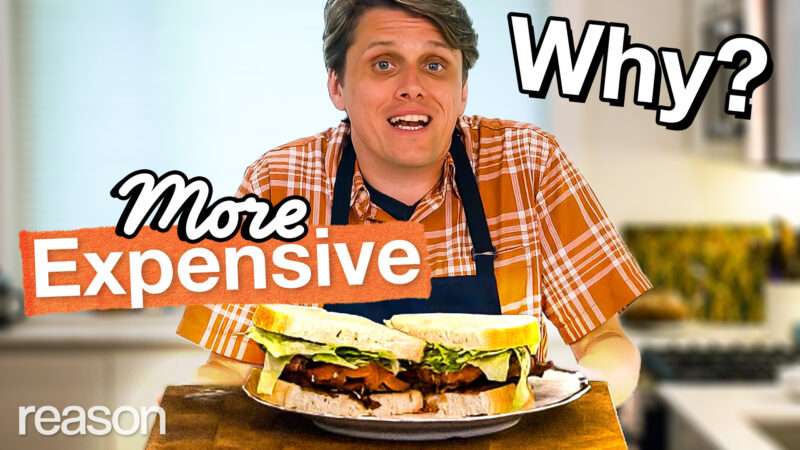
Economist Leonard Read famously observed that no one on Earth is capable of single-handedly making a pencil.
What about a sandwich? You can slap together a BLT—a bacon, lettuce, tomato sandwich, a classic of the deli counter—in a few minutes, and the ingredients will set you back no more than a few bucks. It's simple and delicious, which is all a good sandwich needs to be.
But don't be fooled. The humble BLT is a lesson in the incredible complexity and remarkable ability of markets to meet our needs, even without anyone coordinating the whole process. Getting that bacon, lettuce, and tomato to your plate requires farmers, truckers, processors, manufacturers, retailers, and more.
It is also, unfortunately, becoming a lesson in what happens when governments intervene in those markets.
Start with the bacon.
Under the terms of Proposition 12, which voters in California approved in 2018, farms are required to give chickens, calves, and hogs more space. But the rule doesn't apply only to farms in California. To sell any meat product into the Golden State, producers must show that they comply with the rule.
The rule was meant to improve animal welfare, but there are some obvious tradeoffs. Complying with California's rules raised production costs across the board by about 9 percent, according to the National Pork Producers Council.
That's one of the reasons why bacon has been getting more expensive. An average pound of bacon cost $5.83 in January 2021, according to the federal Bureau of Labor Statistics (BLS). Now, it will set you back about $6.60. That's still a pretty good deal—especially when you consider how many jobs are involved in getting that crispy slice of meat onto your sandwich—but Proposition 12 clearly demonstrates how state policy, even when well-intentioned, carries costs.
Now, let us consider the lettuce.
Much of America's supply of leafy greens comes from Yuma, Arizona, where farmers depend heavily on immigrant labor to get the job done. Most of those farmworkers use H-2A visas to cross into the United States, but intensified immigration enforcement has made it harder for farms to find the workers they need. With militarized checkpoints and huge fines for anyone caught not carrying their papers, some workers have decided that those jobs aren't worth the hassle.
The Department of Labor has warned of an "imminent labor shortage" that could threaten food supplies. There simply aren't enough Americans willing and qualified to do many of these jobs. Fewer lechugueros in the fields of Yuma threaten the supply chain that provides the critical, crispy backbone to your BLT.
Pop quiz: Is a tomato a fruit or a vegetable?
It's actually both. Botanically, the tomato is a fruit. But politically, it is considered a vegetable. The Supreme Court decided that in a rather bizarre case in 1893 involving tariffs on tomatoes.
Tomato tariffs are still relevant today.
Last year, President Donald Trump ended a 1996 agreement that allowed Mexican tomatoes to enter the United States without any tariffs. That was a good deal, because Mexican tomatoes are regarded as some of the tastiest in the world. Also, longer growing seasons in Mexico meant that Americans had access to fresh tomatoes for larger portions of the year.
Now, Mexican tomatoes are subject to tariffs. We still import them, but they are more expensive to buy. Fresh tomato prices subsequently jumped nearly 40 percent year over year.
That move was meant to benefit domestic tomato growers. And, sure, that might work. But the tradeoff is more expensive tomatoes at the grocery store and some reduction in the economic benefits that come along with importing tomatoes.
Governments can impose rules to protect animals, restrict immigration, shield domestic industries, or bring back manufacturing jobs. Each policy may have a defensible goal, but every intervention also comes with a price.
Sometimes that price is paid by a farmer. Sometimes by a worker. And increasingly, it is paid by the consumer standing in the grocery aisle or sitting down to have lunch.
A sandwich is a compact microcosm of an economy, so what's true for the BLT would be true in other—and more important—parts of the world.
The post How Regulation, Immigration Policy, and Tariffs Made Your BLT More Expensive appeared first on Reason Magazine.




 Bengali (Bangladesh) ·
  English (United States) ·