
 1 month ago
17
1 month ago
17 
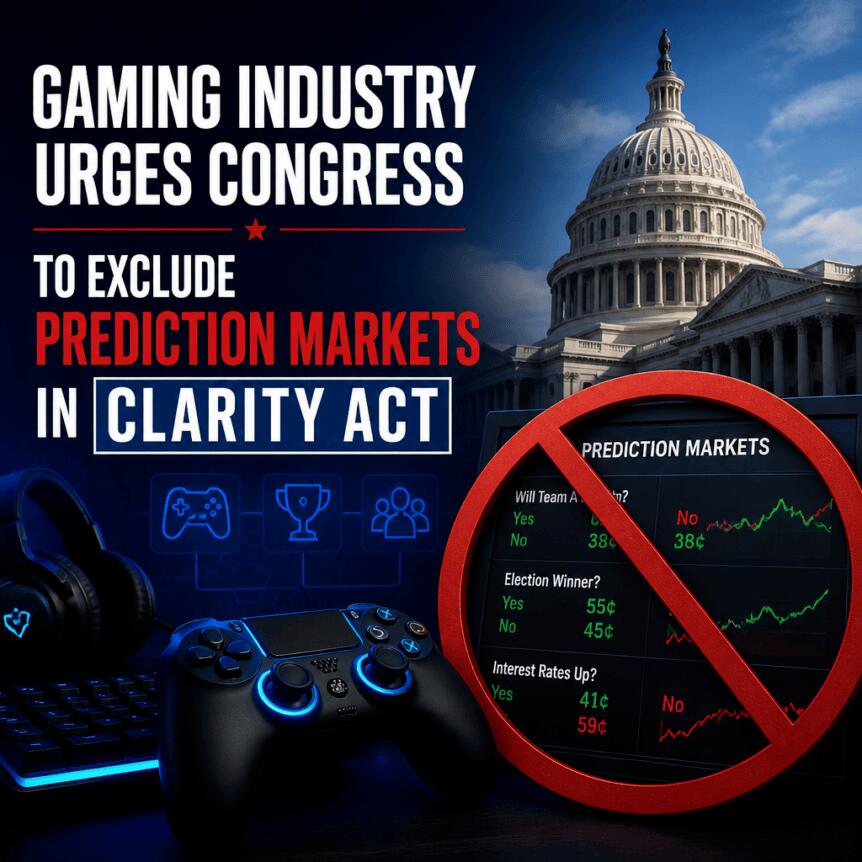
Several U.S. gaming industry groups and labor organizations have asked Senate lawmakers to add explicit language to the Digital Asset Market Clarity (CLARITY) Act that would prohibit “event contracts” tied to sports and casino-style gaming from being offered through prediction market platforms.
In a letter reported by Semafor on Wednesday, organizations including the Indian Gaming Association and the American Gaming Association said they are concerned that prediction markets have contributed to a major expansion of gambling activity in the United States without voter approval or legislative authorization. They urged Congress, while the CLARITY Act is still under consideration, to clarify that sports betting falls outside the Commodity Futures Trading Commission’s (CFTC) regulatory remit and cannot be structured as digital “prediction market” products.
Key takeaways
Gaming and labor groups are pushing for CLARITY Act amendments to explicitly bar sports and casino-style “event contracts” on prediction market platforms. The groups argue that these activities should remain governed by state and tribal gambling frameworks rather than CFTC oversight. Regulatory conflict centers on the CFTC’s position that it has “exclusive jurisdiction” over prediction markets. Litigation involving the CFTC and state regulators could escalate toward higher-court review depending on how agencies and platforms litigate jurisdictional issues. Congress has already passed the House version of CLARITY, but Senate consideration has been delayed amid concerns including stablecoin yield and tokenized markets.Requested CLARITY Act language and the jurisdiction dispute
The advocacy campaign reflects a broader policy dispute over which regulator should oversee prediction markets when products are connected to sports and gambling-adjacent events. According to the Semafor report, the signatories to the letter told Congress to use the CLARITY Act to “affirm” that sports betting is not within the CFTC’s remit and cannot be offered through prediction market platforms.
The letter also characterized prediction markets as a mechanism that has accelerated gambling expansion over the preceding 18 months. While the letter did not attempt to resolve all differences among the organizations on gambling policy, it emphasized a shared view that the existing state and tribal regulatory system should remain the primary framework for sports wagering-related products.
As a practical compliance issue, the groups argue that federal enforcement authority would be poorly calibrated to the granular, geographically scoped licensing and operational rules that states and tribes already apply. Their position is that CFTC supervision—particularly where products are marketed as event-linked bets—could create duplicative or misaligned oversight rather than resolving how platforms should be authorized to operate.
CFTC stance and industry pressure on regulators
The groups’ request arrives as CFTC leadership under Chair Michael Selig has argued that the commission has “exclusive jurisdiction” over prediction markets. Selig has previously taken an aggressive posture in support of platforms associated with event contracts, including by backing legal challenges to state-level efforts to block such products.
Supporters of the CFTC’s approach, as reflected in the agency’s broader litigation posture, have generally framed prediction market event contracts as falling within federal commodities/derivatives authority—rather than traditional gambling law. In response, the letter states that the CFTC was created to oversee commodities and derivatives markets, not gambling or sports wagering, and argues that the agency lacks the institutional capacity to police nationwide sports betting given the existence of established state and tribal regulatory systems.
Beyond jurisdictional theory, the dispute has had measurable political and fiscal traction. The American Gaming Association reported that state gaming authorities had lost about $1.08 billion in tax dollars “since prediction markets began offering sports event contracts.” For institutional stakeholders, such claims often shape legislative negotiations by translating regulatory boundaries into concrete budget impacts and industry incentives for lawmakers to limit federal intervention.
Why the CLARITY Act is central to enforcement outcomes
The CLARITY Act is designed to shift elements of regulatory and enforcement authority over certain digital asset activities away from the SEC and toward the CFTC. Lawmakers and analysts have described the measure as an attempt to reduce uncertainty about which federal agency governs which digital asset instruments, particularly in areas where the SEC’s approach to market structure and token classification has been contested.
Some lawmakers expected the Senate to move the bill out of Congress by August. However, the legislation passed the House in July 2025 and has faced delays linked to concerns including stablecoin yield, ethics considerations, and the treatment of tokenized equities. These issues matter for compliance and governance because they affect how regulated market actors can structure products, market disclosures, and custody or custody-adjacent arrangements—especially where stablecoins and tokenized instruments intersect.
Within that broader policy framework, the proposed addition sought by the letter would specifically target prediction markets that resemble sports betting or casino-style gaming. If adopted, that change could constrain how platforms label or structure their offerings, and it could also influence whether regulators treat certain products as commodity-like derivatives or as wagers subject to gambling licensing.
Potential path to the U.S. Supreme Court
Jurisdictional battles between federal agencies and state regulators frequently create pathways to appellate review, and the question of whether prediction market “event contracts” can be treated as swaps under federal commodities law has been a recurring theme in litigation.
Some legal experts and advocates anticipate that if the CFTC continues to threaten state enforcement actions through court challenges, the conflict could ultimately reach the U.S. Supreme Court. The letter’s signatories and related commentary point to the potential for a federal–state regulatory split to become the subject of final, nationwide constitutional and statutory interpretation.
One historical anchor is the U.S. Supreme Court’s 2018 decision in Murphy v. National Collegiate Athletic Association, which recognized that individual states have authority to regulate sports gambling. Platforms such as Kalshi and Polymarket, as well as the CFTC’s position in related matters, have largely treated prediction market event contracts as “swaps” that should fall under CFTC jurisdiction rather than state gambling regulation.
For compliance teams and regulated market participants, the uncertainty is significant: the outcome of jurisdictional litigation affects licensing requirements, marketing and distribution strategies, and risk management around enforcement. It also affects cross-border behavior for firms operating in multiple states, because a change in the legal characterization of event contracts can alter the compliance burden from one set of licensing rules to another.
Closing perspective
As the CLARITY Act moves through the Senate, the key unresolved issue will be whether Congress will explicitly carve out sports-and-casino-style event contracts from CFTC oversight—potentially reshaping the regulatory perimeter for prediction market platforms. Stakeholders should monitor how lawmakers negotiate amendments, and whether ongoing federal-state litigation prompts further appellate and, potentially, Supreme Court review.
This article was originally published as Gaming Industry Urges Congress to Exclude Prediction Markets in CLARITY Act on Crypto Breaking News – your trusted source for crypto news, Bitcoin news, and blockchain updates.





 Bengali (Bangladesh) ·
  English (United States) ·