

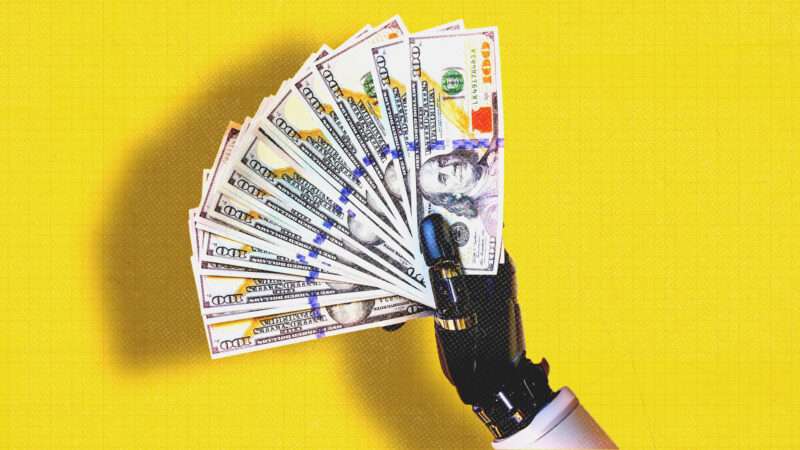
Silicon Valley has a new pitch for Washington: Artificial intelligence will solve all your budget problems. Industry leaders claim the technology will turbocharge productivity growth, generate a flood of new tax revenue, slash the cost of delivering government services, and perhaps even bend the curve on Medicare and Medicaid spending. Deficits will shrink. The likelihood of a debt crisis will melt away, as technology accomplishes what politicians couldn't. In the words of Elon Musk, AI and robotics are "the only thing that can solve for the debt situation."
Politicians, desperate for any exit from their self-imposed fiscal catastrophe, are listening. The "easy answers" of simply cutting waste, defunding immigrants and foreigners, taxing the rich, or slashing defense spending are woefully insufficient to address budget deficits on track to hit 9 percent of GDP within a decade and 14 percent of GDP within three decades under current policies. Closing deficits of this magnitude would require an aggressive combination of Social Security and Medicare reforms with new broad-based taxes—unless Silicon Valley can produce an AI-based economic miracle that lets Americans continue collecting exorbitant government benefits at relatively low tax rates.
Unfortunately, like all the other "easy solutions" to budget deficits, AI is highly unlikely to produce the trillions of dollars in annual fiscal savings necessary to avert the hard decisions. Betting America's fiscal future on AI is wishful thinking.
To analyze the prospects, we can examine the fiscal and economic categories AI is most likely to affect.
A Productivity Miracle Still Leaves a Massive Deficit
The late 1990s technology boom drove annual productivity growth roughly 1 percentage point above its long-run trend from 1995 through 2005. That extra growth generated healthy tax revenue and broadly raised living standards. If AI delivers a comparable shock—and some credible economists believe it could deliver more—the revenue windfall would be real and substantial. A sustained 1-point boost to annual productivity growth rates would raise tax revenues by $143 billion annually in 2028, rising to $834 billion (1.8 percent of GDP) annually by 2036.
While such revenues are significant, they would shave only a fifth off the $4.4 trillion projected budget deficit under current policies. As exciting as it may be to nearly double productivity growth rates, this would barely offset the economic growth declines already occurring due to labor force reductions driven by falling fertility rates, retiring baby boomers, and immigration restrictions.
Yes, some AI enthusiasts may suggest that long-term productivity growth could leap by 2 or 3 percentage points (or more)— essentially doubling or tripling its baseline annual growth rate. This would provide additional deficit reduction but still not come close to balancing the budget. Moreover, the productivity-to-wages-to-tax-revenue chain can weaken. If AI gains accrue disproportionately to capital owners rather than boosting worker wages, added income and payroll taxes may not grow as quickly. On the other hand, AI could help the IRS identify tax cheats and collect unpaid taxes.
All together, even an optimistic scenario delivers only $1 trillion annually in new net revenues by 2036.
The Hidden Price Tag of Automation
The more AI revolutionizes work and expands economic productivity, the more disruptive it will likely be to the workforce. AI is highly unlikely to permanently raise jobless rates—the economy has evolved from hunting and gathering to mass agriculture, the industrial revolution, and the information revolution without that occurring, because there are always new consumer demands to satisfy with new industries and jobs. But a full AI workforce revolution without significant and expensive job displacement costs is highly unlikely, and the adjustment costs for existing workers could be painful and expensive.
Economists have identified two potential job displacement scenarios. The first scenario, which has not borne out so far, involves significant layoffs in AI-heavy industries, bringing long spells of unemployment for mid-career professionals. The second scenario, which is beginning to play out, is a significant reduction in entry-level job openings for younger workers in selected industries. The first scenario produces perhaps 2 million to 3 million jobless workers at a given time requiring unemployment benefits, Medicaid, food assistance, and job-retraining assistance. The second scenario suggests perhaps 4 million to 5 million younger workers entering the labor force in lower-skill jobs at lower wages (or not at all) and thus reducing tax revenues and pushing up low-income benefit costs.
Depending on which scenario ultimately plays out, and to what degree, the total displacement costs could consume anywhere from 15 percent to 40 percent of all new tax revenues (or more than 100 percent if accompanied by a universal benefit of at least $3,000 annually).
Under a midpoint assumption of taking back 25 percent of the budgetary gains from productivity, worker displacement costs would total $250 billion annually by 2036.
Longer Lives, Bigger Bills: AI Could Create a Fiscal Paradox for Social Security and Healthcare
Any AI-produced improvements in worker productivity and wages will automatically expand Social Security's spending liabilities, because initial benefit levels rise with lifetime earnings. These effects would be partially offset by job displacement effects that reduce both near-term payroll tax revenues and long-term benefit liabilities.
If these effects roughly cancel each other out, then Social Security's tie-breaking factor may be AI-assisted advances in medicine meaningfully extending average lifespans, allowing retirees to collect benefits for more years—while simultaneously driving up Medicare costs as well. This would likely mean a modest worsening of Social Security's long-term shortfalls that manifests in the 2030s and 2040s.
AI's fiscal effect on healthcare spending is heavily disputed. The optimists paint a rosy picture in which technology would dramatically slash the one-quarter of national health spending currently allocated to administrative functions. New technologies would diagnose injuries and diseases earlier and treat them more quickly and effectively, extending lifespans and improving quality of life. Many of these advancements would be accomplished with at-home technologies and less time spent in doctors' offices and hospitals. Federal Medicare and Medicaid costs, along with economy-wide health spending, would plummet in this scenario, solving the leading driver of long-term deficits.
All of these exciting outcomes are possible—but probably not the dramatic savings for the federal budget. Even if AI substantially reduces healthcare administrative costs, there is no guarantee the productivity gains would accrue to the government through lower payment rates; many past productivity gains have accrued to health providers and insurers instead. Aggressive diagnostic improvements can save treatment costs for many, but they can also encourage overdiagnosis, which brings unnecessary utilization costs for others.
Adopting new technologies requires substantial capital investment. And while automating existing procedures can lower costs, developing expensive new technologies that people want to use can drive utilization costs higher. Overall, it is not clear that AI's efficiency savings would outweigh the costs of faster and more aggressive diagnoses plus the higher demand for expensive new technologies.
Moreover, even AI's markedly improved health outcomes can only delay, not prevent, the inevitable cost of disease, end-of-life care, and death (with higher Social Security and Medicare spending in the meantime). Thus, it is not clear that even the rosy AI scenario described above would notably reduce per-beneficiary healthcare costs over these (likely extended) lives.
So an AI boost could lead to modest economy-wide health savings, but these would largely accrue to health providers and insurers rather than the federal government. Medicare and Medicaid spending would keep rising with an aging population and rising health care demand.
AI in the Military: More Missiles, Not More Savings
AI has the potential to streamline military logistics, intelligence and surveillance, and autonomous systems. At the same time, this would likely trigger an expensive investment surge in AI-enabled weapons systems. Historically, military "efficiency" gains have tended to get recycled into capability expansion rather than applied to deficit reduction.
These scenarios do not appear imminent in any case, as less than 1 percent of the Defense Department's 2024 budget request went toward AI. Thus, AI-related savings in the defense budget, currently taking up 13 percent of federal spending, would be small to nonexistent.
The Computing Revolution Didn't Notably Shrink Government. Why Would AI?
AI should streamline government administration and reduce the need for federal workers. Yet the federal personnel savings may disappoint. The federal bureaucracy's widespread adoption of computers and internet technology in the 1980s and 1990s merely froze nondefense federal employment. That precedent, along with strong civil service job protections and current AI-based job trends, suggests that eliminating perhaps a tenth of the 2.2 million federal civilian workforce would represent an ambitious target. In this area, the federal budget might see annual savings of $30 billion from the $300 billion in salary and benefit costs for current civilian employees.
Looking at the federal government's broader administrative expenses (which are a much smaller share of government spending than benefit costs) a fully scaled up AI-based systems may be able to shave $20 billion to $50 billion annually from the estimated $186 billion in fraud and improper payments. At the same time, deploying AI across federal agencies will require significant upfront acquisition, integration, and training costs. For roughly a decade, there would likely be no net savings as upfront investment costs swallow any efficiency savings.
AI Might Send Interest Rates and Interest Costs Soaring
If AI is as transformative as its boosters promise, it will be accompanied by a surge in investment demand as businesses and governments worldwide compete to deploy the technology. That investment demand puts upward pressure on real interest rates. While this concern has been noted by Olivier Blanchard, the IMF, and others, its potential fiscal cost has not fully penetrated the AI fiscal debate.
This is especially important because surging federal debt already risks pushing interest rates higher. While AI's specific long-term effect on interest rates is speculative and subject to various assumptions, studies from the IMF and from Ernst and Young have suggested that advanced economies could see upward interest rate pressure of 0.2–0.7 percentage points. If we take a midpoint assumption of 0.4 percentage points in higher interest rates, that would cost the federal budget approximately $240 billion in interest costs by 2036, which takes back a quarter of the federal budget gains from higher productivity.
Adding It All Up Does Not Solve Everything
Let's assume that modest Social Security costs and health gains roughly balance out—and military savings remain modest. This leaves us with healthy tax revenue growth and some minor government employment savings, totaling perhaps a little over $1 trillion annually by 2036, that are partially offset by the resulting costs of job displacement and higher interest rates on the federal debt (consuming perhaps half of those savings).
Add in some interest savings from the deficit reduction, and the analysis above nets out to perhaps $600 billion in annual savings within a decade—which would eliminate a little over one-eighth of the $4.4 trillion deficit projection under current policies. That would be real progress, but nowhere near enough to "solve for the debt situation," in Musk's words.
Bernie Sanders' AI Stock Grab Won't Fix the Deficit Either
Sen. Bernie Sanders (I–Vt) wants the federal government to seize a 50 percent equity stake in the largest AI companies. That may sound like a huge and painless new government revenue source: a way to capture AI's wealth directly rather than waiting for it to flow through wages and profits into tax revenues.
But the proposal rests on a fundamental accounting illusion. A government equity stake generates no actual federal revenue until shares are sold or dividends are paid—and current AI companies are unlikely to begin paying dividends for many years, given their reinvestment needs. The "trillions of dollars" Sanders envisions are unrealized paper gains sitting on a balance sheet, not cash in the Treasury. That is, unless Washington plans to sell the very equity shares that Sanders wants to use to control these companies.
Beyond the revenue illusion, a confiscatory 50 percent stock tax would deter the private investment and entrepreneurial risk-taking that drives AI development, undermining the very productivity gains and tax revenues that Washington is counting on. Government board seats would politicize corporate decision-making and discourage outside investors. Sanders' promise of expensive universal benefits would likely far exceed any limited annual revenue stream the fund actually generates. It would be far simpler to tax the profits, wages, and capital gains AI generates, without nationalizing half of Silicon Valley.
The Best-Case Scenario is Not The Standard Baseline Scenario
I'm not making a case for AI doomerism. Artificial intelligence has the potential to make workers more productive and efficient, to develop new technologies, to raise wages, to make our lives longer and healthier, and to benefit us in ways we cannot yet imagine.
But there is little basis for expecting AI to drastically reduce the staggering $200 trillion in budget deficits projected over the next three decades. The same AI forces that could bless the federal Treasury with faster worker productivity and tax revenue growth would also likely bring rising job displacement costs and higher interest rates on the debt. The potential savings from automating more medical diagnoses and treatments may be offset by the costs of using those new technologies over longer lives. Faster-growing wages would raise Social Security payroll tax revenues—and future Social Security benefit costs as well.
Anthropic CEO Dario Amodei has claimed that the "money is going to be there. The budget may balance without us doing anything because there's so much growth." Balancing the budget would require annual labor productivity growth rates to leap permanently from 1.5 percent to approximately 5.5 percent. Even if this virtually unprecedented productivity plateau emerged, a large share of the resulting revenues would be consumed by: 1) steeply rising interest rates on the federal debt resulting from this gold rush of new investment demand, and 2) enormous worker displacement costs. Indeed, the very AI scenario most likely to balance the budget is also the one most likely to trigger demands for a universal basic income, with an annual cost potentially exceeding $1 trillion. Significant budget deficits would persist.
AI's ultimate effect on the economy and the federal budget is difficult to predict with precision. AI optimists can surely quibble with the analysis above, building scenarios where the fiscal benefits wildly exceed these estimates while the costs simply do not materialize. Such an outcome would be great. Yet Congress and the White House should not treat tail-end, best-case scenarios as an excuse to sit back and do nothing while federal debt projections barrel toward 240 percent of GDP over the next few decades. The projected deficits are simply too incomprehensibly huge for AI to solve, even under the standard rosy baseline scenario of peace, prosperity, low interest rates, and no new tax cuts or spending expansions.
The cost of being wrong would be a debt crisis followed by brutal tax increases and benefit cuts. For 60 years, Washington has relied on magical thinking and gimmicks while building a $31 trillion federal debt. Responsible lawmakers should hope for the best but budget for more modest scenarios.
The post Even an AI-Sparked Economic Miracle Will Not Save the Federal Budget appeared first on Reason.com.





 Bengali (Bangladesh) ·
  English (United States) ·