
 2 hours ago
3
2 hours ago
3 
TLDR
The U.S. dollar index fell to around 98.80, its lowest level since late May The Treasury announced it would double bond buyback operations to $4 billion per operation for longer-dated bonds The 30-year Treasury yield dropped from a 19-year high of 5.337% to around 5.18% following the move The Japanese yen pulled back from the closely watched 160 level, last trading at 158.55 per dollar Fed minutes from July showed policymakers remain concerned about inflation and are open to further rate hikesThe U.S. dollar dropped to its lowest point in three months on Thursday after the Treasury Department stepped in to ease pressure in the bond market.
The dollar index fell to around 98.80, its weakest level since late May. The euro climbed to $1.1674, its highest since late May.
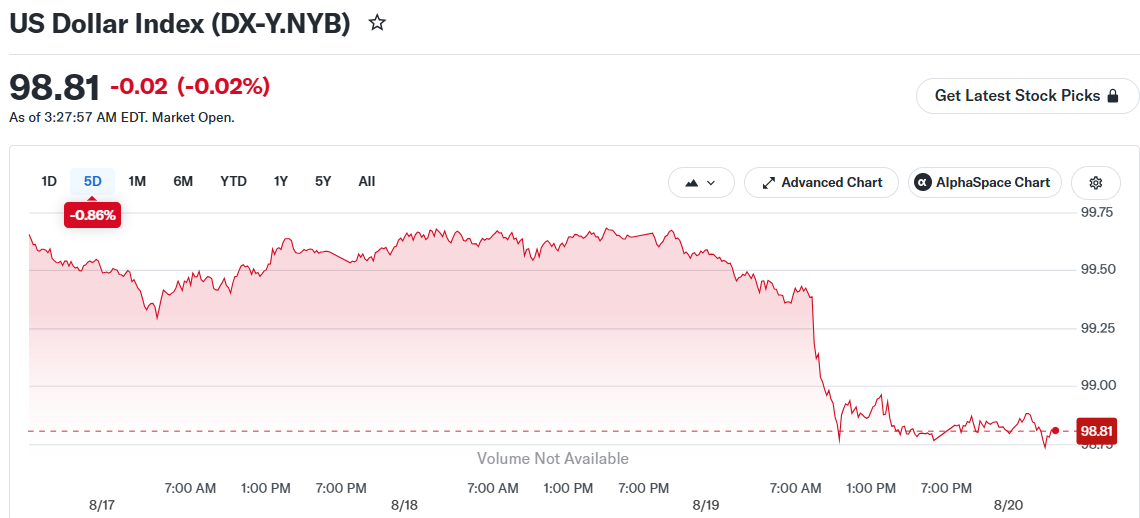 US Dollar Index (DX-Y.NYB)
The bond market had been under heavy selling pressure this week. Investors grew worried about rising government debt and higher oil prices tied to the ongoing U.S.-Israeli conflict with Iran.
The 30-year Treasury yield hit a 19-year high of 5.337% earlier this week. That level put pressure on financial markets globally.
Treasury Doubles Down on Bond Buybacks
The Treasury responded on Wednesday by announcing it would at least double the size of some buyback operations for longer-dated bonds, raising the cap to $4 billion per operation from $2 billion. The targeted bonds have maturities of 10 years or more.
BREAKING: The US Treasury announces it will double the size long-term US government debt buybacks following the rapid surge in US Treasury yields.
Repurchases of $2 billion will now be increased to "at least" $4 billion, the US Treasury said.
The move is intended to provide…
— The Kobeissi Letter (@KobeissiLetter) August 19, 2026
Following the announcement, the 30-year yield fell to around 5.18%, dropping roughly 9 basis points. The 10-year yield also pulled back.
Analysts at TD Securities noted that while the buyback is not the same as quantitative easing, the timing was telling. It came just ahead of an auction for 20-year Treasury notes.
The Treasury also said more details on future buybacks would be released on November 4, the day after U.S. midterm elections. Analysts flagged that this leaves room for the government to expand future purchases.
The move effectively shifts more government borrowing toward short-term bills while buying back longer-dated debt. This eases pressure on long-term yields without requiring the Federal Reserve to expand its balance sheet.
Currency Markets React
The dollar’s drop gave the Japanese yen some breathing room. The yen had been trading close to the closely watched 160 per dollar level and was last at 158.55. A joint U.S.-Japan intervention in late July had failed to produce a lasting effect.
The South Korean won had fallen 1.8% overnight but recovered some ground. The Australian dollar held steady after gaining 0.5% the prior session.
Sterling rose to $1.3614, just below a three-month high. The Swiss franc eased slightly from a two-month high.
The Indian rupee edged lower after five consecutive sessions of gains. The Reserve Bank of India had reportedly intervened across spot, futures, and offshore markets.
Meanwhile, oil prices climbed back toward $92 a barrel as hopes for a quick resolution to the U.S.-Iran conflict faded, adding to inflation concerns.
Fed minutes from July showed policymakers remain watchful on inflation, with some open to more rate hikes if prices do not fall toward the 2% target.
The post Dollar Slides to Three-Month Lows as Treasury Steps In to Cool Bond Market appeared first on CoinCentral.





 Bengali (Bangladesh) ·
  English (United States) ·