

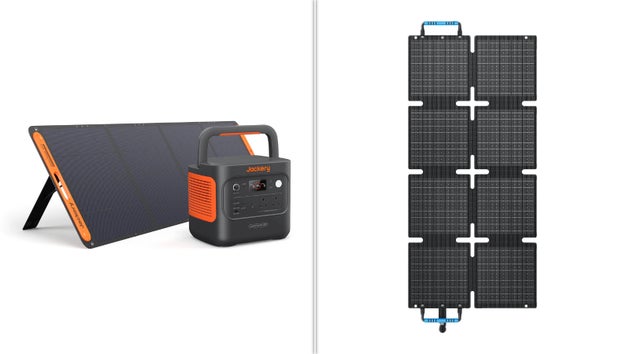
 Jackery/ Bluetti
We hope you love the products we recommend! All of them were independently selected by our editors. Just so you know, HuffPost UK may collect a share of sales or other compensation from the links on this page if you decide to shop from them. Oh, and FYI — prices are accurate and items in stock as of time of publication.
Given the current state of the world, we probably don’t have to do much to sell you on the benefits of renewable energy.
So it makes complete sense that supermarket Lidl recently announced it will start supplying plug-in solar panels for as little as £400 in the next few months.
With energy bills rising this month, the move to increase supply of renewable power sources on British high streets could help people offset their energy bills.
We know what you’re thinking: there’s not much sun in the UK at the moment. But that doesn’t mean the energy saved by using solar panels won’t add up.
And the good news is that you don’t need to wait for Lidl and other high street suppliers to try a plug-in solar panel: there are plenty of larger options available to buy now.
Best plug-in solar panels at a glance:
Jackery Solar Generator 2000 v2VTOMAN Jump 2200 Portable Power Station And 400W Solar PanelBluetti Solar PanelAnker Solix Portable Solar Panel 200WDOKIO Foldable Portable Solar PanelBest plug-in solar panels to shop now
Whether you’re dipping your toe in the world of renewable energy, or looking for a seriously durable source to rely on during the apocalypse (or what other people would call camping), we’ve rounded up the best plug-in solar panels, from £99 to £1,900.
How do plug-in solar panels work?
Instead of having to pay for a costly installation (or deal with getting dreaded planning permission) plug-in solar panels can be installed in your home yourself, or simply propped up when you’re camping or off-grid.
Connecting a solar panel to an inverter can result in energy to charge your electronics within a few hours.
Some are even powerful enough to power a camper van, or kitchen appliances, while others are light and foldable, so they’re easily transported.
What can plug-in solar panels be used for?
Available in different forms and with varying wattage outputs, solar panels can be used in lots of contexts, including:
During power outagesTo save money on energy bills by charging electronics and kitchen appliancesWhen you’re camping or off-gridTo power your car.What are the benefits of solar panels?
If you’re still not sure why you would need a solar panel in your home, we asked Kian Milroy, renewables electrical engineer at solar panel intallation Heatabl to explain the how they can offset your energy bills.
“The obvious benefit of solar panels is that they allow you to generate some of your own electricity, rather than buying it from the grid,” he says. “That means you can reduce your electricity bills and protect yourself against future energy price increases.“
However, it is unlikely you’ll be able to use solar panel as your sole source of energy in the UK, Milroy notes.
“We just don’t get enough sun in winter,” he says. “But if you use a lot of energy during the day, whether you’re working from home, charging an electric vehicle, or you’re at home with a young family, it can make a material difference to your bills.
“And if you manage to produce surplus electricity, you can usually export it back to the grid through a Smart Export Guarantee tariff. But the savings you generate will always depend on your roof, how many panels you have, and how much energy you use.”






 Bengali (Bangladesh) ·
  English (United States) ·