

The war in Yemen has come full circle. In 2015, a proxy conflict broke out, with the United States backing Saudi Arabia against Iranian-backed rebels there. After years of a brutal slog, in 2022, the two sides agreed to a fragile truce. It broke down this summer as the U.S.-Israeli war on Iran turned into a regional conflict.
Earlier this week, President Donald Trump ordered a U.S. attack on Yemen, but pulled back at the last minute. Meanwhile, Democrats in Congress have been pushing the administration in two different directions: either to get involved or back off. While the hawks are a small and unpopular group within the Democratic base, they have the backing of Democratic leadership.
"The Trump administration is not supporting [the] fight against one of the largest terrorist militant groups in the Middle East," Rep. Jared Moskowitz (D–Fla.) complained during a House Foreign Affairs Committee hearing about Yemen earlier this month.
He had an implicit nod from Democratic leadership, which had just appointed Moskowitz as ranking member of the Middle East subcommittee. It's a sign of how Congress could approach foreign policy if Democrats win a majority in the upcoming midterms.
In 2014, the pro-Iran faction Ansar Allah (better known by the name of its leader, Abdul Malik al-Houthi) launched a coup d'état in Sanaa, the Yemeni capital. The United Nations quickly recognized a rival government in Aden, and a few months later, a Saudi-led coalition invaded Yemen in support of the Aden government, with U.S. backing. The resulting war killed an estimated 233,000 people.
Despite a 2022 truce, both sides began flexing their muscles. The Houthis started harassing international shipping and clashing with the U.S. Navy in the name of the Palestinian cause. Saudi Arabia, meanwhile, crushed an attempted secession movement against Aden backed by the United Arab Emirates in January 2026.
The two sides finally came back to blows in July 2026, after the funeral of Ayatollah Ali Khamenei in Iran. Saudi Arabia fired warning shots at the airport in Sanaa to stop the Houthi delegation from returning from Iran with Iranian advisers, and Houthi forces hit back hard, sweeping Yemen's coast while bombing Saudi oil infrastructure.
The U.S. military has sent around 100 advisers to Saudi Arabia in support of the campaign in Yemen. France is also sending troops to defend the most important Saudi pipeline, and Britain has offered an aerial tanker for refueling Saudi fighter jets.
Saudi Crown Prince Mohammed bin Salman and the Aden government have both been lobbying Trump to get more directly involved. House Foreign Affairs Committee Ranking Member Gregory Meeks (D–N.Y.) gave those efforts a boost on the sidelines of the U.N. General Assembly in New York this month, meeting with a delegation from Aden to discuss "how the United States Congress can support Yemen's government against the Houthis," according to Meeks' statement.
From the other side of the aisle, Rep. Joe Wilson (R–S.C.) has already put in an opening bid. He has proposed a bill to give the Aden government $100 million in military aid, $100 million in economic aid, and $100 million for anti-Houthi propaganda.
But the war-weary Democratic base doesn't necessarily want deeper U.S. involvement in Middle Eastern wars. (Nor does the Republican base, parts of which increasingly regret the war with Iran.) After all, one of the big Democratic foreign policy pushes during the first Trump administration was to pull U.S. support from the Saudi war in Yemen.
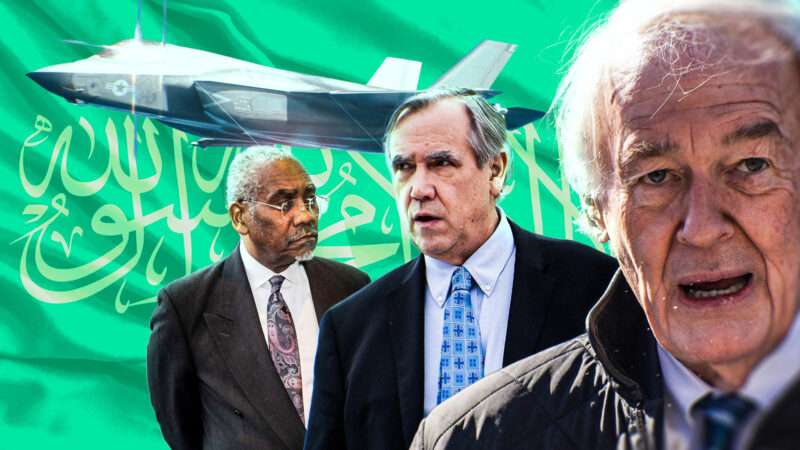
Almost immediately after the State Department announced a $24.3 billion sale of F-35 fighter jets and $5 billion sale of bombs to Saudi Arabia last week, Sen. Ed Markey (D–Mass.) proposed a resolution to block them. Sens. Jeff Merkley (D–Ore.) and Bernie Sanders (I–Vt.) joined him as cosponsors. Markey tied the arms sale to the recent U.S.-Saudi nuclear cooperation agreement proposed by Trump—which Meeks also opposes.
"The United States must not send thousands of conventional weapons to Saudi Arabia or allow it to develop a nuclear program. I am deeply concerned by the Kingdom's human rights abuses, the security of the region as the war in Iran rages on, and the proxy war that is escalating between Iran and Saudi Arabia in Yemen," Markey said in a statement. "Further escalation in the Saudi-Iran proxy war will worsen an already dire humanitarian catastrophe in Yemen and risks setting off a nuclear arms race between Iran and Saudi Arabia."
Democratic suspicion of Saudi Arabia may be a silver lining from doves' perspective, limiting how much Democrats are willing to throw in behind a Saudi campaign in Yemen. In the same meeting with Aden's representatives where he called for U.S. support, Meeks also called for "revitalized dialogue and diplomacy." It was an implicit nod to the Trump administration's direct talks with Sanaa.
Of course, the whole situation is downstream of Trump's decision to attack Iran. And back then, Democrats showed the same mix of hawkish and dovish reactions, with some trying to restrain Trump and some egging him on.
"Iran is a bad actor and must be aggressively confronted for its human rights violations, nuclear ambitions, support of terrorism and the threat it poses to our allies like Israel and Jordan in the region," House Minority Leader Hakeem Jeffries (D–N.Y.) said in his first statement on the war, but then called for Trump "to avoid another costly, prolonged military quagmire in the Middle East."
The post Democrats Are Quietly Clashing Over U.S. Involvement in Saudi Arabia's War in Yemen appeared first on Reason Magazine.




 Bengali (Bangladesh) ·
  English (United States) ·