

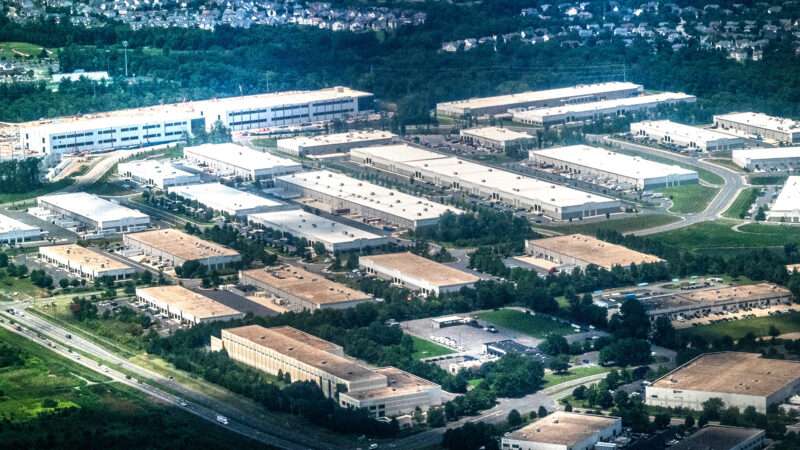
What if we just bribed them? "The letters started arriving in June, from a big developer who said he would give $10,000 to every family in town. They could spend it on anything. 'Really whatever you want,' the developer wrote," reports The Wall Street Journal. Residents of Hazle Township, in Pennsylvania, just needed to let NorthPoint Development build a data center (the first of 15!) in the foothills of the Pocono Mountains. "Then, $10,000 checks would go out to each of the 4,500 households there. It would be a $45 million payout, the developer wrote."
This is a year-changing amount of money for residents there, where median annual household income runs about $60,000. But most residents are not interested in taking the checks, or any of the more subtle bribes that have been thrown their way. "Data-center developers are increasingly offering towns and cities packages in the tens of millions of dollars, including funds for fire departments, emergency services and schools," reports the Journal. In Hazle Township, the developer trying to woo them even started sponsoring amusement park rides at a local festival. "$10,000 doesn't match how much it's going to tank my property value," one retired teacher told the Journal. This concern has been echoed by many others in the past few years, as NorthPoint has attempted to secure local buy-in first through persuasion, and now through…pecuniary persuasion.
This approach—just handing out cash to those who would be affected—is becoming more common, as data center constructions becomes a hot-button political issue in America's rural counties.
Right now, "the country houses nearly 100 hyperscale data centers, which consume at least 100 megawatts of power at peak operation—enough to power about 80,000 homes," reports The Washington Post in an interactive feature on how landscapes across the country have changed with the data center boom. "There are another 120 under construction, according to Cleanview, a market intelligence company tracking data center development. Four hundred and sixty more are planned."
Interestingly, only about 40 percent of these projects were completed on already-built-out land; about 60 percent of the land has come from clearing forests or farms. And because strain on power grids had become a reason for residents to oppose data-center construction, more and more developers are proposing their own power generation to inoculate themselves against residents' criticisms that electricity costs could be passed on to them. But this requires the centers to be even larger, gobbling up more acreage, so there are still tradeoffs.
Scenes from New York: "A second view from the high tide in Red Hook, Brooklyn this morning (Saturday September 26, 2026), during the Nor'easter. The waves were pushing into Van Brunt Street, and water was also coming up from the sewage pipes, flooding the street further inland," reports Nathan Kensinger, who is working on documenting sea level rise in New York City. Erosion worsened in Jacob Riis Park, down on my beloved Rockaway Peninsula.
QUICK HITS
"Florida's Brightline has filed for bankruptcy protection after years of lower-than-expected revenue left it unable to repay billions it borrowed to finance the Miami-to-Orlando private railroad," reports Bloomberg. "Texas has more Black voters than any other state—around 2.7 million, according to the Pew Research Center—with large communities in Houston, Fort Worth, Dallas and in East Texas," notes The New York Times. So Democratic candidate James Talarico, if he hopes to beat Ken Paxton and secure a seat in the U.S. Senate, needs not only to win the black vote but also to get large numbers of black voters to turn out—something with which both Democrats and Republicans in Texas have historically struggled. "British police said on Monday the five men who were detained near the Fairford airbase used by the US to attack Iran were all British nationals who live in London," reports Reuters. "The police said that the five men, who were arrested on Sunday on suspicion of terrorism and explosive offences, were all in their mid-twenties." The Catholic Church is contending with whether to remove art due to the sins of the artist: Mosaics at the Basilica of Our Lady of the Rosary, in Lourdes, France, were made by a Slovenian priest-artist Marko Rupnik, who has been credibly accused by nearly two dozen women (including nuns) of sexual and physical abuse. The mosaics have been covered up, and "a secretive trial of Rupnik is unfolding in Vatican City," reports The Washington Post. Lourdes is an important pilgrimage site, as it's where many apparitions of the Virgin Mary were reported in the middle of the 19th century. Central Park death spiral watch:It's crazy how bad @CentralPark_NYC is getting recently. 6 armed robberies, a near fatal bike crash, assaults. And now a murder in what a week, 10 days? https://t.co/T2FcWmgdz3
— Andrew Fine (@AFineBlogger) September 27, 2026
A good point:It's easy to hate insurance companies, but do you have the courage to hate hospitals? https://t.co/Q4MJXaFl11
— Emma Camp (@emmma_camp_) September 27, 2026
The post Data Centers and Their Discontents appeared first on Reason Magazine.




 Bengali (Bangladesh) ·
  English (United States) ·