
 38 minutes ago
8


CoreWeave earnings delivered the growth number AI investors wanted and the interest bill they still have to confront. Quarterly revenue reached $3.661 billion, but a $709 million net loss showed why booming demand for computing capacity does not automatically translate into profits for the companies supplying it.
The November 10 results offer a concrete answer to one part of the AI debate: customers are spending. The harder question is whether the infrastructure can be financed and operated on terms that leave enough value for shareholders after lenders are paid.
CoreWeave earnings beat revenue expectations
The company’s results release reports revenue up from $1.365 billion a year earlier. Reuters put the analyst consensus at $3.55 billion, so the result exceeded that benchmark. Comparisons elsewhere can differ slightly because estimates come from different data providers.
“This was a breakout quarter for CoreWeave,” chief executive Michael Intrator said in the release. He highlighted an expected approximately $9 billion of customer prepayments and deposits over the next three months as one of several funding sources.
That expectation is relevant to the financing debate, but it remains a forecast. A customer deposit can improve near-term liquidity without being equivalent to profit earned from delivering a service. The company still needs to provide the capacity and meet the obligations attached to its contracts.
The interest bill is the tension
CoreWeave reported $207 million of operating income against $846 million of net interest expense. Its adjusted EBITDA was $2.256 billion. The difference between those measures is central to reading the quarter: adjusted EBITDA strips out costs that remain important to an infrastructure business and its investors.
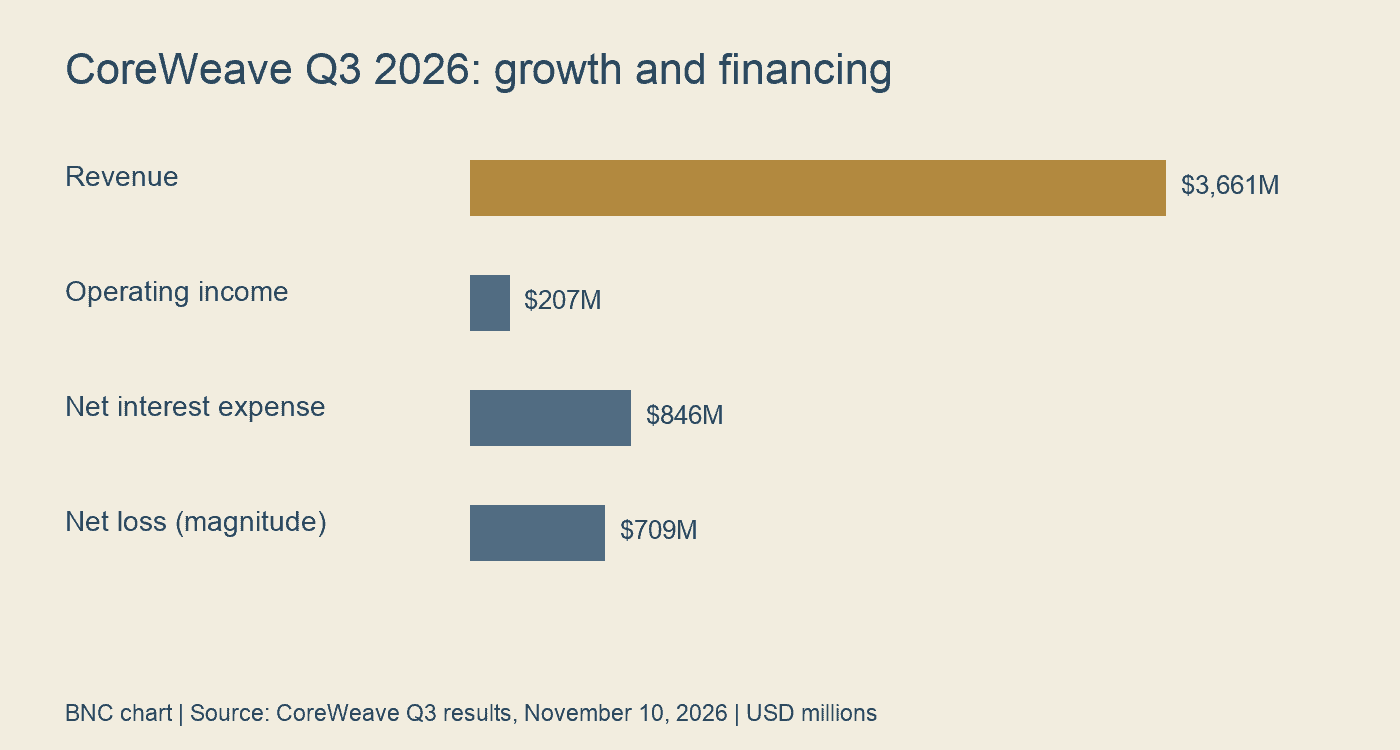 BNC chart from CoreWeave’s November 10 earnings release, linked above. Net loss is shown as a magnitude; the bars are separate financial measures, not additive.
Operating income measures the business after operating expenses. Net interest expense reflects the cost of financing. A positive operating result can therefore coexist with a large net loss when financing and other items absorb the operating profit.
The comparison does not establish that the business cannot become profitable. It establishes the hurdle that growth must clear. Investors who focus only on revenue risk overlooking how much of the benefit flows to providers of capital before reaching ordinary shareholders.
Backlog is a promise to deliver
The company reported approximately $132.5 billion in revenue backlog. Its definition includes committed customer-contract amounts subject to delivery and service-availability requirements. It is future business to execute, not cash already earned.
A long backlog can make investment planning more credible because it gives management evidence of demand. It can also create a demanding construction and deployment schedule. Servers, power and facilities must be available when customers require them, and financing has to bridge the gap between spending and collecting revenue.
For investors, the useful question is therefore not simply whether backlog increased. It is how efficiently contracted demand turns into operating cash and earnings. Delays or higher funding costs can change that conversion even when the customer relationship remains intact.
Guidance raises the stakes again
CoreWeave raised its full-year revenue outlook to $13 billion–$13.3 billion. It expects fourth-quarter interest expense of $1.05 billion–$1.15 billion. Those two forecasts frame the next test: continued growth alongside a substantial financing burden.
The guidance should not be read as a guarantee. Investors will need to compare actual delivery and funding outcomes with management’s expectations when the next results arrive. A revenue forecast can improve while the eventual return on invested capital remains an open question.
BNC’s earlier assessment of Wall Street’s argument that the AI sell-off was overdone identified earnings as an important test. CoreWeave now supplies evidence for both sides: strong sales for the optimists, and meaningful funding costs for the sceptics.
Why this matters beyond one AI stock
The wider AI investment case depends on several links working together. Model developers must attract paying users; cloud operators must supply computing capacity; and infrastructure owners must earn enough to support the capital required. Success at one link does not automatically settle the economics of the others.
That distinction also matters when comparing businesses exposed to data centres. A supplier selling equipment, a landlord leasing powered buildings and a cloud company renting computing services can benefit from the same trend while carrying very different financing risks.
CoreWeave’s results make those differences easier to see. Rapid revenue growth is evidence of demand for its services. The interest line is evidence of the price of building the platform that meets that demand. Neither figure should be used to erase the other.
The next disclosures worth watching are actual customer payments, the conversion of backlog into delivered services and the relationship between operating earnings and financing costs. These offer a more durable test than a single session’s share-price move.
CoreWeave has strengthened the case that AI infrastructure demand is real. It has not yet removed the question that made this earnings report so consequential: how much that growth will ultimately be worth after paying to finance it.



 Bengali (Bangladesh) ·
 English (United States) ·