
 1 week ago
3


Anthropic has released Claude Fable 5.2 and Claude Mythos 5.2, cutting standard API token prices by 20% and promising faster output as it pushes its most capable AI into more demanding coding, research and engineering work.
The company’s launch announcement on X describes the models as “designed to tackle the most daunting technical challenges.” The release is dated November 9 in Anthropic’s documentation and arrived on November 10 for New Zealand readers.
Fable and Mythos use the same underlying model, with different safeguards and access requirements.
Claude Fable 5.2 versus Mythos 5.2: who gets access?
According to Anthropic’s model documentation, Fable 5.2 targets demanding reasoning and lengthy agent sessions, including multistep research and work carried through to finished documents, spreadsheets or presentations. It supports a one-million-token context window and up to 128,000 output tokens.
Mythos shares its specifications and pricing but is restricted to organisations admitted through Anthropic’s verification programmes. The company directs cybersecurity and life-sciences researchers to the relevant access programmes.
Fable’s broader availability comes with stronger safeguards for cybersecurity and biology. The access split is therefore about permitted uses and misuse controls, not simply a cheaper model and a more expensive one.
Fable 5.2 is available through the Claude API and major cloud platforms, including Amazon Bedrock, Google Cloud and Microsoft Foundry. Availability and hosting arrangements vary by platform.
Lower prices, with a premium for speed
The published base rates are $8 per million input tokens and $40 per million output tokens for both models. Their 5.1 predecessors cost $10 and $50 respectively. That is a 20% reduction in each rate.
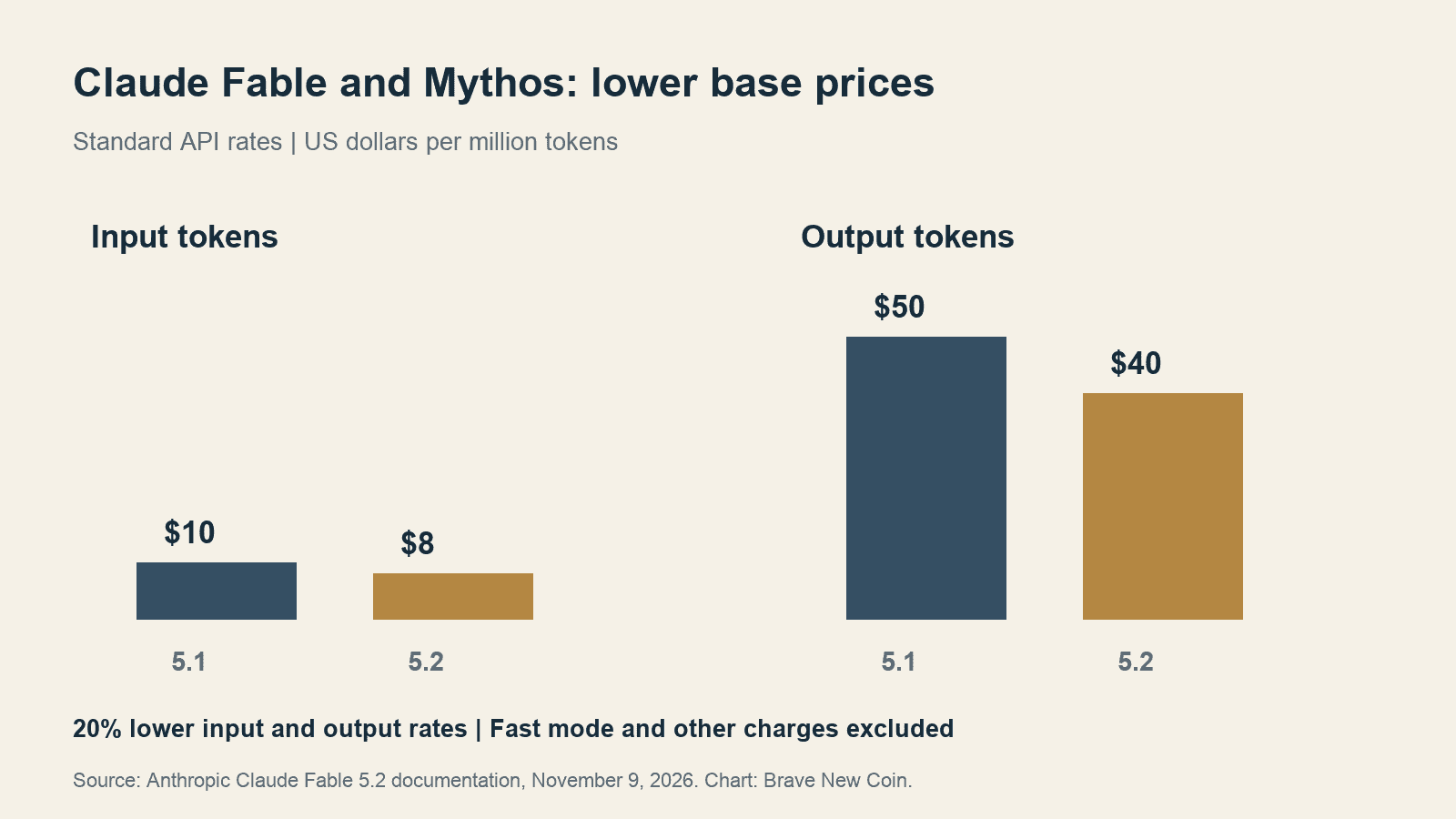
Chart: Brave New Coin. Source: Anthropic’s 5.2 documentation. Standard token rates only; fast mode, tools and other charges are excluded.
Anthropic says the new models generate output up to 30% faster than the 5.1 versions. Its optional fast mode promises token generation at up to 2.5 times the speed, at $16 per million input tokens and $80 per million output tokens.
Those speed figures are company claims. The higher fast-mode price also means users should distinguish faster responses from cheaper completed work. Total costs depend on the amount of reasoning, the number of agents and the tools involved.
Beyond the chatbot: working electronic prototypes
A separate Anthropic research report offers a more tangible demonstration than a conversational benchmark. Working with circuit-board manufacturer Diode Computers, the company asked Fable 5.2 to design a USB speakerphone, a home voice-assistant hub and a handheld virtual pet.
Anthropic says Claude selected components, laid out circuit boards, designed enclosures and wrote firmware. Human engineers manufactured and assembled the devices under its guidance, and the prototypes worked without electrical modifications.
The practical limit matters: these are prototypes. Anthropic says they have not completed electrical validation, antenna tuning, thermal testing or certification, and were not designed for mass production. The demonstration shows progress in coordinating engineering tasks; commercial product readiness still requires further work.
What Anthropic’s coding benchmark shows
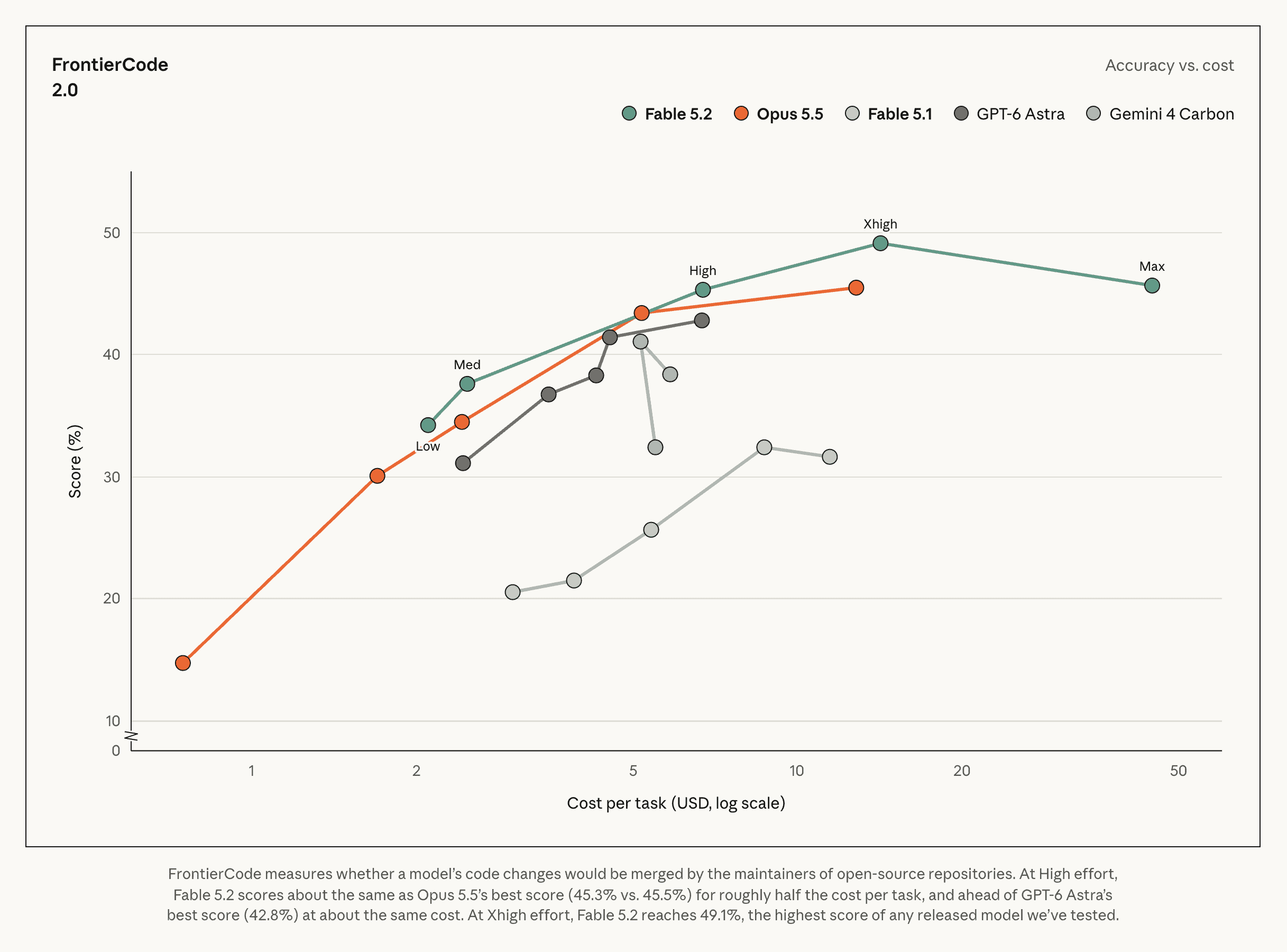
Chart: Anthropic, Claude Fable 5.2 and Mythos 5.2 announcement. FrontierCode 2.0 coding accuracy versus cost per task; the cost axis is logarithmic. Results are vendor-reported and depend on the stated evaluation settings.
Anthropic’s FrontierCode 2.0 evaluation gives Fable 5.2 a 49.1% score at Xhigh effort, versus 32.4% for Fable 5.1 at that setting. The chart also shows Fable 5.2 scoring 45.3% at High effort, close to Opus 5.5’s 45.5% at Max, for roughly half the cost per task.
There is an important wrinkle: Fable 5.2’s more expensive Max setting scores below Xhigh on this evaluation. More spending does not automatically produce a better result. These are Anthropic’s evaluation results, with specific settings and methods; users still need to test their own workloads.
Why Ethan Mollick calls it “Jagged AGI”
Early hands-on testing raises a more revealing question: can the model recognise when its own work has gone off course? In Fable 5.2 and Jagged AGI, entrepreneurship professor Ethan Mollick describes near-expert performance across many computer-based tasks. He describes it as “almost” artificial general intelligence (AGI), under a limited definition that excludes many human tasks and most jobs.
One creative project became bogged down after agent teams built an 87,500-word rulebook. “The AI had built a bureaucracy,” he wrote. Human intervention and a separate team of AI reviewers helped untangle the process. He also stopped a business-building experiment at the demonstration stage, without establishing that the AI could run it independently.
The distinction is between producing impressive work and recognising whether it is useful, proportionate and finished. For business buyers, that makes human review and coordination costs part of the productivity calculation. Mollick disclosed free prerelease usage, while saying he takes no money from AI labs and has no financial interest in Anthropic’s IPO.
The upgrade has compatibility and privacy conditions
Developers moving from 5.1 face changes beyond a new model name. Anthropic’s upgrade documentation warns that editing earlier conversation history can invalidate retained reasoning blocks. An older computer-use interface also fails on most platforms, with an Amazon Bedrock exception. Existing integrations need testing before a production switch.
Enterprise privacy is another purchasing consideration. Anthropic’s Enterprise Frontier Safeguards architecture allows monitoring data to be stored in infrastructure controlled by the customer, with review signals routed to that customer’s team. Access and deployment conditions still need to be checked for each organisation.
The model documentation specifies 30-day data retention unless Anthropic expressly authorises a zero-data-retention arrangement. For banks, trading firms and other organisations handling sensitive material, that is a deployment condition to establish before connecting the model to internal systems.
The launch follows BNC’s coverage of Anthropic’s power commitments and IPO valuation pressure. Lower unit prices and more ambitious uses sharpen the commercial question: can customers obtain enough useful work from increasingly capable models to justify the infrastructure behind them?
For users evaluating 5.2 now, the meaningful test is a completed task at an acceptable cost, with the right access and data controls—not the model name alone.





 Bengali (Bangladesh) ·
 English (United States) ·