

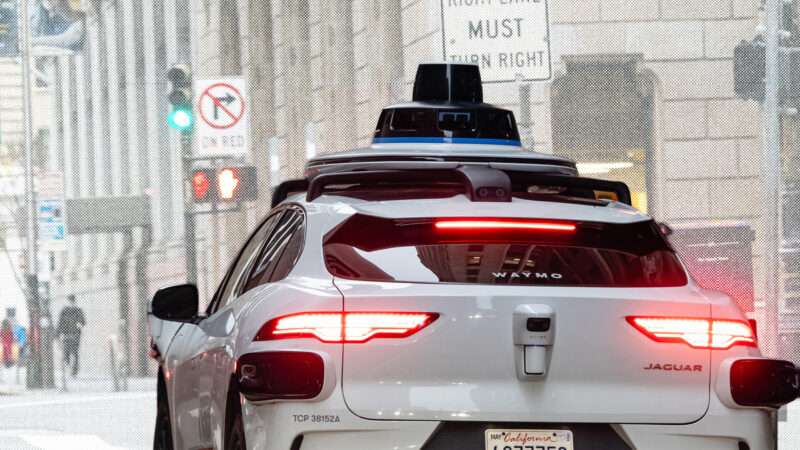
Waymo's driverless cars are no longer on California's freeways, at least for now.
On November 11, the California Department of Motor Vehicles (DMV) issued an order immediately barring Waymo vehicles from rides or testing on California highways, though they can continue operating on other streets. On Tuesday, the order was made public, and the DMV confirmed that it had banned the cars from California freeways. A DMV spokesperson said Waymo's operation poses an "imminent hazard to public safety," citing "recurring incursions" by the company's vehicles into active construction zones, according to KQED News.
The DMV pointed to two specific instances in the last week. One involved three Waymos entering an active construction zone on U.S. Highway 101, putting workers at risk. Another involved a Waymo trying to pass California Highway Patrol vehicles that were attempting to create a blockade on an interstate. The DMV says these restrictions will remain in place until "Waymo demonstrates to the Department that it has taken effective corrective actions to address the deficiencies." After the ban was announced, Waymo stated that it is temporarily halting freeway operations in its other markets while it sorts out these issues.
This isn't the first time the company has run into trouble navigating complex driving situations. In May, Waymo voluntarily paused freeway operations in multiple cities, including San Francisco, Los Angeles, and Miami, after problems in construction zones and cars getting stuck in flooding. In December, a power outage in San Francisco caused traffic lights to go out. This confused Waymo vehicles, which stalled at intersections around the city and forced the company to halt operations briefly. These unique situations, known in the industry as "edge cases," remain the hardest technical problem for autonomous vehicles to overcome.
Waymo relies on sensors and extensive mapping to guide its vehicles, which works well for routine driving but can struggle in scenarios requiring reasoning. To address this, Google is training Waymo (which is owned by Alphabet, Google's parent company) with Gemini, its large language model, to help its system understand context and navigate edge cases. Tesla self-driving has a more generalized approach that relies purely on cameras and its AI neural network, allowing its supervised self-driving system to function almost anywhere. Teslas have shown the ability to read hand signals, navigate construction zones, and even drive-thrus.
Waymo's technology may be imperfect, but the cars are safer than their main competitor: human drivers. On Sunday night, a man driving on the wrong side of state Route 99 in Sutter County, California, caused a head-on crash. He died at the scene, and the other driver was injured. Last Thursday, another driver was speeding down the wrong side of the state's 91 Freeway in Riverside, leading to a head-on collision that killed three people.
Waymo's latest safety analysis shows that across more than 270 million driverless miles, its vehicles were involved in 82 percent fewer injury-causing crashes and 95 percent fewer crashes resulting in serious injury or death compared to human drivers in the same cities. Keeping these vehicles off freeways and expressways, which make up around half of all miles driven in California, could cost countless lives.
Despite their impressive driving record, autonomous vehicles (A.V.s) have faced pushback from governments outside the Golden State. Last week, the Washington, D.C. City Council rejected a bill to legalize A.V.s in the city, which would have subjected A.V. companies to a hefty tax and a 75,000-mile testing mandate before they could carry passengers. The bill was rejected largely due to concerns about job displacement. Meanwhile, communities across the nation are coming up with their own safety standards and restrictions for A.V.s, which has created a maze of different rules these companies have to navigate.
While it's true that Waymo vehicles' erratic behavior in construction zones needs to be addressed, an indefinite ban threatens to keep this technology off freeways long after it should be. Regulators, in the name of defending public safety, are really undermining it.
The post California Bans Waymo From Freeways. Is That Really Safer? appeared first on Reason Magazine.





 Bengali (Bangladesh) ·
 English (United States) ·