
 18 hours ago
1

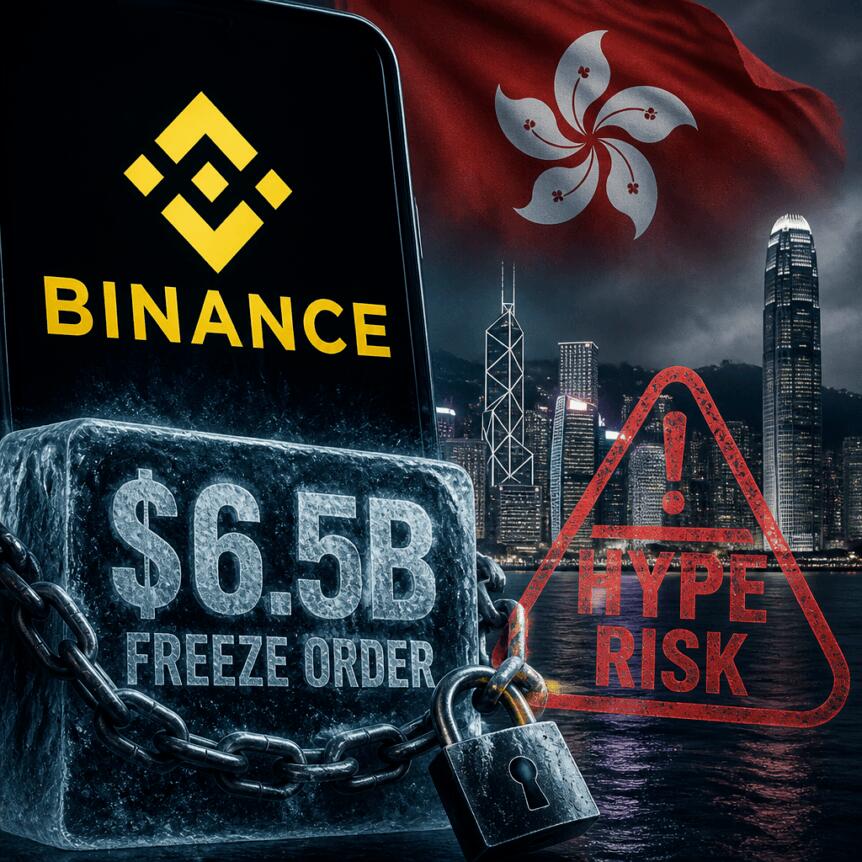
Binance has obtained a $6.5 billion worldwide freezing order tied to assets it says were stolen in its record hack on Oct. 29, a move that could significantly tighten cross-border efforts to locate and immobilize illicit funds. The order was issued by the Abu Dhabi Global Market Courts, and is designed to help exchanges, issuers and other partners freeze stolen crypto linked to the incident.
Separately, regulators across Asia continued to press on enforcement and market structure: Hong Kong added decentralized derivatives platform Hyperliquid to its official “Alert List,” Singapore moved forward with tokenized bills using wholesale CBDC, and Chinese authorities outlined what blockchain services can and cannot advertise. The developments underscore how the region is balancing innovation with heightened compliance expectations.
Key takeaways
Binance secured a $6.5 billion global freezing injunction in Abu Dhabi, targeting perpetrators behind the Oct. 29 hack and supporting actions to freeze and recover stolen assets. The court orders can be delivered via blockchain to specific wallet addresses, and Binance will maintain a “living list” of 26,000 addresses tied to stolen holdings. Hong Kong’s SFC added Hyperliquid to its Alert List, citing an apparent lack of licensing in the city and concerns about marketing to local users. Singapore’s MAS issued 100 million Singapore dollars in tokenized bills on its test network, with wholesale CBDC used by banks to pay for the instruments. China’s regulators encouraged blockchain adoption for data sharing while restricting ICO- and exchange-related terminology in the names of certain blockchain information services.Binance’s $6.5B freeze order targets stolen funds via wallet-level notices
According to Cointelegraph, Binance received a $6.5 billion worldwide freezing injunction from the Abu Dhabi Global Market Courts to assist in recovering assets it says were stolen during its Oct. 29 hack. The order is aimed at unidentified perpetrators, and is intended to give “issuers, exchanges and other partners” a legal basis to freeze and return the assets.
A key practical detail is how the injunction can be served. As reported by Cointelegraph, the court orders can be delivered through blockchain mechanisms, allowing legal notices to reach wallet addresses directly rather than relying solely on traditional communication channels. Binance also plans to inform market participants of updates to a “living list” containing 26,000 wallet addresses identified as holding stolen assets.
For market participants, this approach matters because most recovery attempts depend on quickly identifying on-chain holders, then coordinating legal or operational action across counterparties. Wallet-level notification and a continuously updated list can reduce delays between discovery and enforcement, which is often where recovery efforts fail when funds move faster than legal processes.
The move also comes as Binance prepares to expand further in Asia. Binance’s APAC head SB Seker told Reuters this week that its finances remain sound and that it plans to broaden its presence across South East Asia. Reuters reported that Binance currently holds operating licenses in 15 markets and that Seker said discussions are underway with at least five or six markets, with three in relatively mature stages.
Hong Kong adds Hyperliquid to its “suspicious” platform list
Hong Kong’s Securities and Futures Commission (SFC) escalated its monitoring of crypto trading platforms by adding decentralized perps exchange Hyperliquid to its Alert List, according to Cointelegraph. The SFC said Hyperliquid lacks a license to operate in Hong Kong and is suspected of actively marketing services to the public in the region.
This increases the number of platforms formally listed as suspicious by the regulator to 69. While these alerts are not the same as a court finding, they can influence how local intermediaries handle token-related risks and how users access or promote these services.
Hyperliquid’s listing also fits into a broader pattern in Hong Kong where regulators have increasingly focused on aligning crypto market activity with licensing and disclosure expectations. For users, the immediate takeaway is that an “Alert List” inclusion signals elevated regulatory attention and heightened risk around platform availability and marketing practices.
MAS issues tokenized Singapore dollar bills on wholesale CBDC rails
In Singapore, the Monetary Authority of Singapore (MAS) confirmed progress in tokenization experiments after issuing 100 million Singapore dollars (about $77.5 million) in tokenized bills on Nov. 6, as reported by Cointelegraph. MAS said five banks submitted bids totaling more than twice the amount offered.
Cointelegraph also noted that the bills are structured as four-week instruments maturing on Dec. 4. MAS issued them directly on the Singapore Dollar Test Network, where—according to the central bank—banks pay using wholesale central bank digital currency (CBDC). MAS said the tokenized bills give borrowers an asset they could potentially pledge as collateral for loans on the same network.
Why this matters for the wider market is that “test network” issuance demonstrates how tokenized instruments might move from concept to repeatable workflow: underwriting and bidding, settlement and payment, and then collateralization—without requiring all steps to happen off-chain or through separate legacy processes.
MAS’s announcement also reflects an incremental approach: instead of positioning tokenized treasuries as a finished replacement for existing infrastructure, regulators appear focused on verifying whether wholesale-CBDC settlement can support issuance mechanics and collateral use cases end to end.
China’s blockchain stance: support for data tech, tighter naming limits for ICOs
China’s regulatory environment continues to split support for underlying blockchain infrastructure from restrictions on specific crypto-related financial promotion. Cointelegraph reported that the Shanghai Municipal Science and Technology Commission and the Shanghai Municipal Bureau of Data issued a policy encouraging the adoption of blockchain and other technologies to share and track scientific data.
At the same time, the Cyberspace Administration of China (CAC) clarified that the names of blockchain information services are not allowed to include words such as “virtual currency,” “exchange,” and “ICO.” This indicates that while blockchain-linked experimentation may be welcomed—particularly where it can be framed around data governance—communication around token trading, fundraising schemes, or exchange operations faces tighter controls.
For builders and compliance teams, these naming constraints can affect how products are marketed, branded, and registered. They also highlight the broader asymmetry that has defined much of China’s approach: the technology may be encouraged, while crypto finance terms remain constrained.
Regional enforcement and supply-chain expansion: Vietnam soy traceability and Thailand arrests
Beyond regulatory actions, other parts of the region showed how blockchain is being used or challenged outside trading venues. In Vietnam, Cointelegraph reported that Bunge and the feed ingredient trading firm Bangkok Produce Merchandising Company expanded their blockchain-based soy traceability initiative to the country. The collaboration has already established traceable supply chains for soybean and soybean meal from Brazil to Thailand, and the extension aims to broaden that traceability footprint.
Meanwhile, Thailand police reportedly arrested four foreign nationals in Pattaya over an alleged crypto investment scam that defrauded victims of more than 400 million baht (about $11.8 million). Cointelegraph said the operation followed the rescue of a 19-year-old Chinese student held for ransom and uncovered an alleged crypto romance scam involving additional suspects.
These separate stories—one about tracking commodities, the other about fraud investigations—illustrate the dual narrative confronting the region: blockchain-enabled traceability is gaining traction in traditional supply chains, while law enforcement continues to target scams that exploit crypto’s perceived legitimacy.
Looking ahead, the most immediate variables to watch are whether Binance’s wallet-level freezing workflow accelerates recoveries from the Oct. 29 hack and how quickly Hong Kong’s Alert List translates into practical restrictions for users and intermediaries. In parallel, Singapore’s tokenized bill issuance and China’s naming rules will likely shape how compliant tokenized products are launched—and how they’re described—to meet evolving regulatory expectations.
This article was originally published as Binance Faces $6.5B Freeze Order as Hong Kong Flags HYPE Risk on Crypto Breaking News – your trusted source for crypto news, Bitcoin news, and blockchain updates.





 Bengali (Bangladesh) ·
 English (United States) ·