

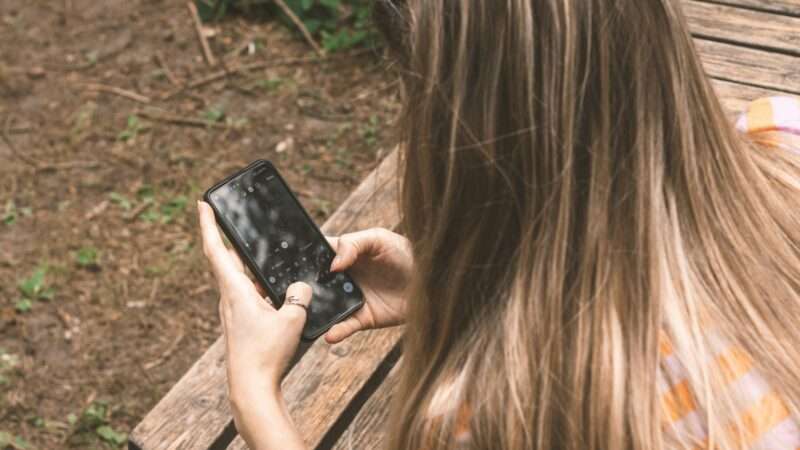
Say it with me: Correlation does not equal causation. But once again, we've got someone spinning noncausal survey results as "social media is bad news for teenagers," despite the fact that most of the teens studied were only moderate users and problems among the heaviest users could cause social media overuse, rather than vice versa. The survey also found serious class differences in use that could help explain disparities in habits, happiness levels, and outlook between those who use these platforms a lot and those who don't.
Researcher Daniel Cox acknowledges that "not all" teens react the same way to social media and that not all social media use seems to be a problem. "I should note that at least in this study, only heavy social media use—spending at least four hours a day on these platforms—appeared to matter," he writes. "There were few differences between moderate and light users. And it was only among girls that social media seemed to be a problem." Cox, a senior fellow at the American Enterprise Institute (AEI), also notes that while some say "social media has made teens lonelier and more isolated," his group's research "does not show that heavy social media users are any less sociable" and "teenagers with few close friends do not report any higher (or lower) social media use than teens with lots of friends."
Heavy Social Media Users Are in the Minority
Banning teenagers from social media is often predicated on the idea that these platforms are universally bad for young people. Proponents of teen bans and social media "addiction" lawsuits often compare social media to cigarettes or even cocaine and act as if platforms like Instagram and TikTok are simply too powerful for most teens to resist.
If that was the case, we should expect to see compulsive use among a majority of teenagers.
But in Cox's survey—conducted by NORC at the University of Chicago on behalf of AEI's Survey Center on American Life—60 percent of the 13- to 17-year-old girls surveyed said they spend two or fewer hours per day on social media, Cox reports. And 39 percent of these girls said they either didn't use social media at all or used it for less than one hour per day.
Among all the teens surveyed (not just girls), 10 percent said they spend no time on social media and 29 percent said they spend less than one hour per day on it. The largest portion of teens—34 percent—said they use social media for one to three hours per day. Only 26 percent said they're on social media for four or more hours daily.
Teen Girl Tech Fiends Fare Worse, but why?
It's among girls in the four-or-more-hours-per-day group where major differences in habits and happiness levels emerged. Teen girls in this group said they felt less satisfied with their lives, that they were more pessimistic about the state of the country, that they slept less, and that they felt worse about their personal health.
They were also less likely to rate themselves as happier than their peers (19 percent vs. 39 percent for girls who spent less than an hour per day on social media), less likely to socialize with friends during nonschool hours (28 percent vs. 37 percent), and less likely to read for fun (15 percent vs. 32 percent).
Sure, some of these problems could be caused—or at least exacerbated—by social media use.
But it's also entirely plausible that girls who are unhappy, anxious about the world, or anxious about their bodies would simply turn to social media more than do girls who are happier, less anxious, and more secure. Likewise, girls who already have fewer friends or a harder time socializing may turn to screens more than popular, social butterflies do.
And maybe girls in the heavy-use group would never have been big readers, even if Snapchat and YouTube weren't a factor. We can't just assume that social media is displacing reading for fun when it could simply be displacing other sorts of screen time, like watching TV—or even displacing risky activities, like drinking alcohol or having unprotected sex. After all, teen drinking and teen pregnancy are both down.
The idea that heavy social media use is causing teens' issues is often taken as a given. But we all know that depression and anxiety can provoke a range of maladaptive behaviors. So why does almost no one admit that excessive social media use could be a symptom rather than a cause (or at least a symptom and a cause) of teen distress and unease?
Class Confounds Things Even More
Potentially pre-existing mental health problems aren't the only snag in the "social media causes negative outcomes" narrative. There's another—perhaps even bigger—confounding factor at play here: "a class divide in social media use," as Cox describes it.
In the AEI survey, teens whose parents do not have college degrees spent significantly more time gaming and more time on social apps. "The survey finds that teen girls raised by parents without college degrees are on more social media apps, spend more hours using them, and are less inclined to cut back than girls whose parents went to college, while among boys, the same divide emerges in the hours spent gaming," Cox reports.
This finding—consistent with other research finding socioeconomic divides in screen time—introduces another possible explanation for some of the disparities we see between the heaviest and lightest users of social media.
Is it any wonder that teenagers from more educated families—which also tend to be richer and different in other ways from families where parents only have a high-school degree or less—might read more books or have fewer worries about the state of the country? Is it a stretch to think that they might feel more optimistic about their own lives for reasons that have nothing to do with screen time?
Indeed, Cox's study finds that teen girls with college-educated parents are more likely than those without to assume they will own their own home someday, find a rewarding career, earn enough money to live comfortably, marry, and have kids. Teen girls from more educated families are more optimistic all around, and they also use social media less—presenting a strong possibility that class is a moderating factor here, in addition to or instead of social media use.
In the News
"BREAKING: Study Proves Chemical Abortion is in Our Water" was the subject line of a Students for Life email that landed in my inbox Monday. "For years, Students for Life of America has raised the concern that chemical abortion pills (specifically, mifepristone) are in our drinking water," the email continued. "A peer-reviewed study published in the Journal of the Alliance for Hippocratic Medicine (JAHM) shows that we were right all along."
About that study, it might seem very impressive at first blush, being "peer-reviewed" in a fancy-sounding journal. But the journal in question is published by an explicitly anti-abortion group that previously sued the Food and Drug Administration over abortion pills.
And far from "proving" that there is mifepristone in the water, the study appears to have looked at the presence of progesterone-blocking compounds more broadly. And mifepristone isn't the only drug that relies on progesterone-blocking compounds. They're a component of emergency contraception and drugs that treat conditions like uterine fibroids, endometriosis, and hyperglycemia in people with Cushing's syndrome. And compounds that block progesterone can also come from certain sorts of plastic products, like Bisphenol A.
"Environmental experts disputed the new study's assertion that it proved the existence of detectable levels of mifepristone in the U.S. water supply," notes Politico:
Jack Vanden Heuvel, a molecular toxicologist at Pennsylvania State University whose lab frequently examines pharmaceutical contamination in waterways, noted that while the report describes measuring the "mifepristone concentration" in water samples, the testing method described in the study actually measures a reaction in the water samples that could be caused either by the drug or equivalent chemicals that block the hormone progesterone.
A number of compounds besides mifepristone can do that, he said, including certain contraceptives and endocrine-distrupting chemicals, like BPA, which is found in many plastic products and some polychlorinated biphenyls, which were once used in electrical equipment. The study didn't test for those other progesterone-blocking compounds, so it's not clear whether they or mifepristone caused the detected activity.
"What they did is a big 'no-no,'" said Vanden Heuvel. "This would not have been published if I had been a peer reviewer."
The study also does not describe using any analytical chemistry testing techniques that could specifically identify mifepristone in the water samples, said Betsy Southerland, a former career scientist who left EPA's Office of Water during the first Trump administration after more than three decades at the agency.
The study's author, Elise Rose, told Politico that these critiques are unfounded, as the test used would only identify mifepristone or chemicals genetically "identical or nearly identical" to it. "She acknowledged, however, that some of what was detected 'could be a metabolite of mifepristone that's very close in structure' and that the group did not deploy any of the other analytical chemistry techniques Southerland says are necessary," notes Politico.
Read This Thread
Open a new credit card or change your address, and that address can move through data brokers to ICE, which can search it without a warrant.  https://t.co/SXeFX93HZO
— Austin Kocher, PhD (@ackocher) July 27, 2026
More Sex & Tech
• Sacramento's most recent crackdown on "human trafficking"—a joint effort with the FBI and Homeland Security Investigations—involved arresting 13 people who tried to solicit an undercover cop posing as a sex worker. Can we please just go back to calling this a vice sting? (Or better yet, stop doing it.)
• Lawmakers want to give Homeland Security an AI kill switch: "Last week, Reps. Ted Lieu (D–Calif.) and Nathaniel Moran (R–Texas) introduced the AI Kill Switch Act, which would…allow the secretary of Homeland Security to order an AI company to limit or disable a system," reports Reason's Reem Ibrahim. "Violations could result in fines of up to $2 million per day, rising to $20 million per day for violating an emergency order."
• More on remote work: "An analysis from the Bureau of Labor Statistics found that across industries, the rise in remote work and total factor productivity growth may be positively correlated, and many employees report higher productivity at home," notes Chelsea Follett at Human Progress. "Some research also suggests that hybrid and fully remote work may have positive effects on individual employee productivity, satisfaction, and physical health, as well as employee retention."
• In a series of recent massage parlor raids in Los Angeles, one officer said that despite two women not claiming to be victims, "you can see it in their eyes" that they are. The cops still cited one of the women for prostitution.
• A new four-paper series in The Lancet Public Health looks at sex worker health. I haven't read the individual papers yet, just a summary, but it looks like they're all open access here.
• "The Archive of Wrong AI Projections" is exactly what it sounds like, and it's wonderful.
The post 'Class Divide' in Teen Social Media Habits Could Explain Differences Between Heavy and Light Users appeared first on Reason.com.




 Bengali (Bangladesh) ·
  English (United States) ·