

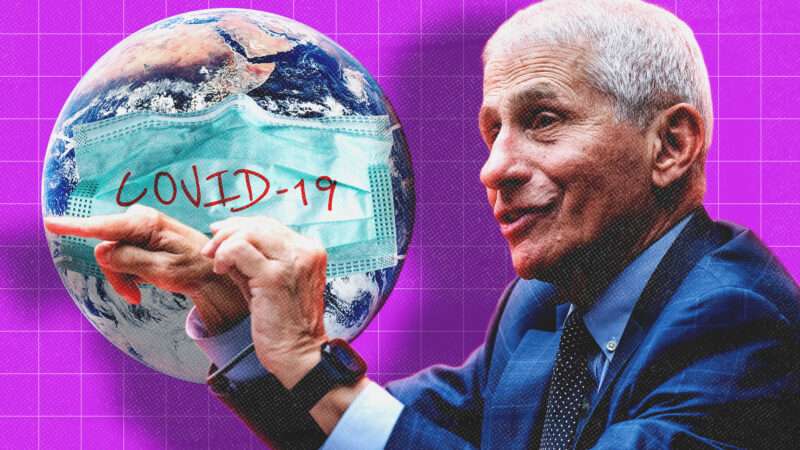
At a hearing of the Senate's Homeland Security and Government Committee today, Anthony Fauci invoked the Fifth Amendment to avoid answering questions about gain-of-function research his former agency, the National Institute of Allergy and Infectious Diseases (NIAID), funded in Wuhan, China, and the role that research might have played in starting the pandemic.
"I believed in and respect the value of legitimate congressional oversight," said Fauci, who had been subpoenaed to appear before the committee that's chaired by Sen. Rand Paul (R–Ky.), in a brief opening statement.
"Given Sen. Paul's obvious obsession with calling for my prosecution, his repeated slanderous comments about me, and recently his publicly releasing my unredacted personal diary aimed at embarrassing and intimidating me," Fauci said that he would refuse to answer the committee's questions.
Even after Paul directed Fauci to answer the committee's questions, noting that he'd received a pardon from President Joe Biden covering his conduct going back to 2014, when the U.S. government first paused funding of gain-of-function research, Fauci repeated the invocation of his Fifth Amendment right to not answer questions.
When Fauci's attorney attempted to address the committee on behalf of his client, Paul said he was not a recognized witness, and eventually ordered him removed from the hearing room.
Gain-of-function research refers to experiments in which viruses are manipulated in laboratory settings to become more virulent. Fauci has long been a proponent of this controversial research, which some scientists consider dangerous for its potential to create new pandemic viruses.
While under Fauci's leadership, the National Institute of Allergy and Infectious Diseases (NIAID) issued multiple grants to researchers working at the Wuhan Institute of Virology to support their work making novel coronaviruses that could more easily spread in humans.
When Paul pressed Fauci about these grants in past Senate committee hearings in 2021, Fauci strenuously denied that these grants funded research that would meet the federal government's definition of gain-of-function research.
He emphatically stated that this research was not subject to the government's gain-of-function funding pause, which ran from 2014 through 2017, and did not qualify for enhanced scrutiny under the subsequent vetting system established after that pause.
"The [National Institutes of Health] has not ever and does not now fund gain-of-function research" at the Wuhan Institute, said Fauci in response to Paul's questioning during a May 2021 hearing.
"You do not know what you are talking about," he said in a July 2021 hearing, when Paul pressed him on the NIAID's support for a paper co-authored by Chinese virologist Zheng-Li Shi describing how novel coronaviruses were made in the Wuhan lab to infect human lung cells.
Today's hearing produced no new statements on this subject, given Fauci's invocation of the Fifth Amendment.
In subsequent public statements and congressional testimony, Fauci continued to assert such research could not have possibly led to the creation of the virus that caused the pandemic, given how different the published viruses researchers were manipulating were from the virus that causes COVID-19.
When asked by Paul and others whether Chinese researchers might have performed similar unpublished experiments with different viruses that could have led to the creation of the pandemic virus in the Wuhan lab, Fauci pleaded ignorance of Chinese activities.
"I do not have any accounting of what the Chinese may have done," he said in his May 2021 Senate testimony.
These denials are contradicted by Fauci's own diary entries from early in the pandemic, in which he took the possibility that research being conducted by the NIAID-supported Shi, which he casually referred to as gain-of-function research, could have created the COVID-19 virus in a lab.
Fauci's diary entry from January 31, 2020, confirms the previously reported detail that the NIAID director was contacted by researchers who believed that SARS-CoV-2, the virus that causes COVID-19, might well have been engineered given the virus' furin cleavage site on its spike protein that allows it to bind with human cell receptors.
He took this suggestion seriously enough to convene a call with experts the following day to discuss whether the virus was natural or man-made.
In a diary entry dated February 1, 2020, Fauci said that all but two researchers on that call "felt that deliberate insertion [of the furin cleavage site] was possible."
"Given the fact that Dr. Zheng-Li Shi at the University of Wuhan has been working for years in GOF in coronaviruses to allow adaptation of the spike protein to bind to the human" cell receptors, "we could not let this go," reads Fauci's diary entry.
GOF is the shorthand for gain-of-function research.
That entry shows that, at least at the time, Fauci recognized that NIAID-supported researchers were conducting funded gain-of-function research in Wuhan, and that this research could plausibly have created SARS-CoV-2.
This contrasts with his later, emphatic testimony that the NIAID never supported gain-of-function research in Wuhan and that Fauci himself was ignorant of Chinese researchers' activities there.
The experts assembled on that February 2020 call later produced the Proximal Origin paper, which completely dismissed the possibility that SARS-CoV-2 was an engineered virus. Fauci provided editorial input on that paper.
Repeated tranches of Slack messages from several of the authors of that paper show that before and after publication, they privately believed, in contrast to the paper's conclusions, that the virus could have been engineered in a lab.
"Our paper was pretty strong in saying 'there's no way' [the virus was engineered], but I have less confidence in that statement at this stage," said Proximal Origin co-author Kristian Andersen, a Danish researcher at Scripps Research, in a Slack message to his co-authors.
Andersen had been one of the researchers who first contacted Fauci in January 2020 about the possibility that the furin cleavage site on SARS-CoV-2 had been deliberately inserted.
In later diary entries, Fauci's private statements hew more closely to his public position that NIAID-funded research could not possibly have played a significant role in a possible lab leak.
"I unfortunately have been drawn into being a target of the far right because I represent something that is antithetical to them, namely, the truth," wrote Fauci in an October 2021 diary entry. "It is stunning how much time is consumed on warding off the egregious lies about the [NIAID] grant that funded [sic] hey small project in the Wuhan institute of virology."
On that February 1 call, one of two participants to completely dismiss the possibility that COVID came from a lab was Dutch researcher Ron Fouchier, who had conducted gain-of-function experiments on flu viruses that proved so controversial they led to the 2014 pause on U.S. government funding of such research.
In his diary entry, Fauci thus took Fouchier's belief in a natural origin of SARS-CoV-2 with a grain of salt, saying "this is expected of him since he was the original GOF person."
In other words, the NIAID director believed that one's past conduct of gain-of-function experiments might color one's judgment on whether such research could create a deadly pandemic virus.
Yet in the years before the pandemic, Fauci was himself a primary champion of government funding of gain-of-function research, who repeatedly argued the potential benefits of this research were worth the acknowledged risks that it could create a pandemic via a lab leak.
By Fauci's own standard, we might similarly take his own protestations that NIAID-supported research in Wuhan didn't create the pandemic with a grain of salt.
Fauci has quite ably turned the debate about the risks of the research his agency supported in Wuhan into a semantic discussion about the precise regulatory definition of gain-of-function research.
Those regulatory definitions themselves require subjective determinations by public health officials about what kinds of experiments might be likely to produce new pandemic viruses.
Despite his later denials, Fauci's diary entries seem to concede that research meeting that regulatory definition was in fact going on in Wuhan with Fauci's knowledge and NIAID support.
As Paul said at today's hearing, questions about precise regulatory definitions distract from a more basic question: "The real question is whether [this research] was dangerous; was it wise to fund it?"
The post At Senate Hearing, Fauci Takes the Fifth To Avoid Accounting for Inconsistent Statements About a Lab Leak appeared first on Reason.com.




 Bengali (Bangladesh) ·
  English (United States) ·